
What Is This Calculator?
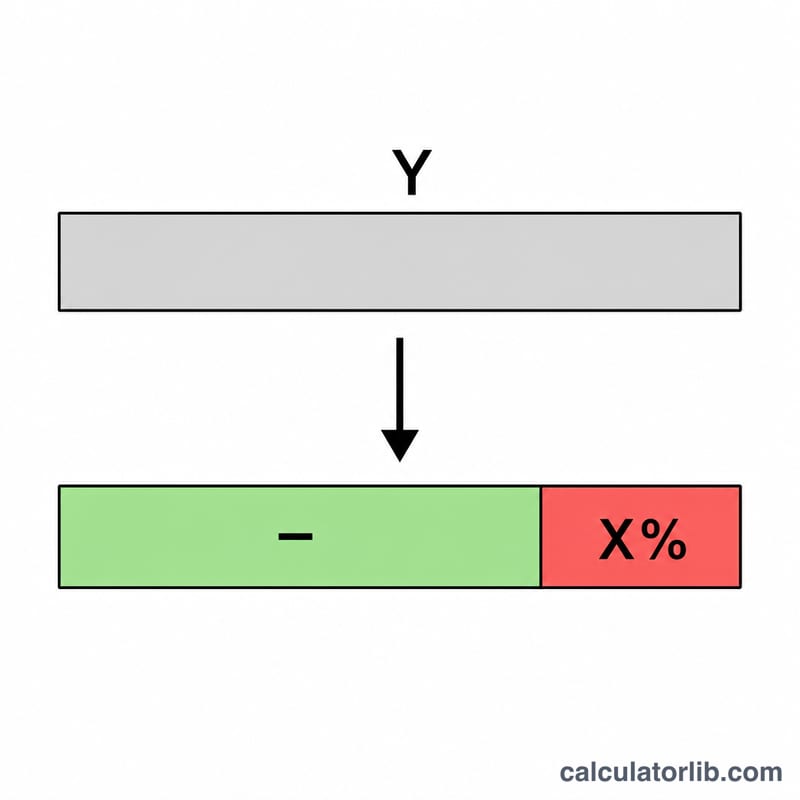
This calculator answers a very common question: "What number is X% less than Y?" In other words, if you take a number Y and reduce it by a given percentage X, what value remains? This is exactly the math behind a percentage discount, a price markdown, or any reduction expressed as a percent.
How to Use It
Enter the percentage you want to subtract in the Percent less (X%) field, and enter the starting number in the Number (Y) field. The calculator instantly shows the reduced result, along with the original number and the exact amount that was subtracted.
The Formula Explained
The result is calculated as $$\text{Result} = \text{Y} \times \left(1 - \frac{\text{X}}{100}\right)$$ First \(X/100\) converts the percentage into a decimal fraction. Subtracting that from 1 gives the fraction of Y that remains after the reduction. Multiplying by Y produces the final number. The amount removed is simply \(\text{Y} \times X/100\).
Worked Example
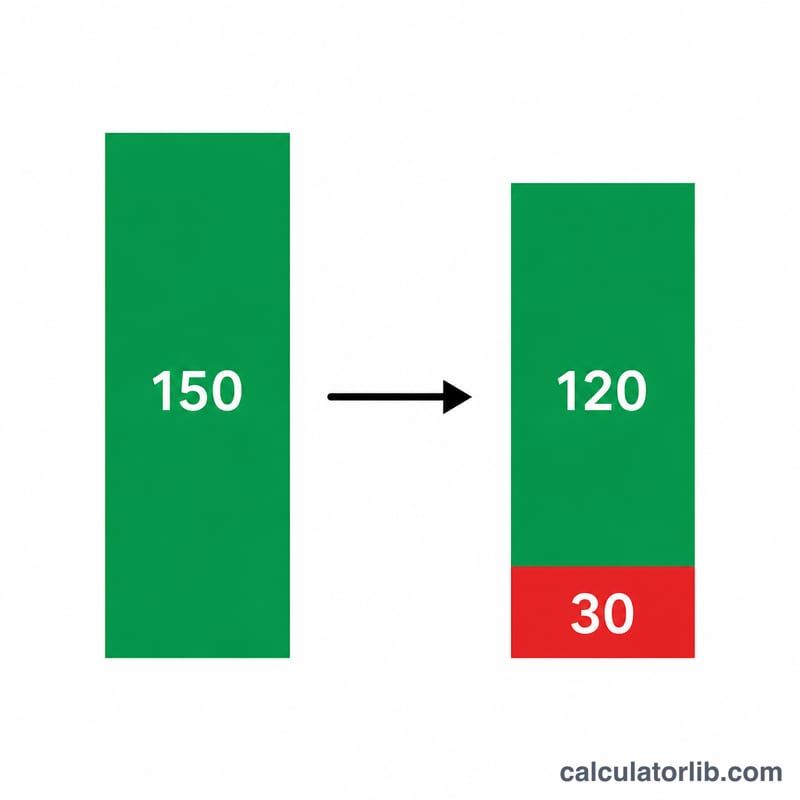
Suppose you want to know what number is 20% less than 200. Convert the percent: \(20/100 = 0.20\). The remaining fraction is \(1 - 0.20 = 0.80\). Multiply by the base: $$200 \times 0.80 = 160$$ The amount of decrease is \(200 \times 0.20 = 40\), and indeed \(200 - 40 = 160\).
FAQ
Can X be more than 100? Yes. If X is greater than 100 the result becomes negative, since you are subtracting more than the whole of Y.
What if X is 0? Then nothing is subtracted and the result equals Y exactly.
Is this the same as a discount? Yes — finding the price that is X% less than Y is identical to applying an X% discount to Y.