
What This Calculator Does
This tool converts a volumetric flow rate (how much volume of fluid passes a point per unit time) into a mass flow rate (how much mass passes per unit time). It uses the fundamental relationship between mass, density, and volume. The result is reported in kilograms per second, with handy per-minute and per-hour conversions.
How to Use It
Enter two values: the fluid density (\(\rho\)) in kilograms per cubic metre, and the volumetric flow rate (\(Q\)) in cubic metres per second. For reference, water at room temperature has a density of about 1000 kg/m³ and air at sea level is about 1.225 kg/m³. The calculator multiplies the two values to give the mass flow rate instantly.
The Formula Explained
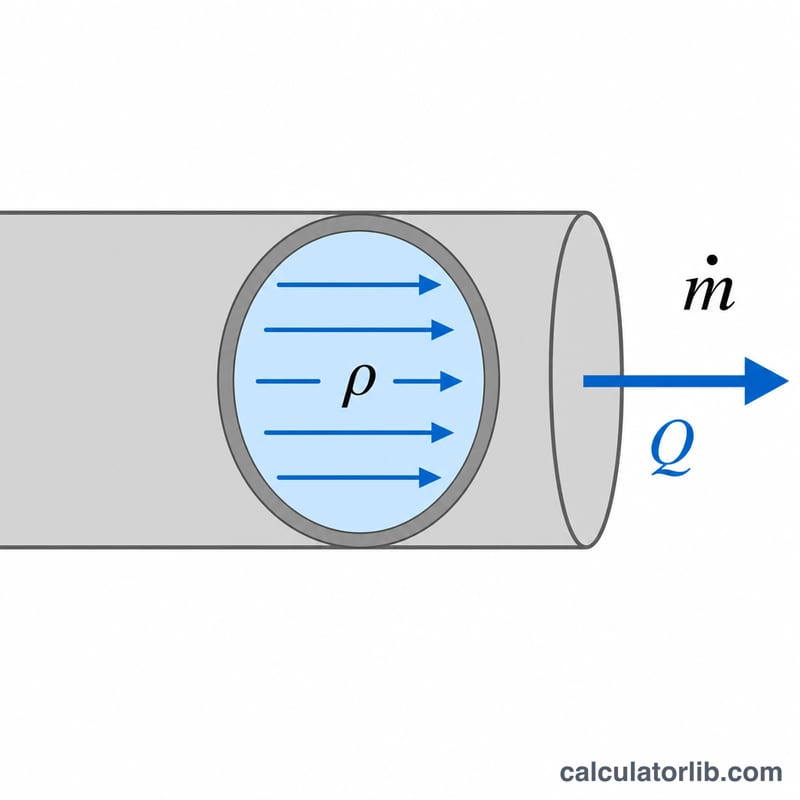
The governing equation is $$\dot{m} = \rho \times Q$$ where \(\dot{m}\) is the mass flow rate (kg/s), \(\rho\) is the fluid density (kg/m³), and \(Q\) is the volumetric flow rate (m³/s). Because density expresses mass per unit volume, multiplying it by the volume flowing per second yields the mass flowing per second. The units cancel cleanly: \((\text{kg/m}^3) \times (\text{m}^3\text{/s}) = \text{kg/s}\).
Worked Example
Suppose water (\(\rho = 1000\) kg/m³) flows through a pipe at \(Q = 0.05\) m³/s. Then $$\dot{m} = 1000 \times 0.05 = 50 \text{ kg/s}.$$ Over a minute that is \(50 \times 60 = 3000\) kg/min, and over an hour \(50 \times 3600 = 180{,}000\) kg/h.
FAQ
What if my flow rate is in litres per second? Convert litres to cubic metres by dividing by 1000 (1 L = 0.001 m³) before entering \(Q\).
Does temperature matter? Yes — density changes with temperature and pressure, especially for gases. Use the density at your operating conditions for an accurate result.
Can I use it for any fluid? Yes, the formula is universal for any liquid or gas as long as you supply the correct density.