
What Is Mass Flow Rate?
Mass flow rate (\(\dot{m}\), pronounced "m-dot") is the amount of mass passing through a given cross-section per unit time, expressed in kilograms per second (kg/s). It is a fundamental quantity in fluid mechanics, thermodynamics, HVAC design, piping systems, and rocket propulsion. This calculator uses the continuity-based relationship \(\dot{m} = \rho \cdot A \cdot V\) to determine how much mass of a fluid travels through a pipe or duct each second.
How to Use This Calculator
Enter three values: the fluid density (\(\rho\)) in kilograms per cubic metre, the cross-sectional area (\(A\)) of the pipe or duct in square metres, and the average flow velocity (\(V\)) in metres per second. The calculator multiplies them together to give the mass flow rate in kg/s, and also reports the volumetric flow rate (\(Q = A \cdot V\)) in m³/s as a bonus.
The Formula Explained
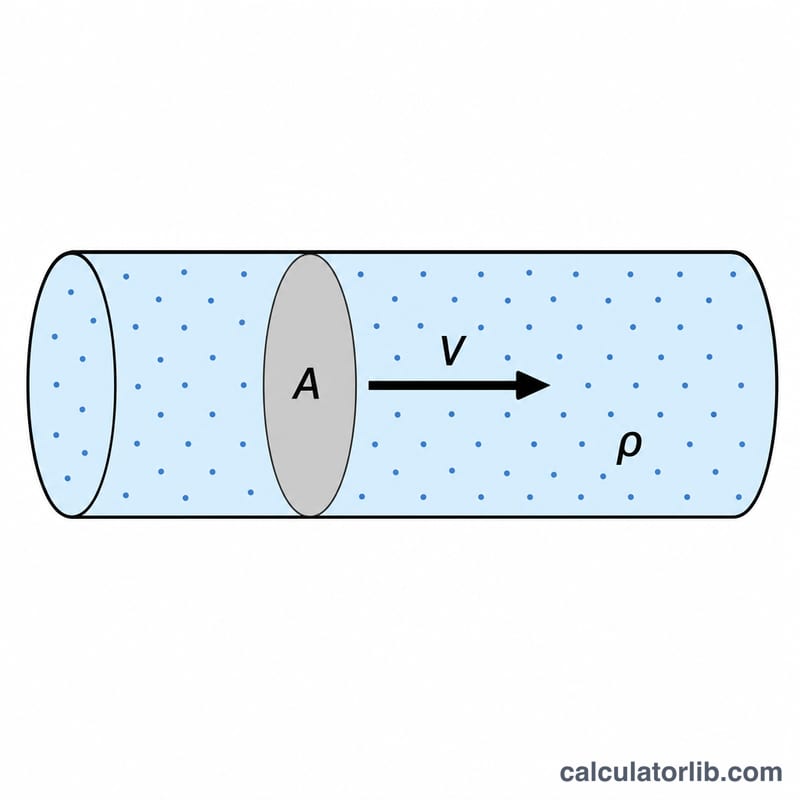
The governing equation is $$\dot{m} = \rho \cdot A \cdot V$$ Density (\(\rho\)) tells you how much mass occupies each cubic metre of fluid. The product \(A \cdot V\) gives the volume of fluid sweeping past a point each second (the volumetric flow rate \(Q\)). Multiplying volume per second by mass per volume yields mass per second. For incompressible steady flow, this product is conserved along a streamline, which is the basis of the continuity equation.
Worked Example
Water (\(\rho = 1000 \text{ kg/m}^3\)) flows through a pipe with cross-sectional area 0.05 m² at a velocity of 2 m/s. Then $$\dot{m} = 1000 \times 0.05 \times 2 = 100 \text{ kg/s},$$ and the volumetric flow rate is $$Q = 0.05 \times 2 = 0.1 \text{ m}^3/\text{s}.$$ So 100 kilograms of water pass through the pipe every second.
FAQ
What units should I use? Use SI units — density in kg/m³, area in m², and velocity in m/s — to get mass flow rate in kg/s.
How do I get the cross-sectional area of a round pipe? Use \(A = \pi \cdot r^2\), where \(r\) is the inner radius in metres. For a pipe of diameter \(d\), \(A = \pi \cdot d^2 / 4\).
Does this work for gases? Yes, provided you use the gas density at the relevant temperature and pressure. For compressible flow, density can vary along the flow, so use the local value at the cross-section of interest.