
What is the Passing Score Calculator?
This tool tells you exactly how many questions you must answer correctly to pass an exam. Give it the total number of questions and the pass mark expressed as a percentage, and it returns the minimum number of correct answers required — plus how many you can afford to get wrong.
How to use it
Enter the total questions on the exam and the pass mark percentage (for example 60 for a 60% pass threshold). The calculator multiplies the percentage by the number of questions and rounds up to the next whole question, because you cannot answer a fraction of a question.
The formula explained
The core equation is $$\text{Required Correct} = \left\lceil \frac{\text{Pass mark (\%)}}{100} \times \text{Total questions} \right\rceil$$ Rounding up is important: if 60% of 50 questions is exactly 30, you need 30; but if the maths produces 30.1 you must round up to 31, since 30 would fall just short of the threshold.
Worked example
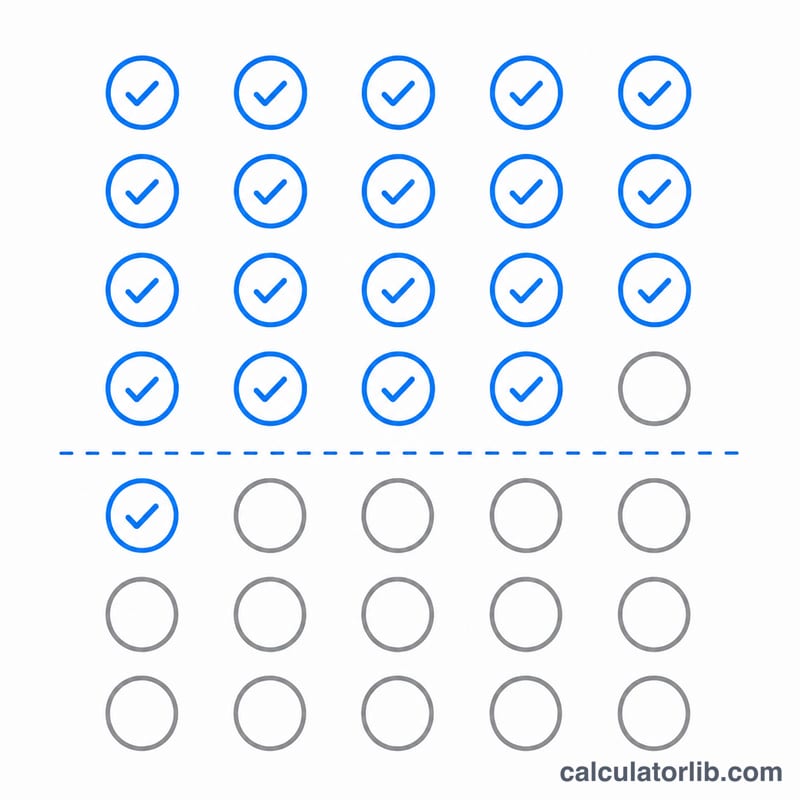
Suppose an exam has 50 questions and a 60% pass mark. Then \(0.60 \times 50 = 30\), and \(\lceil 30 \rceil = 30\). You must answer at least 30 questions correctly, meaning you can miss up to 20. If the pass mark were 70%, you would need \(\lceil 0.70 \times 50 \rceil = 35\) correct.
FAQ
Why round up instead of down? Rounding down could let a score below the pass threshold count as a pass. Rounding up guarantees you meet or exceed the required percentage.
Does this account for negative marking? No — it assumes each correct answer scores equally and there is no penalty for wrong answers. For tests with negative marking, you may need more correct answers.
Can I use decimal pass marks? Yes. Enter values like 62.5 and the calculator will compute the required correct answers accordingly.