
What Is the Pass Percentage Calculator?
The Pass Percentage Calculator tells you what share of a group succeeded on an exam, course, or assessment. It is widely used by teachers, examiners, training providers, and school administrators to summarize results in a single, easy-to-understand figure. By converting raw counts into a percentage, you can compare classes, subjects, or years of different sizes on a fair, like-for-like basis.
How to Use It
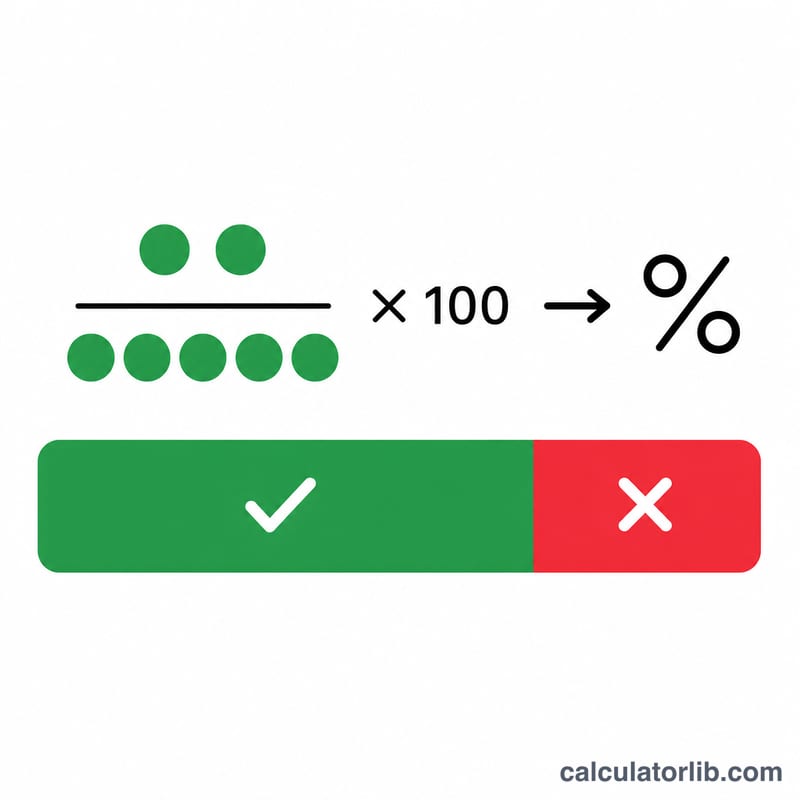
Enter two numbers: the count of students who passed and the total number of students who sat the exam. The calculator divides the passed count by the total, multiplies by 100, and instantly returns the pass percentage. It also reports how many students failed and the corresponding fail percentage so you get a complete picture.
The Formula Explained
The core equation is simple:
$$\text{Pass \%} = \frac{\text{Students Passed}}{\text{Total Students}} \times 100$$
The division gives a proportion between 0 and 1, and multiplying by 100 converts it to a percentage. The fail percentage is the complement: \(100 - \text{Pass\%}\). Make sure the total is greater than zero, otherwise the calculation is undefined.
Worked Example
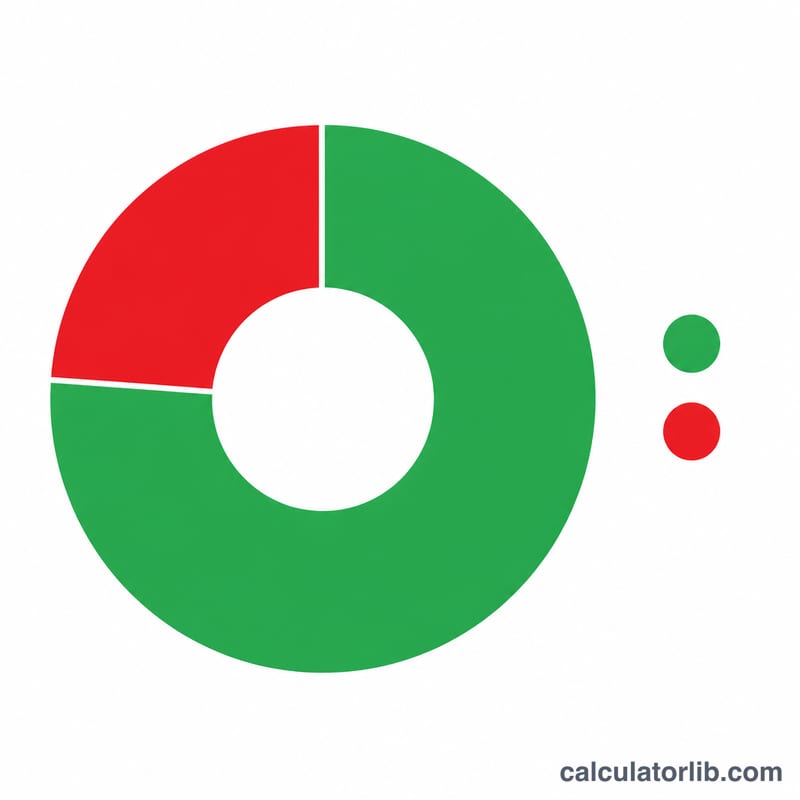
Suppose 85 out of 100 students passed an exam. $$\text{Pass\%} = (85 \div 100) \times 100 = 85\%$$ That leaves 15 students failing, a 15% fail rate. If instead 18 of 24 passed, $$\text{Pass\%} = (18 \div 24) \times 100 = 75\%$$ with 6 students (25%) failing.
FAQ
Can the pass percentage exceed 100%? No. Since passed students can never exceed the total, the result is always between 0% and 100%.
What if no one passed? The pass percentage is 0% and the fail percentage is 100%.
Does it work for any group size? Yes — it works for any total greater than zero, from a small class to a national cohort.