

What Is the CGPA to Percentage Calculator?
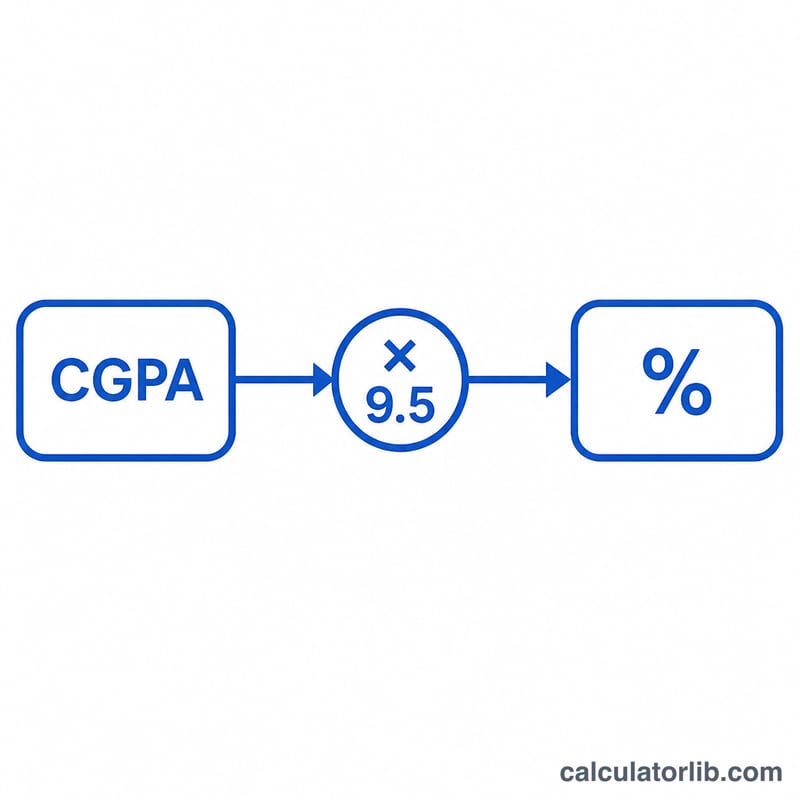
This tool converts your CGPA (Cumulative Grade Point Average) on a 10-point scale into an equivalent percentage. It is most commonly used in India, where the CBSE (Central Board of Secondary Education) recommends multiplying the overall CGPA by 9.5 to obtain the indicative percentage of marks. The default multiplier is 9.5, but you can change it to suit other boards or universities that use a different factor.
How to Use It
Enter your CGPA (for example, 8.6) in the first field. Leave the multiplier at 9.5 for the CBSE standard, or change it if your institution uses another value. Click calculate and you'll instantly see the equivalent percentage.
The Formula Explained
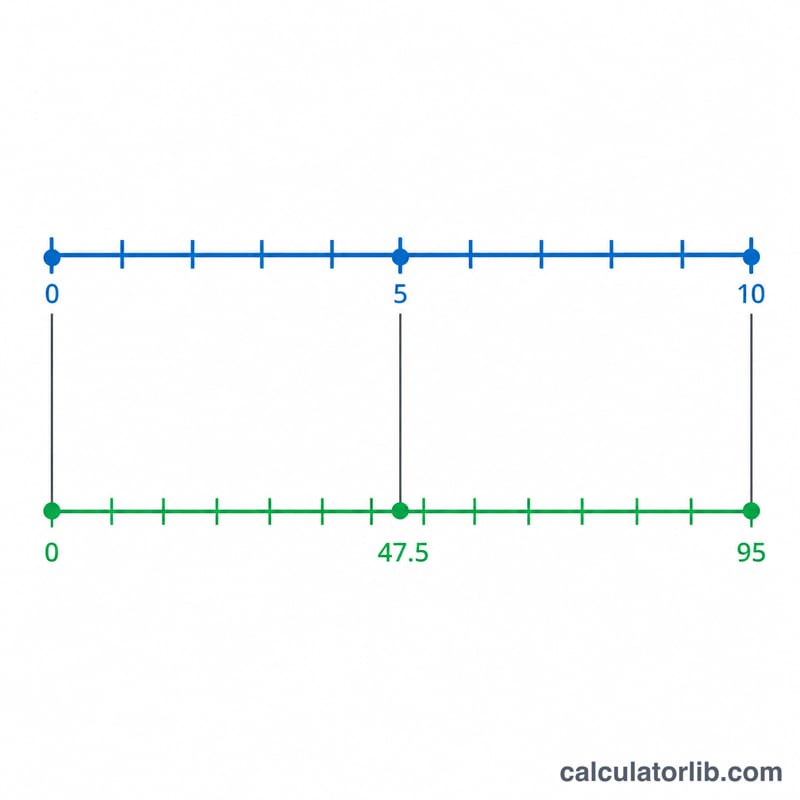
The conversion is a simple linear scaling: $$\text{Percentage} = \text{CGPA} \times 9.5$$ CBSE derived the multiplier of 9.5 by analysing the average marks of toppers across several subjects over many years. So a CGPA of 10 corresponds to 95%, and each grade point is worth 9.5 percentage points.
Worked Example
Suppose your CGPA is 8.6. Then $$\text{Percentage} = 8.6 \times 9.5 = 81.7\%$$ If a student scores a perfect CGPA of 10, the percentage is \(10 \times 9.5 = 95\%\).
FAQ
Is the 9.5 multiplier official? Yes, CBSE officially uses 9.5 to convert overall CGPA to an indicative percentage.
Can I use this for individual subject grade points? Yes — multiply any subject's grade point by 9.5 to get that subject's approximate percentage.
What if my board uses a different formula? Simply enter your board's multiplier in the second field; the calculator will use it instead of 9.5.