
What is skip counting?
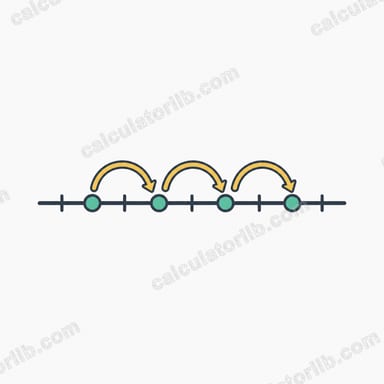
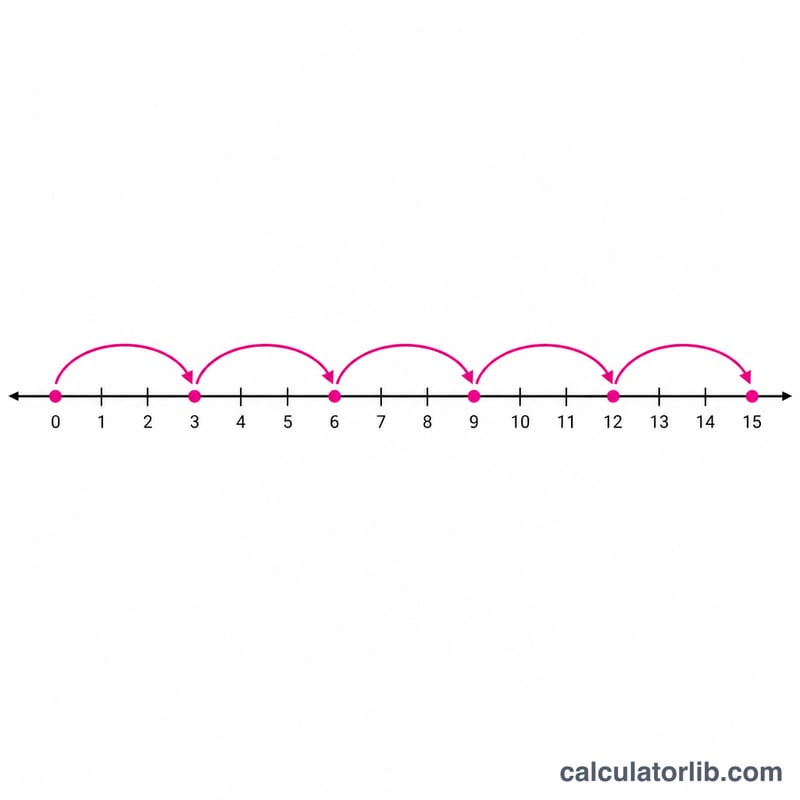
Skip counting means counting forward (or backward) by a fixed amount instead of by ones. Counting by 2s gives 2, 4, 6, 8; counting by 5s gives 5, 10, 15, 20. It is one of the first patterns children learn and it builds the foundation for multiplication, number sense, and arithmetic sequences. This calculator generates any skip-counting list for you: choose a start number, a step, and how many numbers you want.
How to use it
Enter three values: the Start Number (where the sequence begins), the Step (how much you add each time — use a negative step to count down), and How Many Numbers you want listed. Click calculate and you get the full sequence, the last number reached, and the running total of every term.
The formula
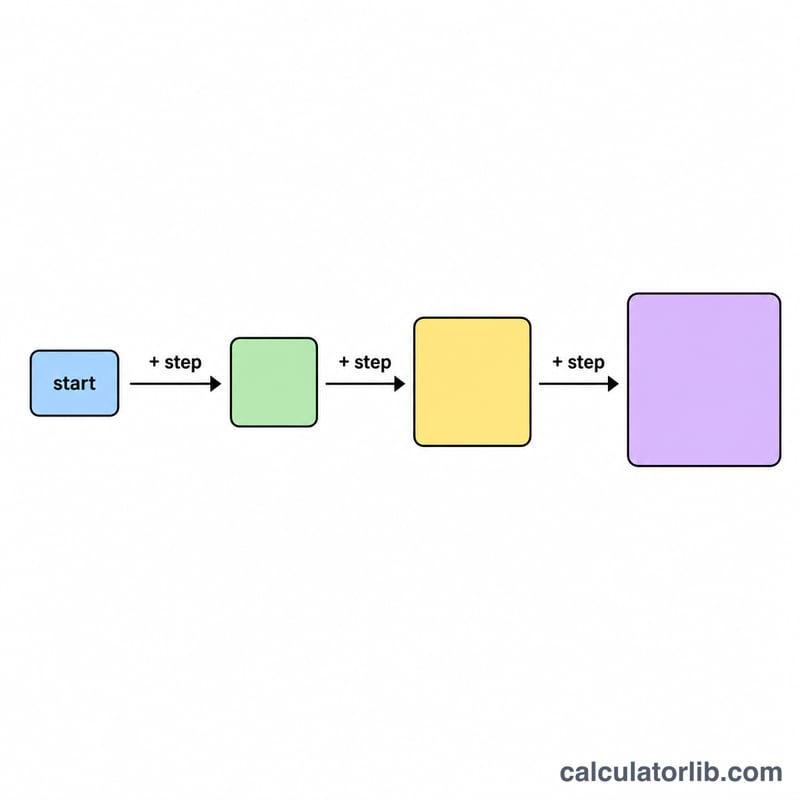
Skip counting is an arithmetic sequence. The k-th term is $$a_k = \text{start} + k \times \text{step}$$ where k starts at 0 for the first term. The sum of the first n terms is $$S_n = \frac{n}{2}\left(2\cdot\text{start} + (n-1)\cdot\text{step}\right)$$
Worked example
Start at 3, step of 4, and 5 numbers. The terms are: 3 (k=0), 7 (k=1), 11 (k=2), 15 (k=3), 19 (k=4). So the sequence is 3, 7, 11, 15, 19, the last number is 19, and the sum is $$3+7+11+15+19 = 55$$
FAQ
Can I count backward? Yes — enter a negative step, such as −5, to count down.
Can the start be negative or a decimal? Yes. The calculator accepts negative and decimal start numbers and steps.
What's the maximum length? You can generate up to 500 numbers at once.