
What this calculator does
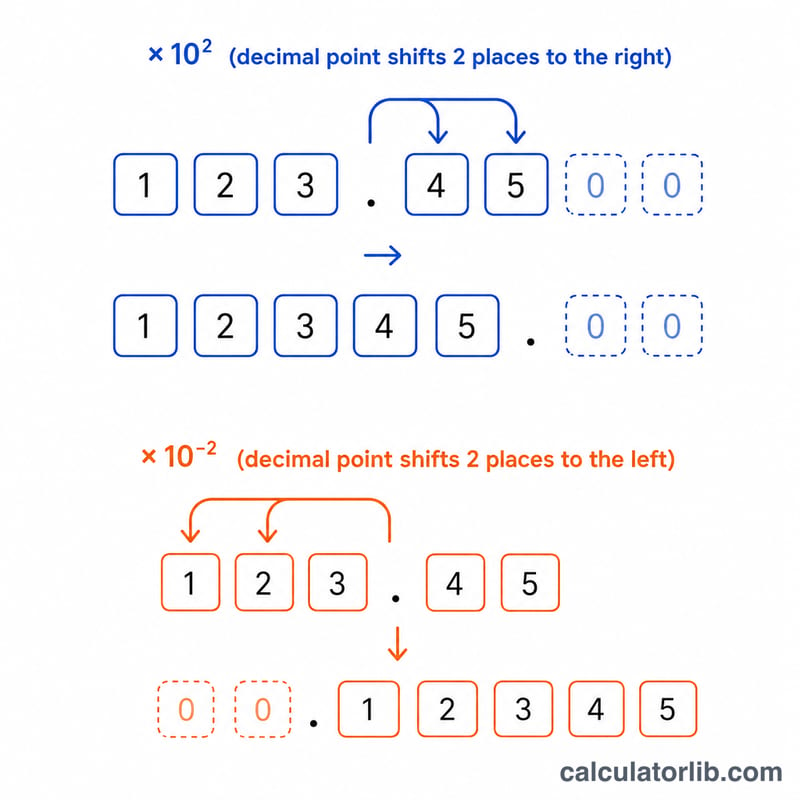
This tool multiplies any number N by a power of ten, \(10^{k}\). Multiplying by a power of 10 is the same as sliding the decimal point. When k is positive the value gets bigger and the decimal point moves to the right; when k is negative the value gets smaller and the decimal point moves to the left. It works for whole numbers, decimals, and negative numbers.
How to use it
Enter your starting number in the Number (N) field. Enter the exponent in the Power of 10 (k) field — for example 3 for ×1000, or −2 for ×0.01. The calculator shows the product, the actual multiplier (\(10^{k}\)), and which direction the decimal point moved.
The formula explained
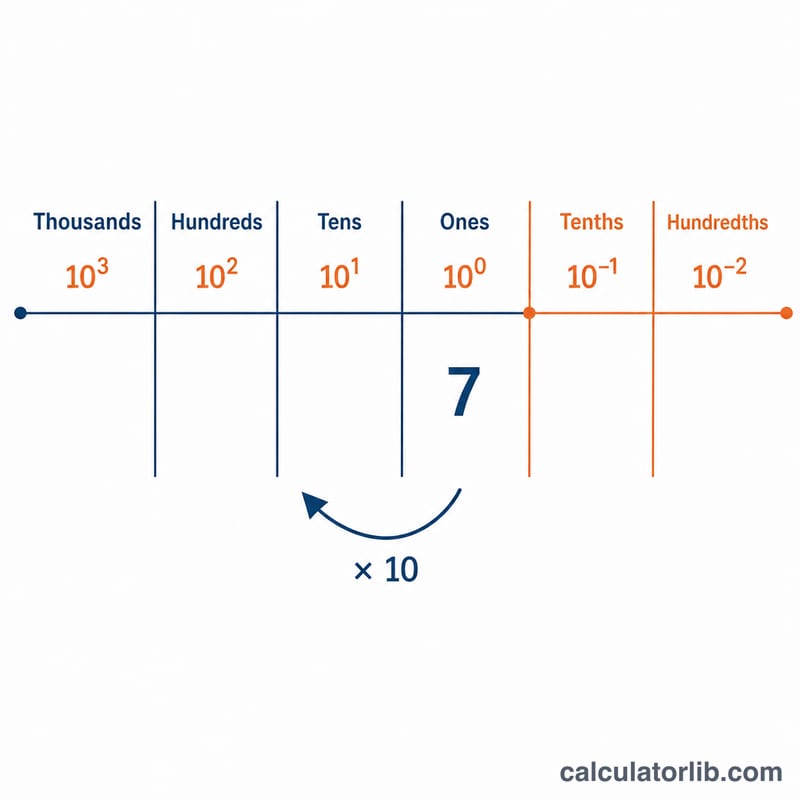
The core equation is $$P = N \times 10^{k}$$ Because our number system is base 10, every place value is ten times the one to its right. So multiplying by \(10^{k}\) simply re-labels each digit's place value, which is what "shifting the decimal point" means. Each unit increase in k moves the point one place right (×10); each decrease moves it one place left (÷10).
Worked example
Take N = 3.45 and k = 3. Then \(10^{3} = 1000\), so $$P = 3.45 \times 1000 = 3450$$ The decimal point moved 3 places to the right. With k = −2, \(P = 3.45 \times 0.01 = 0.0345\), moving the point 2 places left.
FAQ
What if k = 0? Any number times \(10^{0} = 1\), so the result equals N unchanged.
Can k be negative? Yes. A negative k divides by a power of 10, shifting the decimal point left and producing a smaller number.
Does it work with negative numbers? Yes — the sign of N is preserved; only the magnitude scales by \(10^{k}\).