
What This Calculator Does
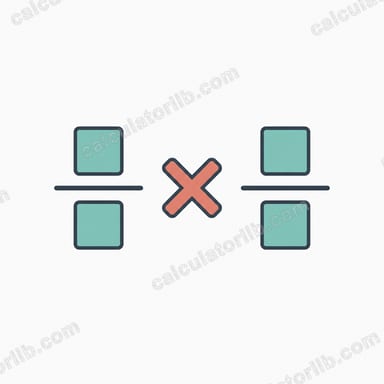
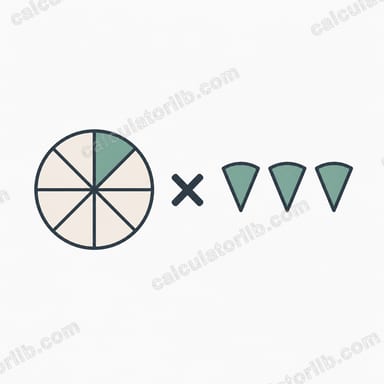
This tool multiplies a fraction by a whole number and returns the result both as a simplified fraction and as a decimal. A whole number n can be written as the fraction n/1, so multiplying a fraction a/b by n simply means multiplying the numerator by n while keeping the denominator the same.
How to Use It
Enter the numerator (a) and denominator (b) of your fraction, then enter the whole number (n) you want to multiply by. The calculator computes the unsimplified product (a×n)/b, reduces it to lowest terms, and shows the equivalent decimal value.
The Formula Explained
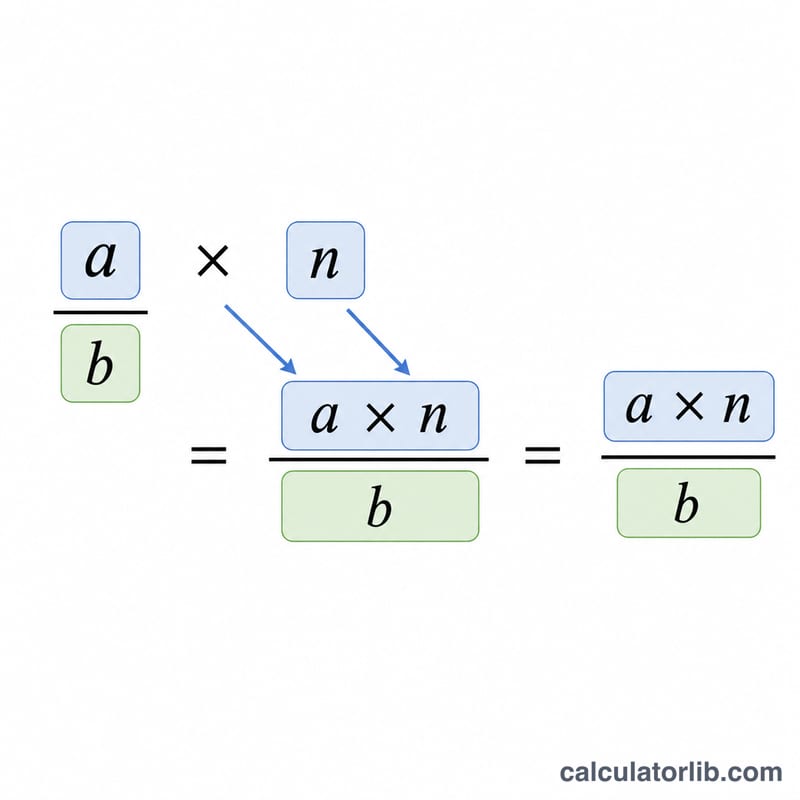
The core rule is $$\frac{a}{b} \times n = \frac{a \times n}{b}$$. Only the numerator changes; the denominator stays put. To simplify, find the greatest common divisor (GCD) of the new numerator and denominator and divide both by it.
Worked Example
Multiply 3/4 by 8. Multiply the numerator: \(3 \times 8 = 24\), keeping denominator 4, giving \(\frac{24}{4}\). The GCD of 24 and 4 is 4, so divide both: \(24 \div 4 = 6\) and \(4 \div 4 = 1\). The result is $$\frac{6}{1} = 6.$$
FAQ
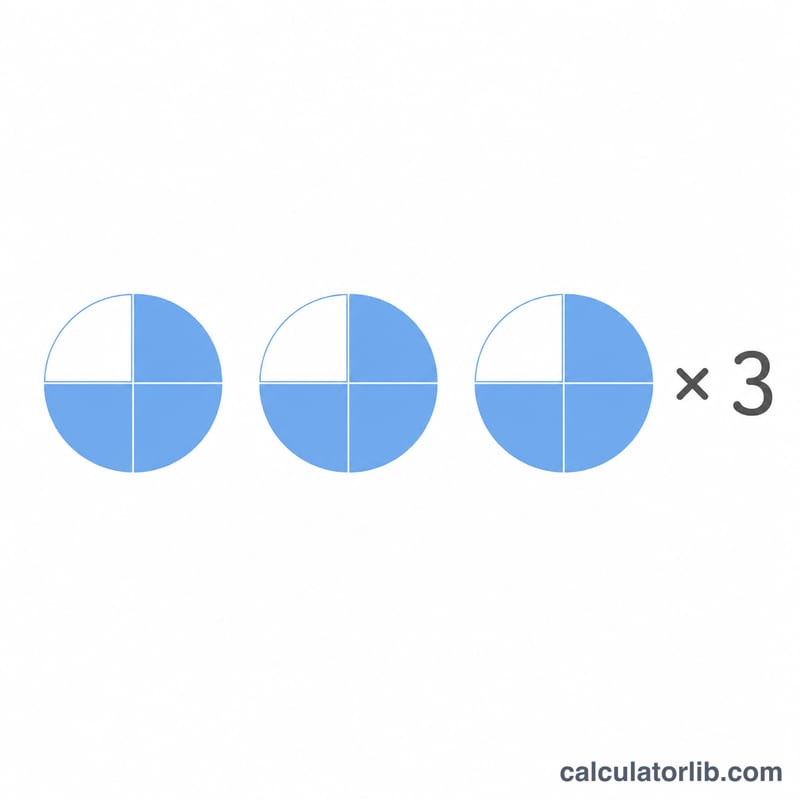
Do I multiply the denominator too? No. The whole number only multiplies the numerator because \(n = \frac{n}{1}\) and the denominators 1 and b combine to b.
What if the result is a whole number? When the denominator simplifies to 1, the fraction is a whole number, shown as n/1 with the decimal confirming it.
Can I use negative numbers? Yes. The sign carries through the numerator; the calculator simplifies the magnitude correctly.