
What This Tool Does
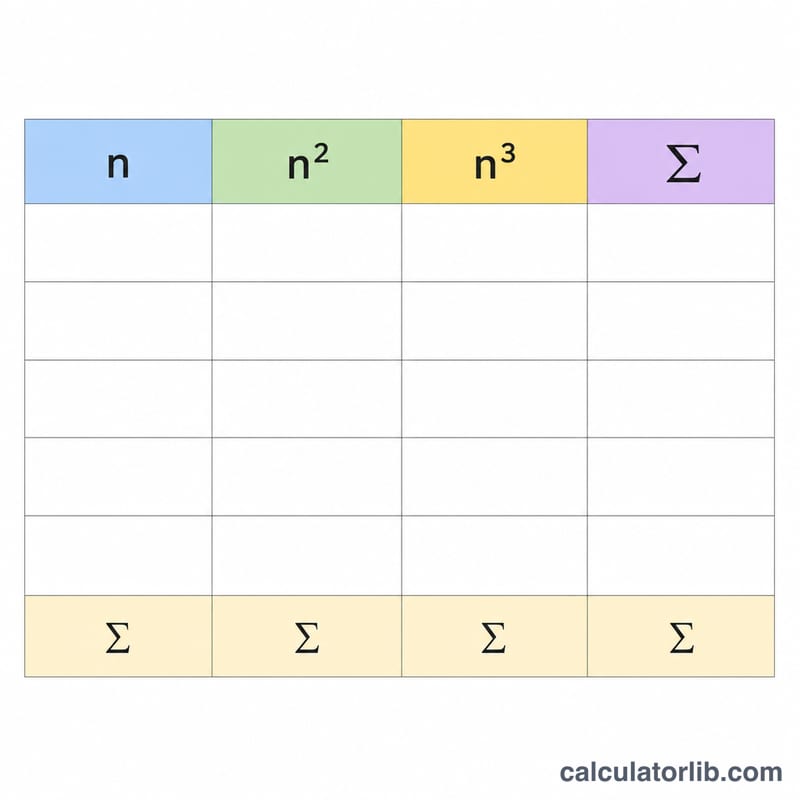
The Squares & Cubes Table Generator builds a clean reference table listing every whole number from 1 up to your chosen value N, alongside its square (\(n^2\)) and cube (\(n^3\)). It also adds up all the squares and all the cubes so you have the totals at a glance. It's a handy companion for students learning powers, teachers preparing worksheets, and anyone who needs a quick lookup of perfect squares and cubes.
How to Use It
Enter a value for N (between 1 and 100) and submit. The calculator generates each row \(k\), \(k^2\), and \(k^3\) in order, then displays the sum of squares as the headline figure and includes the sum of cubes in the totals row. Because it's a pure mathematical tool, the results are exact and apply universally — no units, currency, or region matter here.
The Formula Explained
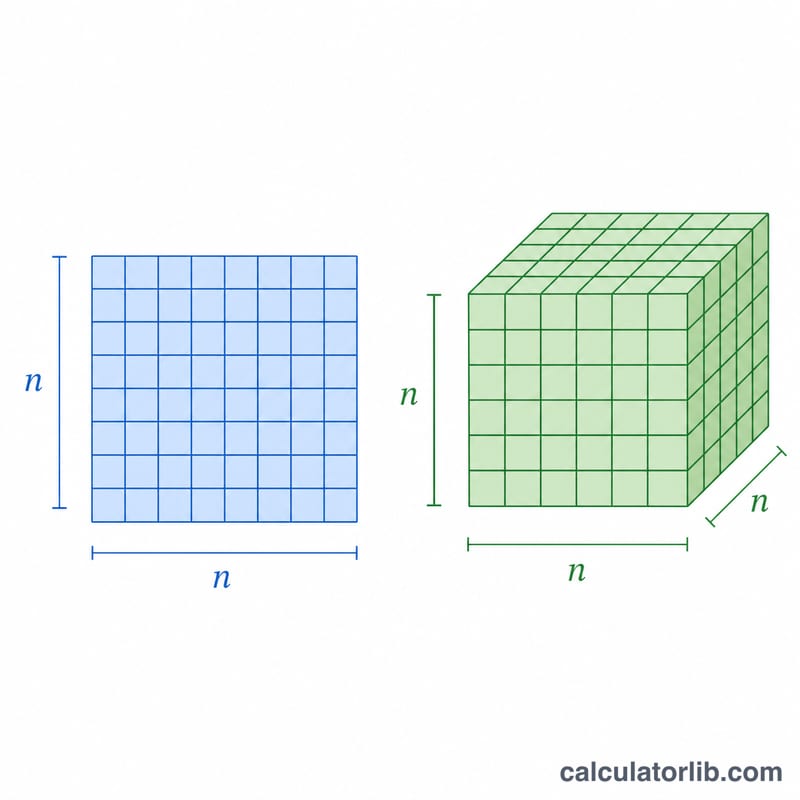
For each integer \(k\) from 1 to N, the square is computed as $$\text{Square}(k) = k^2 = k \times k$$ and the cube as $$\text{Cube}(k) = k^3 = k \times k \times k$$ The squares grow quadratically while the cubes grow cubically, which is why the cube column climbs much faster than the square column as numbers increase.
Worked Example
For N = 5 the rows are: 1 → 1, 1; 2 → 4, 8; 3 → 9, 27; 4 → 16, 64; 5 → 25, 125. The sum of squares is $$1 + 4 + 9 + 16 + 25 = 55$$ and the sum of cubes is $$1 + 8 + 27 + 64 + 125 = 225$$ Notice that 225 = 55... actually 225 equals \((1+2+3+4+5)^2 = 15^2 = 225\) — a famous identity where the sum of the first n cubes equals the square of the triangular number.
FAQ
What is the largest N allowed? You can generate a table up to N = 100.
Why does the sum of cubes equal a perfect square? Because of the identity $$1^3 + 2^3 + \cdots + n^3 = (1 + 2 + \cdots + n)^2$$ the total of the cube column is always a perfect square.
Are the values exact? Yes — every square and cube is computed precisely using integer multiplication.