
What is the Single Multiplication Table Generator?
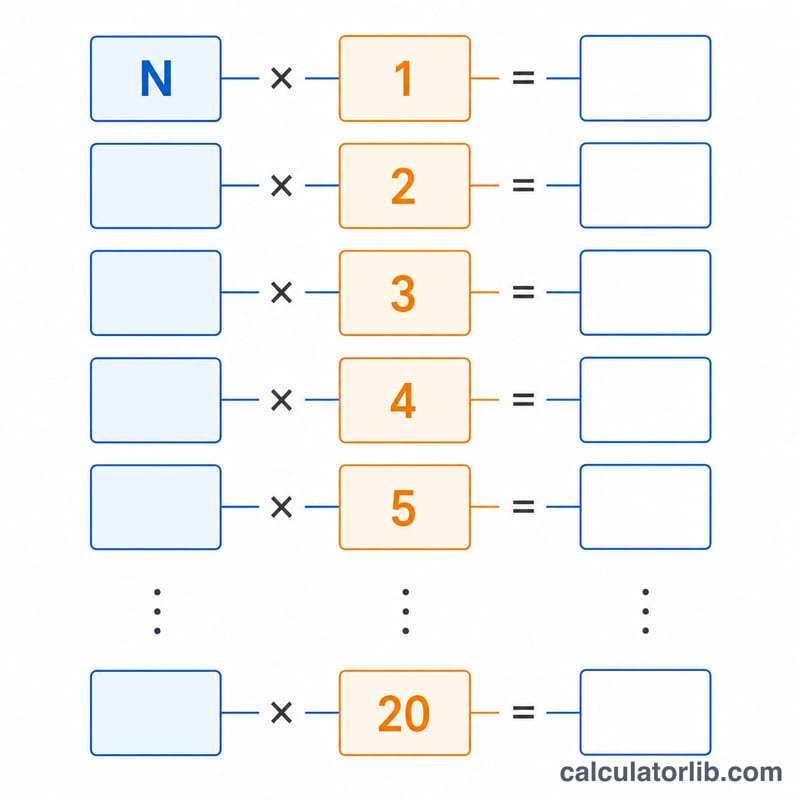
This tool builds the complete times table for one number, N, listing every product from \(N \times 1\) up to \(N \times 20\) (or fewer rows if you choose). It is perfect for students memorizing their tables, teachers preparing worksheets, and anyone who needs a quick reference for a specific number's multiples.
How to use it
Enter the number you want a table for in the Number (N) field. Then pick how many rows you want with Up to (rows) — any value from 1 to 20. The calculator returns each row as "N × k = product", the final product, and the sum of all products combined.
The formula explained
Each row is simply rowk = N × k, where k counts from 1. The running total of every product is $$\text{Sum} = \text{N} \times \frac{n(n+1)}{2},$$ because \(1 + 2 + \ldots + n\) is the triangular number \(\frac{n(n+1)}{2}\). So for a 20-row table, the multipliers sum to 210, and the total is \(N \times 210\).
Worked example
Take N = 7 over 20 rows. The rows run \(7\times1=7\), \(7\times2=14\), \(7\times3=21\), all the way to \(7\times20=140\). The sum of every product is $$7 \times \frac{20\times21}{2} = 7 \times 210 = 1470.$$ The generator displays the full list plus that 1470 total automatically.
FAQ
Can I use decimals? Yes — enter values like 2.5 and the products will be computed accordingly (\(2.5 \times 4 = 10\)).
Why is it limited to 20 rows? Standard multiplication tables typically go to 10, 12, or 20; capping at 20 keeps the table readable while covering the most common needs.
What does the sum mean? It is the total of all the products shown, useful for quick checks and pattern exercises.