
What is the Long Multiplication Calculator?
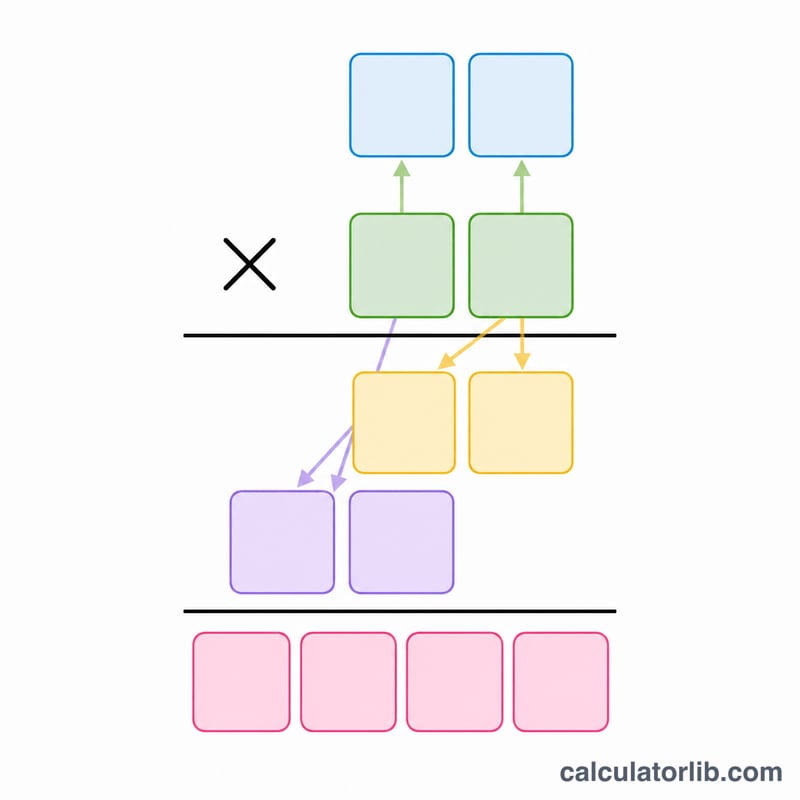
The Long Multiplication Calculator multiplies two numbers and returns their product instantly. Long multiplication is the standard written method taught in school: you multiply one number by each digit of the other, shift each result according to its place value, and then add the partial products together. This tool does the arithmetic for you so you can check homework, verify a manual calculation, or quickly multiply large numbers.
How to use it
Enter your first number (a) and your second number (b), then submit. The calculator displays the product (\(a \times b\)) as the headline result, along with the sum and difference of the two numbers for quick reference. Whole numbers and decimals are both supported.
The formula explained
The core operation is simply $$\text{Product} = a \times b$$ The "long" method breaks it into pieces: for each digit d in b at place value position i, you compute \(a \times d \times 10^{i}\), producing a partial product. Summing all the partial products gives the final answer. For example, \(234 \times 56\) splits into \(234 \times 6 = 1{,}404\) (ones) and \(234 \times 50 = 11{,}700\) (tens), and \(1{,}404 + 11{,}700 = 13{,}104\).
Worked example
Multiply 234 by 56. First partial product: \(234 \times 6 = 1{,}404\). Second partial product: \(234 \times 50 = 11{,}700\). Add them: $$1{,}404 + 11{,}700 = 13{,}104$$ The calculator returns 13,104 directly.
FAQ
Can I multiply decimals? Yes — enter decimal values and the calculator multiplies them exactly the same way.
Why show the sum and difference too? They are handy cross-checks and save you from running separate calculations when comparing two numbers.
Does it work for negative numbers? Yes. A negative times a positive gives a negative product; two negatives give a positive product.