



What this tool does
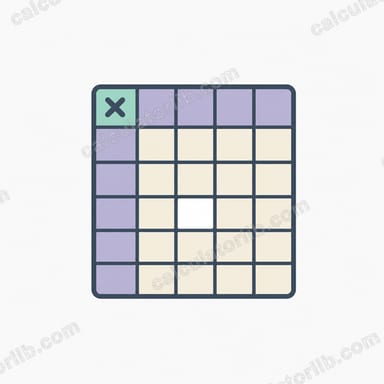
The page shows the multiplication table as a grid you can read, print on one A4 page or practise from. Pick a size (1–12 by default, up to 20), pick one times table to list it on the side, and tap any cell to read its product. The practice set draws questions from the tables you choose and checks each answer as soon as you type it.
How to use it
- Choose the size of the grid and the table to list beside it.
- Select a cell, or move with the arrow keys: its row and column light up and the product is read out.
- Open Practice, tick the tables, choose 10, 20 or 50 questions and the question type (a × b = ?, a × ? = c or mixed), then press Start.
- Type each answer and press Enter. At the end you see your score, your time and the facts you missed, which you can practise again.
Worked example
Row 7 meets column 8 at 7 × 8 = 56. Asked the other way, 7 × ? = 56, the missing factor is 56 ÷ 7 = 8. In a set of 20 questions with 18 right answers the score is 90%, and the two missed facts are listed for another round. Questions are drawn in your browser with its cryptographic random generator; nothing you type is sent or saved.

The formula explained
Every question uses the basic multiplication fact $$P = N \times M$$ where N is the series and M is the second factor, both whole numbers from 1 to 12. In Missing Product mode the expected answer is simply \(N \times M\). In Missing Multiple mode you must recover the hidden factor, which equals \(P / N\). Because P was built as \(N \times M\), the division is always exact - there is no rounding and no remainder.

Full Times Tables Reference Grid (1-12)
The grid below holds all 144 products of the times tables from 1 to 12. Read a row across and a column down; the cell where they meet is the product. For example, row 7 and column 8 give \(7 \times 8 = 56\).
| × | 1 | 2 | 3 | 4 | 5 | 6 | 7 | 8 | 9 | 10 | 11 | 12 |
|---|---|---|---|---|---|---|---|---|---|---|---|---|
| 1 | 1 | 2 | 3 | 4 | 5 | 6 | 7 | 8 | 9 | 10 | 11 | 12 |
| 2 | 2 | 4 | 6 | 8 | 10 | 12 | 14 | 16 | 18 | 20 | 22 | 24 |
| 3 | 3 | 6 | 9 | 12 | 15 | 18 | 21 | 24 | 27 | 30 | 33 | 36 |
| 4 | 4 | 8 | 12 | 16 | 20 | 24 | 28 | 32 | 36 | 40 | 44 | 48 |
| 5 | 5 | 10 | 15 | 20 | 25 | 30 | 35 | 40 | 45 | 50 | 55 | 60 |
| 6 | 6 | 12 | 18 | 24 | 30 | 36 | 42 | 48 | 54 | 60 | 66 | 72 |
| 7 | 7 | 14 | 21 | 28 | 35 | 42 | 49 | 56 | 63 | 70 | 77 | 84 |
| 8 | 8 | 16 | 24 | 32 | 40 | 48 | 56 | 64 | 72 | 80 | 88 | 96 |
| 9 | 9 | 18 | 27 | 36 | 45 | 54 | 63 | 72 | 81 | 90 | 99 | 108 |
| 10 | 10 | 20 | 30 | 40 | 50 | 60 | 70 | 80 | 90 | 100 | 110 | 120 |
| 11 | 11 | 22 | 33 | 44 | 55 | 66 | 77 | 88 | 99 | 110 | 121 | 132 |
| 12 | 12 | 24 | 36 | 48 | 60 | 72 | 84 | 96 | 108 | 120 | 132 | 144 |
The grid is symmetric about its main diagonal, because multiplication is commutative: \(N \times M = M \times N\). So \(3 \times 9 = 27\) and \(9 \times 3 = 27\) are the same fact written two ways. That halves the memorizing job — learn one triangle of the grid and you automatically know the other. Of the 144 cells, only 78 are distinct facts.
The main diagonal holds the square numbers \(N \times N\): 1, 4, 9, 16, 25, 36, 49, 64, 81, 100, 121 and 144. These are worth learning first, since every other cell sits a short step away from a square — for instance, once you know 49, the neighbouring facts \(7 \times 6 = 49 - 7 = 42\) and \(7 \times 8 = 49 + 7 = 56\) follow by adding or subtracting one 7.
Key Multiplication Terms Defined
These are the standard terms used in multiplication practice worldwide. Each definition uses an example drawn from the 1-12 tables.
| Term | Meaning | Example (1-12) |
|---|---|---|
| Factor | A number being multiplied. In \(N \times M = P\), both \(N\) and \(M\) are factors of the product \(P\). | In \(6 \times 9 = 54\), the factors are 6 and 9. |
| Product | The result \(P\) of multiplying the factors together. | The product of 8 and 7 is 56. |
| Multiple | Any product of a number with a whole number. The multiples of \(N\) are exactly the entries in the \(N\) times table. | 21 is a multiple of 7, because \(7 \times 3 = 21\). The first multiples of 7 are 7, 14, 21, 28, 35. |
| Multiplicand | The quantity being multiplied — the size of each equal group. | In "4 bags of 12", written \(12 \times 4\), the multiplicand is 12 (items per bag). |
| Multiplier | The number that says how many times the multiplicand is taken — how many equal groups there are. | In "4 bags of 12", the multiplier is 4, giving \(12 \times 4 = 48\). |
| Times table / series | The fixed number \(N\) whose multiples you are practising for a round, together with its list of products \(N \times 1\) through \(N \times 12\). | The 6 series: 6, 12, 18, 24, 30, 36, 42, 48, 54, 60, 66, 72. |
| Array | A rectangular arrangement of objects in rows and columns; the total count equals rows × columns, which pictures the product. | A 4-by-5 array of dots has \(4 \times 5 = 20\) dots. |
| Square number | A product of a number with itself, \(N \times N\), written \(N^2\). These sit on the diagonal of the reference grid. | \(12 \times 12 = 144\), so 144 is a square number. |
| Commutative property | The order of the factors does not change the product: \(N \times M = M \times N\). | \(3 \times 11 = 33\) and \(11 \times 3 = 33\). |
Two of these terms deserve a note on usage. Multiplicand and multiplier describe roles in a real-world situation, not fixed positions in the written expression — conventions differ between countries and textbooks, and some write "4 groups of 12" as \(4 \times 12\) rather than \(12 \times 4\). Because multiplication is commutative, the numerical answer is 48 either way, so the practice grid treats both orders as the same fact.
The distinction between factor and multiple runs in opposite directions: 7 is a factor of 21, while 21 is a multiple of 7. In the practice modes here, "find the product" asks you for \(P\) given both factors, while "find the multiple" gives you the series and the product and asks which factor is missing — for example, \(9 \times \square = 72\), where the missing factor is 8.
FAQ
What range does it cover? All facts from \(1 \times 1\) up to \(12 \times 12 = 144\).
Why is my division always whole? Because the product is created by multiplying the series by the factor, dividing it back by the series returns the exact factor.
Is the answer comparison exact? Yes - guesses are parsed as integers and compared exactly, with no floating-point tolerance.