
What is the Ratio to Fraction Calculator?
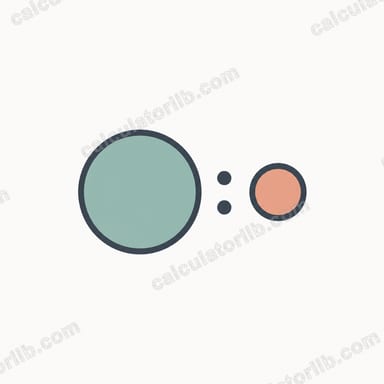
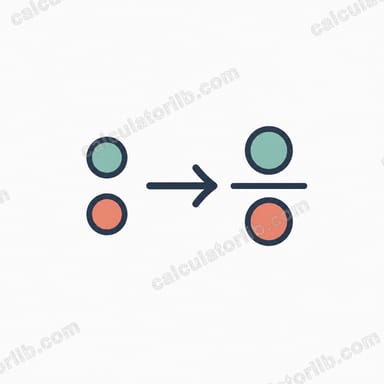
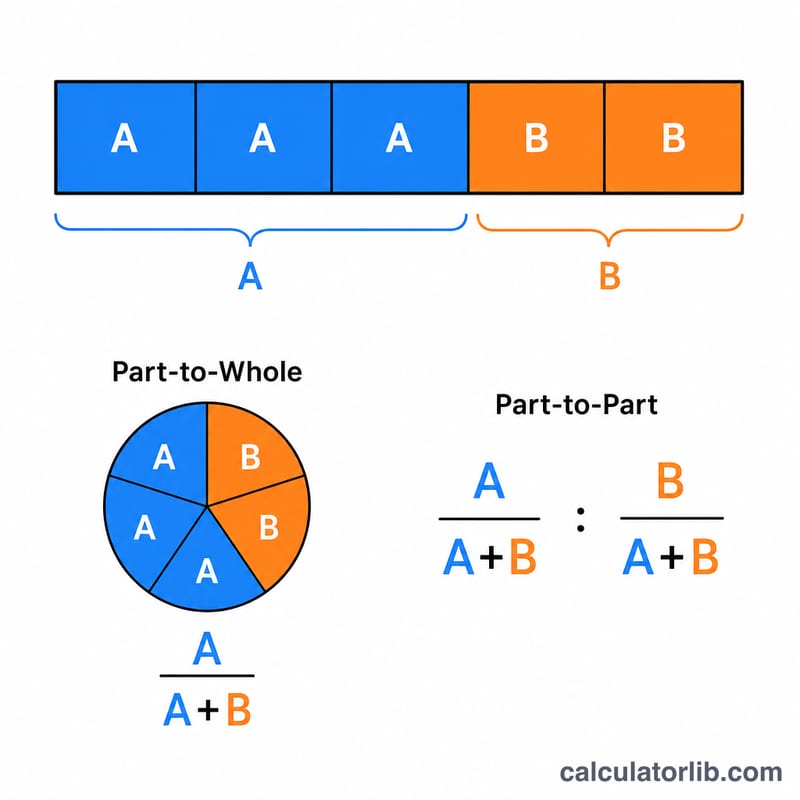
This tool turns a ratio written as A : B into one or more fractions and reduces each fraction to its simplest (lowest) form. It supports two common interpretations of a ratio: part-to-part, where A and B are two pieces of the same whole, and part-to-whole, where B is the total and A is a portion of that total.
How to use it
Pick the type of ratio, then enter two positive whole numbers for A and B. Choose part-to-part when A and B describe separate shares (for example 3 cats to 9 dogs). Choose part-to-whole when B is already the total (for example 6 out of 14 students). Press calculate to see the original fractions, the simplified fractions, and a written solution.
The formula explained
In part-to-part mode the whole is the sum of the terms: \(\text{Whole} = \text{A} + \text{B}\). Term A becomes the fraction \(\frac{\text{A}}{\text{A} + \text{B}}\) and term B becomes \(\frac{\text{B}}{\text{A} + \text{B}}\). In part-to-whole mode the denominator is B itself, so the ratio converts directly to \(\frac{\text{A}}{\text{B}}\). The fractions are therefore:
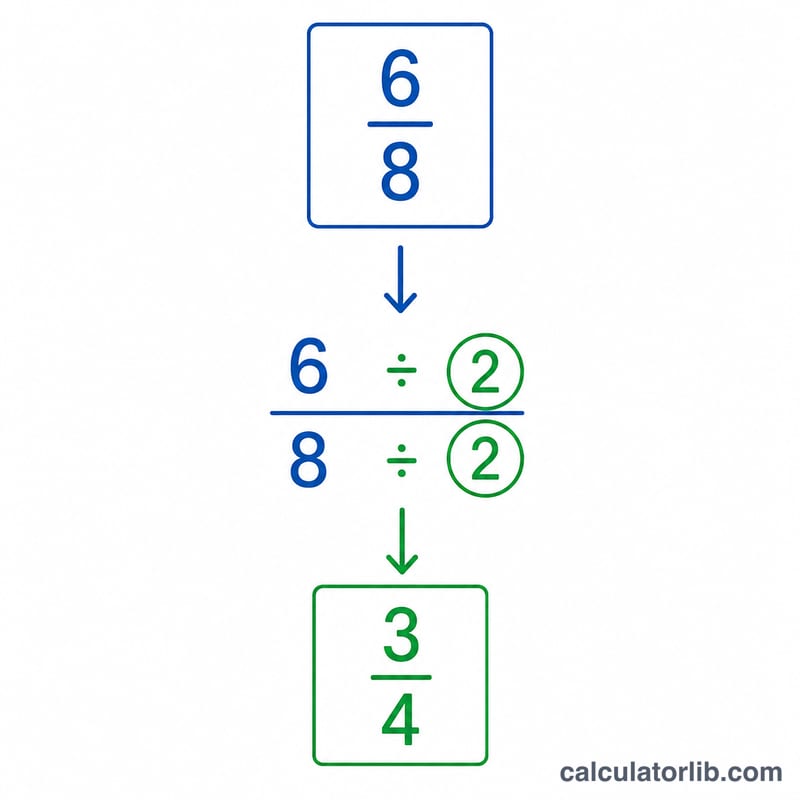
$$\frac{\text{A}}{\text{A} + \text{B}} \;,\quad \frac{\text{B}}{\text{A} + \text{B}}$$Every fraction is then reduced by dividing the numerator and denominator by their greatest common divisor, found with the Euclidean algorithm \(\gcd(x, 0) = x\) and \(\gcd(x, y) = \gcd(y, x \bmod y)\).
Worked example
Take the ratio 3 : 9 in part-to-part mode. The whole is \(3 + 9 = 12\), so the fractions are \(\frac{3}{12}\) and \(\frac{9}{12}\). Since \(\gcd(3, 12) = 3\), the first reduces to \(\frac{1}{4}\); since \(\gcd(9, 12) = 3\), the second reduces to \(\frac{3}{4}\). Part A is \(\frac{1}{4}\) of the whole and Part B is \(\frac{3}{4}\) of the whole.
FAQ
What is the difference between the two modes? Part-to-part uses \(\text{A} + \text{B}\) as the denominator; part-to-whole uses B as the denominator. The same numbers give different fractions depending on the mode.
Can A be larger than B in part-to-whole mode? Yes, but the result is then an improper fraction greater than 1 and no longer represents a portion of a whole.
What if the ratio is already in lowest terms? When the greatest common divisor is 1, the simplified fraction equals the original fraction and is shown unchanged.