
What this calculator does
This tool converts a spoken-style number-word phrase, such as "16.76 Trillion", into its full positional (standard) notation with comma thousands separators, and also restates it in scientific notation. You enter a number and pick a magnitude word from the dropdown; the calculator multiplies the number by ten raised to the word's exponent.
How to use it
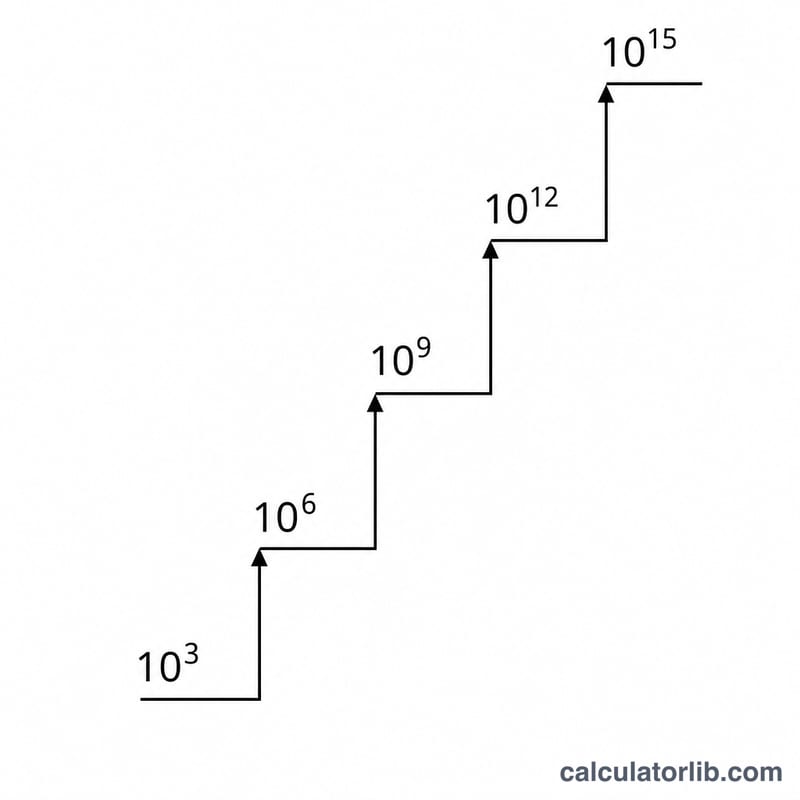
Type any real number (it may include a decimal point and a minus sign) into the Number field, then choose the word that describes its magnitude. Trillion means ten to the twelfth power, Billion is ten to the ninth, Million is ten to the sixth, and so on. Smaller-than-one words such as Tenths, Millionths and Billionths use negative exponents. Press calculate to see the standard and scientific forms.
The formula explained
The core rule is $$\text{value} = \text{number} \times 10^{\,\text{exponent}}$$ Rather than relying on floating-point arithmetic, this calculator shifts the decimal point of the typed number by the exponent: a positive exponent moves the point right and pads with zeros, while a negative exponent moves it left and adds leading zeros. This keeps very large magnitudes (up to Quintillion, ten to the eighteenth) digit-exact. The integer part is then grouped in threes with commas; the fractional part is never grouped.
Worked example
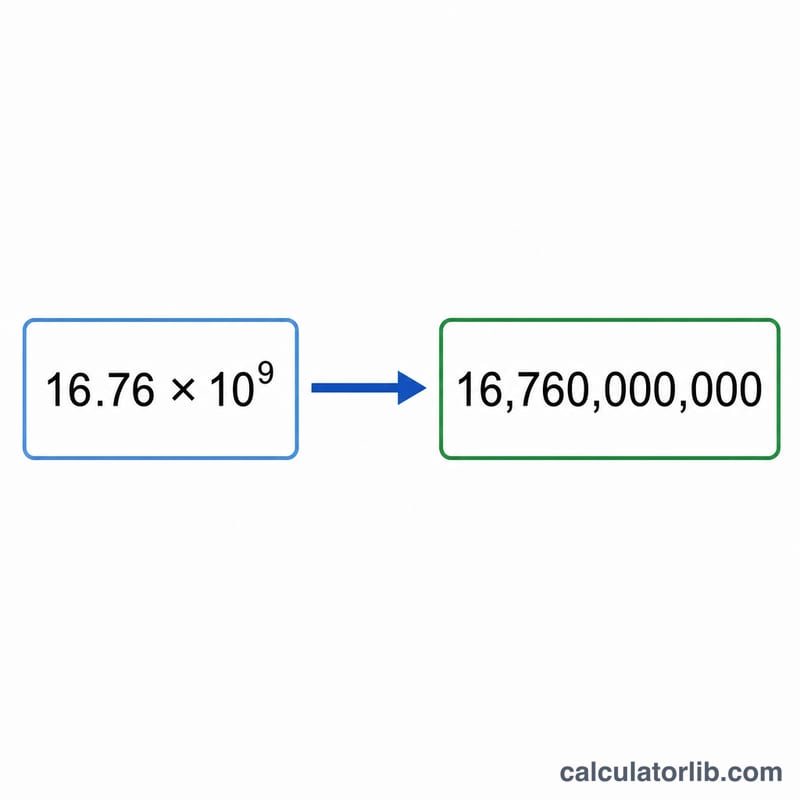
Take "16.76 Trillion". The word Trillion has exponent 12, so the decimal point moves twelve places to the right of "16.76", giving 16,760,000,000,000. Scientific notation keeps the coefficient exactly as entered: $$16.76 \times 10^{12}$$ (this calculator does not renormalize the coefficient to be between 1 and 10).
FAQ
Does it use short or long scale? It uses short-scale naming (US and modern UK), where billion is ten to the ninth power. Because you pick the exponent directly through the word, the numeric output is unambiguous.
Why is the scientific notation not normalized? By design it echoes your number and the chosen power of ten verbatim, so 16.76 Trillion shows as \(16.76 \times 10^{12}\) rather than \(1.676 \times 10^{13}\).
Can I enter negatives or fractions? Yes. Negative numbers get a leading minus sign, and decimals are handled by shifting the existing decimal point, including small magnitudes like 4 Millionths giving 0.000004.