
What this calculator does
TV and monitor sizes are advertised by a single number: the diagonal length of the screen in inches. But the diagonal alone does not tell you how wide or tall the screen actually is — that depends on the aspect ratio. This tool converts a diagonal size and aspect ratio into the real width, height and area of the screen, shown in both inches and centimetres. It works for any rectangular display, so it applies identically everywhere.
How to use it
Pick the aspect ratio (the classic 4:3 of older TVs, or the widescreen 16:9 used by virtually all modern TVs and computers). Enter the screen size in inches — decimals are fine for tablets and phones (for example 9.7). The calculator returns the width, height and screen area. Because a widescreen and a classic screen with the same diagonal are not the same size, you can switch the dropdown to compare them directly.
The formula
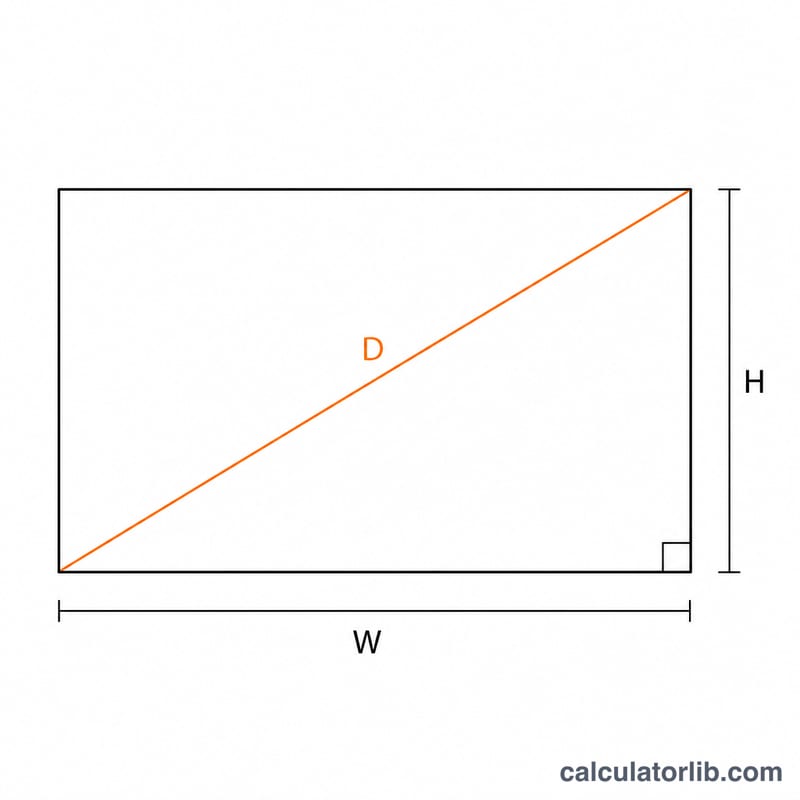
For a rectangle with aspect ratio Rw:Rh and diagonal D, the width and height satisfy \( \text{width}/\text{height} = R_w/R_h \) and \( \text{width}^2 + \text{height}^2 = D^2 \). Solving gives
$$\text{width} = D \times \frac{R_w}{\sqrt{R_w^2 + R_h^2}}, \quad \text{height} = D \times \frac{R_h}{\sqrt{R_w^2 + R_h^2}}$$The area is simply \( \text{width} \times \text{height} \). Inches are converted to centimetres using the exact factor \( 1\ \text{inch} = 2.54\ \text{cm} \).
Worked example
A 37-inch 16:9 screen: the diagonal factor is \( \sqrt{16^2 + 9^2} = \sqrt{337} \approx 18.358 \).
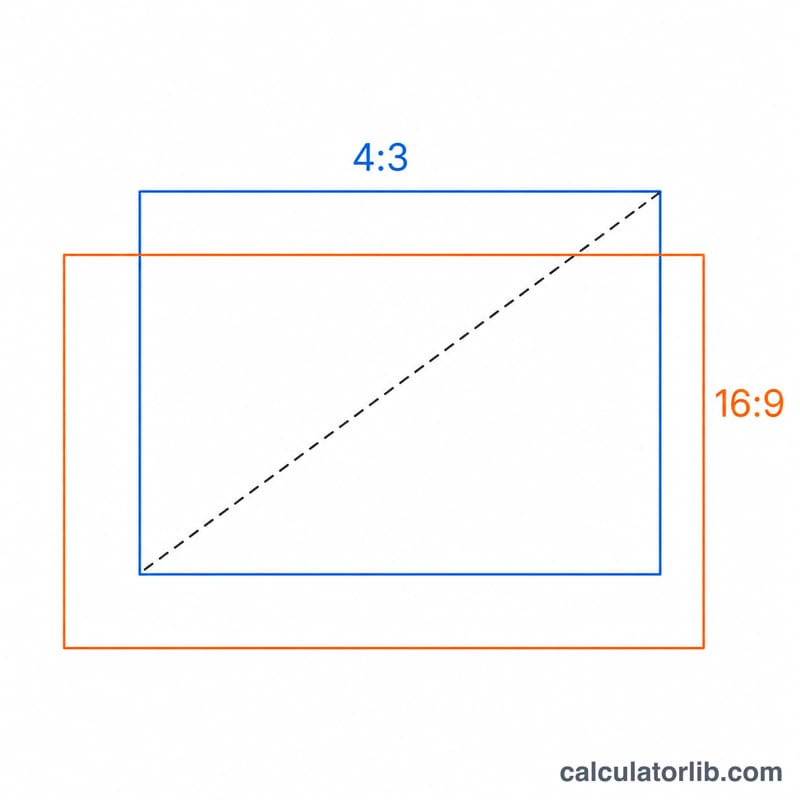
$$\text{Width} = \frac{37 \times 16}{18.358} \approx 32.25\ \text{in}\ (81.91\ \text{cm})$$$$\text{height} = \frac{37 \times 9}{18.358} \approx 18.14\ \text{in}\ (46.08\ \text{cm})$$area \( \approx 585\ \text{in}^2\ (3774\ \text{cm}^2) \). The same 37 inches in 4:3 gives \( 29.6 \times 22.2 \) in and an area of \( 657\ \text{in}^2 \) — wider but shorter, with more total area for the classic ratio.
FAQ
Why is a 16:9 TV smaller in area than a 4:3 TV of the same inches? The diagonal is fixed, but a wider rectangle "spends" more of that diagonal on width and less on height, which reduces the total area for a given diagonal.
Does the bezel count? No. The calculation assumes the diagonal equals the stated inch size of the visible screen; physical products may differ slightly due to bezels and rounding.
Can I use other ratios? The same formula works for any ratio (3:2, 16:10, 21:9, etc.); just plug in the width and height parts.