
What This Calculator Does
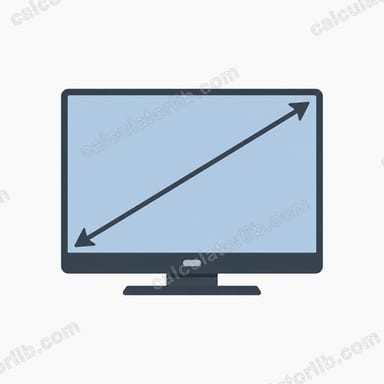
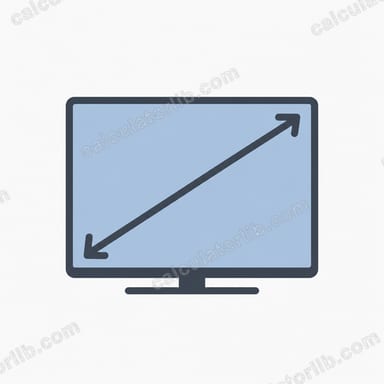
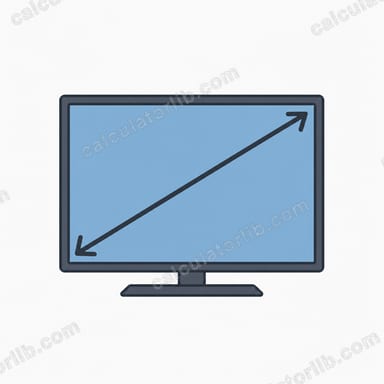
TVs and monitors are advertised by their diagonal measurement — a "55-inch" set tells you the corner-to-corner distance, not how wide or tall the screen actually is. This calculator converts that diagonal, together with the aspect ratio (such as 16:9 or 21:9), into the real width, height and total viewable area so you can check whether a screen will fit your wall, cabinet or media unit.
How to Use It
Enter the diagonal size in any unit (inches or centimetres — the results come back in the same unit). Then enter the aspect ratio as two numbers: width first, height second. For a standard widescreen TV that is 16 and 9. Click calculate to see the width, height and area.
The Formula Explained
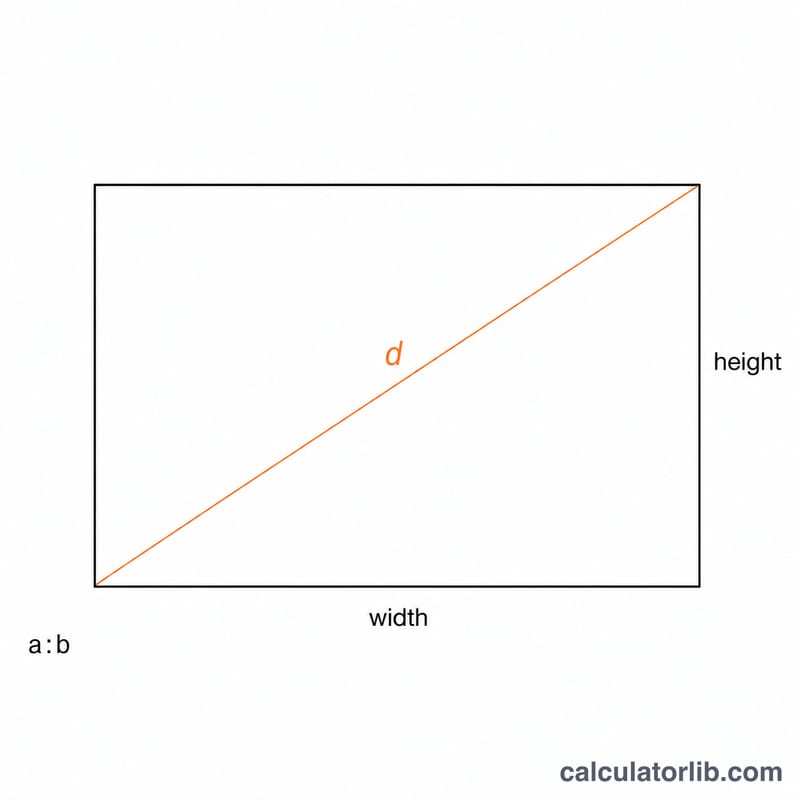
A screen with aspect ratio \(a{:}b\) has its sides in proportion \(a\) to \(b\). The diagonal forms the hypotenuse of a right triangle whose legs are the width and height. Scaling the ratio so the hypotenuse equals the diagonal \(d\) gives:
$$\text{width} = \frac{d \cdot a}{\sqrt{a^2 + b^2}} \quad\text{and}\quad \text{height} = \frac{d \cdot b}{\sqrt{a^2 + b^2}}.$$ The area is \(\text{width} \times \text{height}\).
Worked Example
For a 55-inch 16:9 TV: $$\sqrt{16^2 + 9^2} = \sqrt{337} \approx 18.3576.$$ $$\text{Width} = \frac{55 \times 16}{18.3576} \approx 47.94 \text{ in.}$$ $$\text{Height} = \frac{55 \times 9}{18.3576} \approx 26.97 \text{ in.}$$ $$\text{Area} = 47.94 \times 26.97 \approx 1292.58 \text{ square inches.}$$
FAQ
Does the unit matter? No — output uses whatever unit you enter for the diagonal.
What aspect ratio should I use? Most modern TVs are 16:9. Ultrawide monitors are often 21:9, and older sets were 4:3.
Why is the width less than the diagonal? The diagonal is always the longest distance on a rectangle, so width and height are both smaller.