
What is arc length?
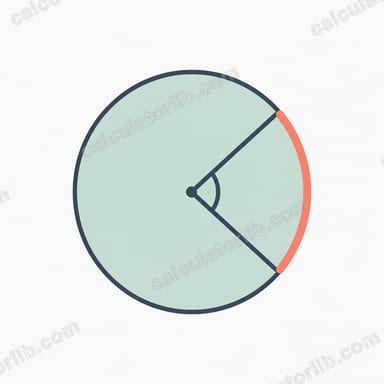
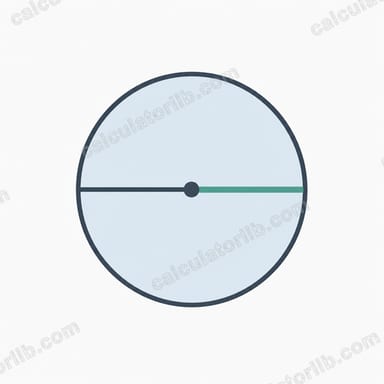
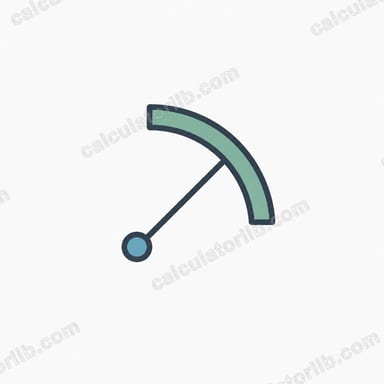
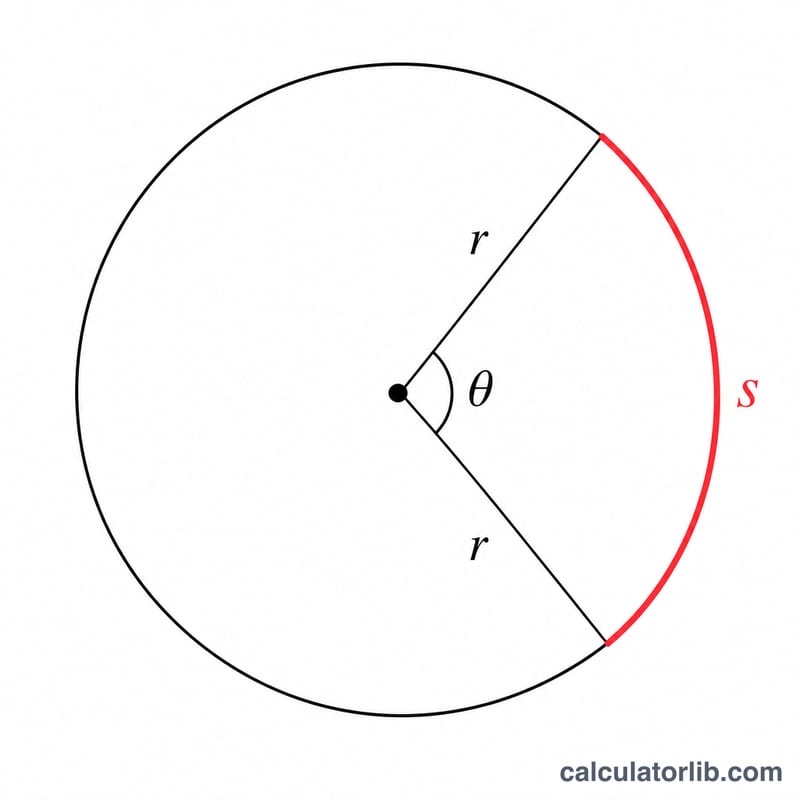
Arc length is the distance measured along the curved edge of a circle between two points. It depends on two things: how large the circle is (its radius) and how wide the slice is (the central angle). This calculator works for any circle and any angle, returning the arc length in the same units you use for the radius.
How to use this calculator
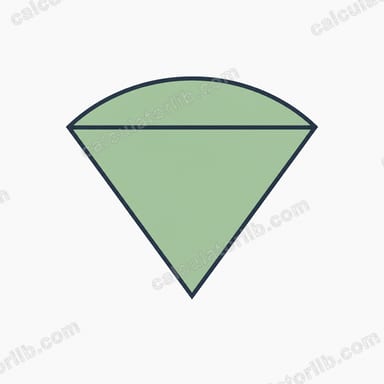
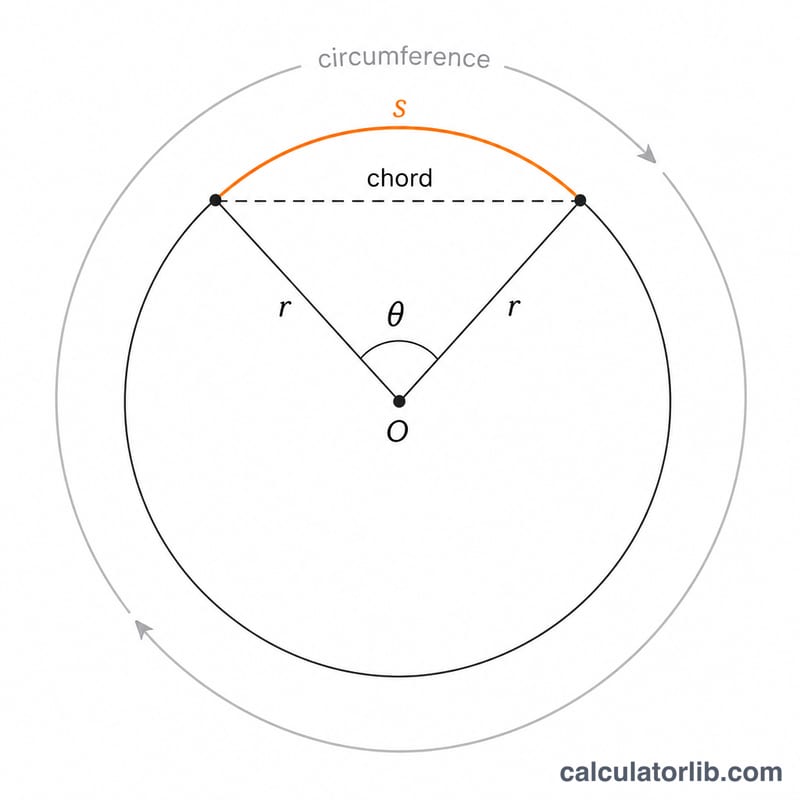
Enter the circle's radius and the central angle that the arc subtends. Choose whether the angle is in degrees or radians, then read off the arc length. The tool also reports the equivalent angle in the other unit, the full circumference, and the straight-line chord connecting the arc's endpoints.
The formula explained
When the angle θ is in radians, arc length is simply $$s = r \times \theta$$. This works because a radian is defined as the angle that cuts off an arc equal to the radius. When the angle is in degrees, convert by treating the arc as a fraction of the whole circle: $$s = 2\pi r \times \frac{\theta^\circ}{360}$$. Both forms give identical answers, since \(360^\circ = 2\pi\) radians.
Worked example
Suppose a circle has a radius of 5 units and a central angle of 90°. The full circumference is \(2\pi \times 5 \approx 31.4159\). Ninety degrees is one quarter of the circle, so the arc length is $$31.4159 \times \frac{90}{360} = 7.85398 \text{ units}.$$ Equivalently, \(90^\circ = \frac{\pi}{2} \approx 1.5708\) radians, and \(5 \times 1.5708 = 7.85398\).
Common Arc Lengths for Standard Angles
The arc length of a circle is found with the formula \(L = r\theta\), where \(\theta\) is the central angle in radians. If your angle is in degrees, first convert it with \(\theta_{rad} = \theta_{deg} \times \frac{\pi}{180}\). Because the full circle (360°) has circumference \(2\pi r\), each angle covers a simple fraction of that circumference.
The table below lists the most common angles, their radian equivalents, the arc length expressed as a fraction of the circumference, and the actual arc length for a unit circle (\(r=1\)).
| Angle (degrees) | Angle (radians) | Fraction of circle | Arc length (general) | Arc length, r = 1 |
|---|---|---|---|---|
| 30° | \(\pi/6\) | 1/12 | \(\pi r/6\) | 0.5236 |
| 45° | \(\pi/4\) | 1/8 | \(\pi r/4\) | 0.7854 |
| 60° | \(\pi/3\) | 1/6 | \(\pi r/3\) | 1.0472 |
| 90° | \(\pi/2\) | 1/4 | \(\pi r/2\) | 1.5708 |
| 120° | \(2\pi/3\) | 1/3 | \(2\pi r/3\) | 2.0944 |
| 180° | \(\pi\) | 1/2 | \(\pi r\) | 3.1416 |
| 270° | \(3\pi/2\) | 3/4 | \(3\pi r/2\) | 4.7124 |
| 360° | \(2\pi\) | 1 (full circle) | \(2\pi r\) | 6.2832 |
For any other radius, multiply the \(r=1\) value by your radius. For example, a 90° arc on a circle of radius 5 has length \(5 \times 1.5708 = 7.854\).
FAQ
What units does the answer use? The arc length comes out in the same units as the radius — enter centimeters and you get centimeters.
How do I convert degrees to radians? Multiply degrees by π/180. So \(180^\circ = \pi \approx 3.14159\) radians.
What is the chord length? The chord is the straight line between the arc's two endpoints, computed as \(2r \cdot \sin(\theta/2)\). It is always shorter than the arc.