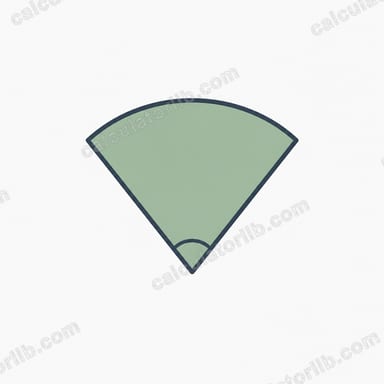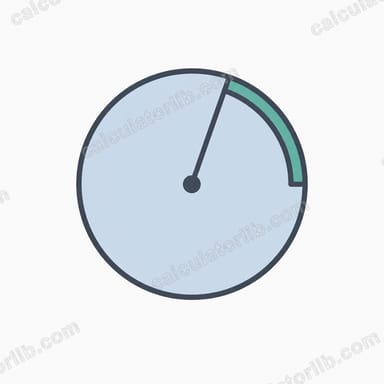

What Is the Sector Area from Arc Length Calculator?
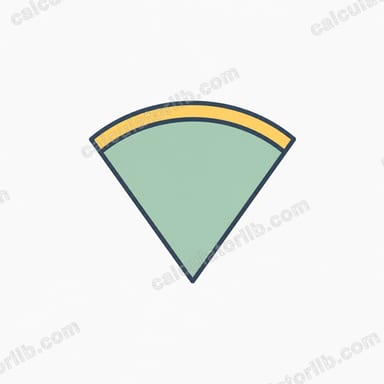
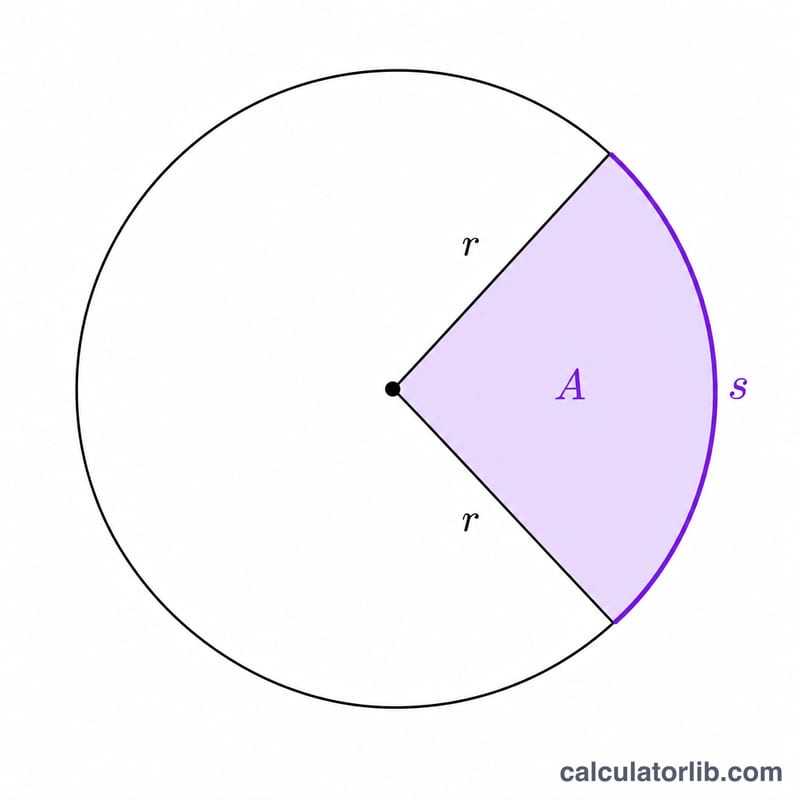
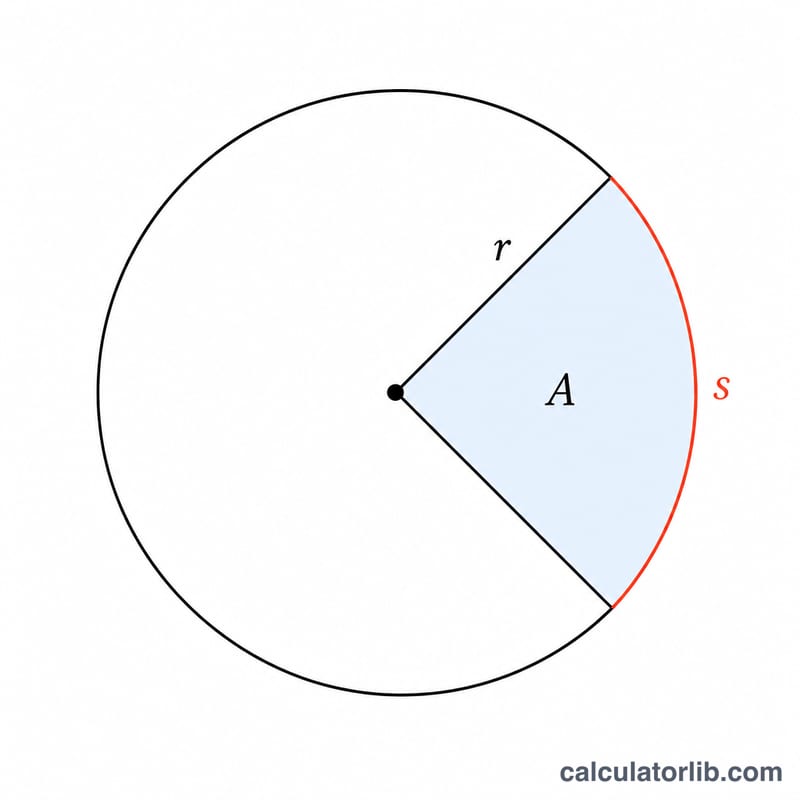
A circular sector is the "pie-slice" region bounded by two radii and the arc between them. While the most common sector-area formula uses the central angle, you can compute the area directly from the radius and the arc length. This calculator does exactly that, returning the sector's area in square units instantly.
How to Use It
Enter the radius (r) of the circle and the arc length (s) — the curved distance along the circle's edge that bounds the sector. Both values must use the same length unit. Press calculate and the tool returns the area in those units squared.
The Formula Explained
The area is given by:
$$A = \frac{1}{2} \cdot r \cdot s$$
This comes from the standard sector area \(A = \frac{1}{2} \cdot r^2 \cdot \theta\) (with \(\theta\) in radians) combined with the arc-length relation \(s = r \cdot \theta\). Substituting \(\theta = s / r\) gives \(A = \frac{1}{2} \cdot r^2 \cdot (s / r) = \frac{1}{2} \cdot r \cdot s\). The angle cancels out, so you only need \(r\) and \(s\).
Worked Example
Suppose a sector has a radius of 5 units and an arc length of 10 units. Then $$A = \frac{1}{2} \cdot 5 \cdot 10 = 25 \text{ square units}.$$ If the radius were 8 and the arc length 6, the area would be $$\frac{1}{2} \cdot 8 \cdot 6 = 24 \text{ square units}.$$
FAQ
Do I need the central angle? No. This method bypasses the angle entirely — you only need the radius and arc length.
What units does the result use? If your inputs are in centimeters, the area is in square centimeters. The output is always the square of your chosen input unit.
Can arc length exceed the circumference? Physically no — a sector's arc cannot be longer than the full circle (\(2\pi r\)). If it is, you've likely entered values for more than one full turn.