What Is the Trapezoid Median?
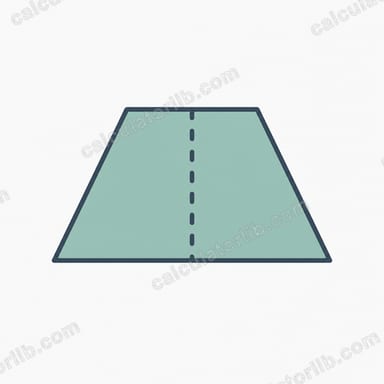
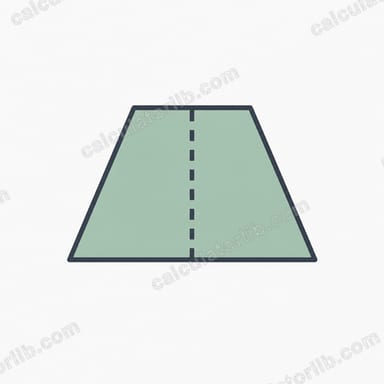
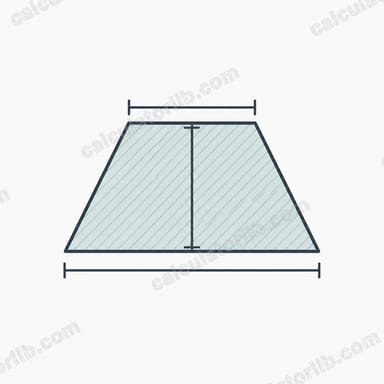
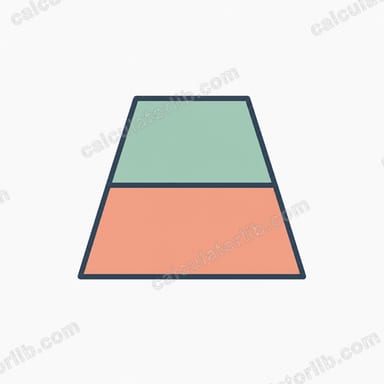
The median of a trapezoid — also called the midsegment or midline — is the line segment that connects the midpoints of the two non-parallel sides (the legs). A key property of any trapezoid is that this segment is always parallel to the two bases, and its length equals the average of those two bases. This calculator computes that length instantly from the two parallel sides you enter.

How to Use the Calculator
Enter the length of base a and base b, the two parallel sides of the trapezoid. The units can be anything (cm, m, inches, feet) as long as both bases use the same unit. Press calculate and you'll get the median length, plus the sum and difference of the bases for reference.
The Formula Explained
The median is given by:
$$m = \frac{a + b}{2}$$
Here a and b are the lengths of the two parallel bases. Because the midsegment sits exactly halfway between the bases, its length is simply their arithmetic mean. Notice the legs and the height of the trapezoid do not affect the median at all — only the two parallel sides matter.
Worked Example
Suppose a trapezoid has bases \(a = 8\) cm and \(b = 4\) cm. Then:
$$m = \frac{8 + 4}{2} = \frac{12}{2} = 6 \text{ cm}$$
The midsegment is 6 cm long, lying parallel to and centered between the two bases.

More Worked Examples
The median (midsegment) of a trapezoid is the segment joining the midpoints of the two non-parallel sides. Its length is the average of the two parallel bases: \(m = \frac{a + b}{2}\). The examples below use this formula in different ways.
Example 1: Decimal bases
A trapezoidal garden bed has parallel sides \(a = 12.5\) m and \(b = 7.3\) m.
- Add the bases: \(12.5 + 7.3 = 19.8\).
- Divide by 2: \(m = \frac{19.8}{2} = \)9.9 m.
The median is 9.9 m, which lies between the two base lengths, as it always must.
Example 2: Finding a missing base
A trapezoid has median \(m = 15\) and one base \(a = 10\). Find the other base \(b\).
- Start with \(m = \frac{a + b}{2}\).
- Multiply both sides by 2: \(2m = a + b\).
- Solve for \(b\): \(b = 2m - a = 2(15) - 10 = 30 - 10 = 20\).
Check: \(\frac{10 + 20}{2} = 15\). ✔
Example 3: Using the median to find area
A trapezoid has bases 9 and 5 and height \(h = 4\). The area equals the median times the height, \(A = m \times h\).
- Find the median: \(m = \frac{9 + 5}{2} = \frac{14}{2} = \)7.
- Multiply by the height: \(A = 7 \times 4 = 28\) square units.
This matches the usual formula \(A = \frac{(a + b)}{2} \times h = \frac{14}{2} \times 4 = 28\), since the median is simply the average base length.
FAQ
Does the median depend on the trapezoid's height? No. The median depends only on the two parallel bases. Two trapezoids with the same bases but different heights have the same median.
What if both bases are equal? Then the shape is a parallelogram and the median equals the base length itself, since \((a + a)/2 = a\).
Can I use the median to find a missing base? Yes. If you know the median \(m\) and one base \(a\), the other base is \(b = 2m - a\).