
What the Arc Length Calculator Does
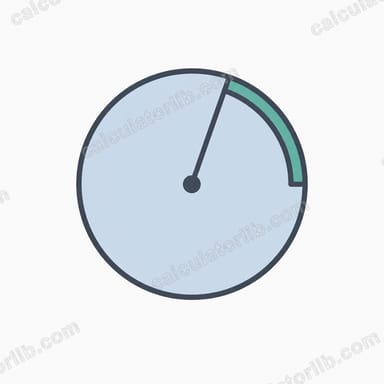
This calculator finds the length of a curved segment along a circle's edge. You enter just two values — the circle's radius and the central angle in degrees — and it returns the arc length. As a bonus, it also computes the sector area and chord length for the same radius and angle, giving you a complete picture of that slice of the circle.
The Two Inputs You Provide
- Radius: the distance from the centre of the circle to its edge, in whatever unit you choose (cm, m, inches, etc.).
- Central Angle (degrees): the angle, measured at the circle's centre, that the arc spans — from 0° up to 360°.
The Formula Explained
Arc length uses the relationship:
L = r · θ = r · (π · angle° / 180)
Because the core arc-length formula (L = r · θ) requires the angle in radians, the calculator first converts your degrees to radians by multiplying by π/180. It then multiplies that radian value by the radius. The same converted angle drives the extra outputs:
- Sector area: ½ · r² · θ (in radians)
- Chord length: 2 · r · sin(θ/2) — the straight-line distance between the arc's two endpoints
Worked Example
Suppose the radius is 10 and the central angle is 60°.
- Convert: θ = 60 × π/180 ≈ 1.0472 radians
- Arc length: L = 10 × 1.0472 ≈ 10.47
- Sector area: ½ × 10² × 1.0472 ≈ 52.36
- Chord length: 2 × 10 × sin(30°) = 20 × 0.5 = 10.00
So a 60° arc on a circle of radius 10 stretches about 10.47 units along the curve, while the straight chord between its ends is exactly 10 units.
Key Terms and Variables
- Arc length (\(L\))
- The distance measured along the curved edge of a circle between two points. For a central angle in degrees, \(L = r\theta\frac{\pi}{180}\); in radians it simplifies to \(L = r\theta\).
- Radius (\(r\))
- The straight-line distance from the center of the circle to any point on its circumference. It scales every arc, chord, and area measurement.
- Central angle (\(\theta\))
- The angle, measured at the center of the circle, that subtends (opens onto) the arc. It can be expressed in degrees or radians.
- Radian
- The natural unit of angle, defined so that an arc equal in length to the radius subtends one radian. A full circle is \(2\pi\) radians, and \(1\text{ rad} \approx 57.2958^\circ\).
- Sector area
- The area of the "pie slice" region bounded by two radii and the arc, given by \(A = \frac{1}{2}r^2\theta\) (radians) or \(A = \frac{\theta}{360}\pi r^2\) (degrees).
- Chord
- The straight-line segment connecting the two endpoints of an arc, found from \(c = 2r\sin(\theta/2)\). The chord is always shorter than its arc.
- Circumference
- The total distance around the entire circle, \(C = 2\pi r\). An arc is simply a fraction \(\frac{\theta}{360}\) of the circumference.
Frequently Asked Questions
What's the difference between arc length and chord length? Arc length follows the curve, while the chord is the straight line connecting the arc's two endpoints. The arc is always equal to or longer than the chord.
Can I enter the angle in radians? No — the input expects degrees, and the tool converts internally. If you have radians, multiply by 180/π first to get degrees.
What if I enter 360°? The arc length becomes the full circumference (2πr) and the chord length collapses to zero, since both endpoints meet at the same point.