
What Is Slope Percent to Degrees?
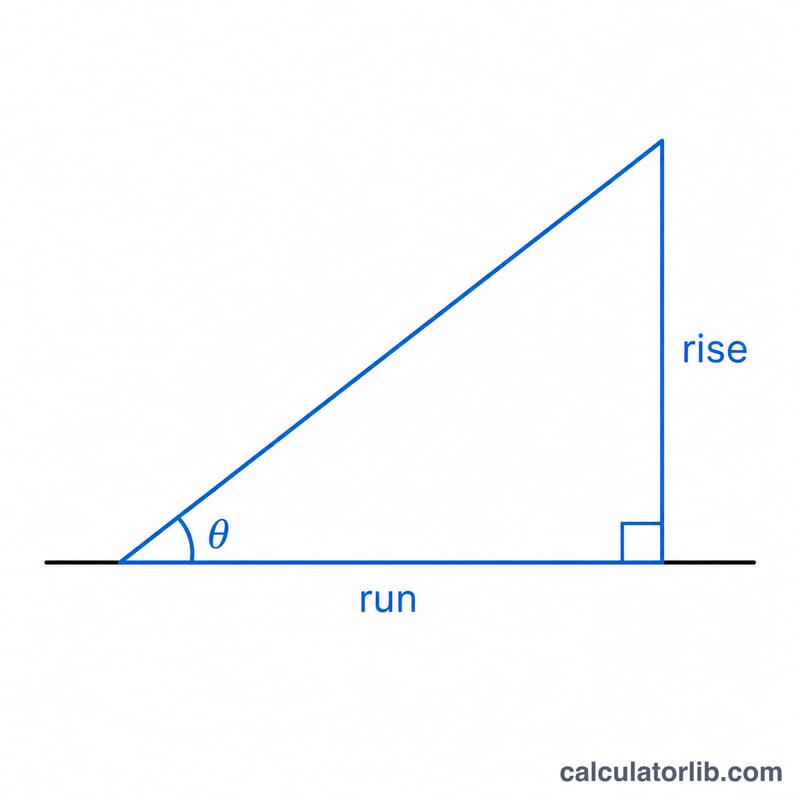
Slope, or grade, can be expressed two common ways: as a percentage and as an angle in degrees. A slope percent is the ratio of vertical rise to horizontal run multiplied by 100. For example, a 10% grade rises 10 units for every 100 units traveled horizontally. An angle in degrees describes the same incline as a geometric angle measured from the horizontal. This calculator converts a slope grade percentage into its equivalent angle in degrees (and radians).
How to Use This Calculator
Enter the slope value as a percentage in the input field and the calculator instantly returns the incline angle in degrees, along with the angle in radians for reference. A value of 100% corresponds to a 45-degree slope, because the rise equals the run. Slopes greater than 100% produce angles above 45 degrees, while gentle grades produce small angles.
The Formula Explained
The conversion uses the arctangent function. Because slope percent equals (rise/run) × 100, dividing by 100 recovers the tangent of the angle: \(\tan(\theta) = \text{rise}/\text{run}\). Taking the inverse tangent gives the angle in radians, which is then converted to degrees by multiplying by \(180/\pi\). In full:
$$\theta = \arctan\left(\frac{\text{Slope (\%)}}{100}\right) \times \frac{180}{\pi}$$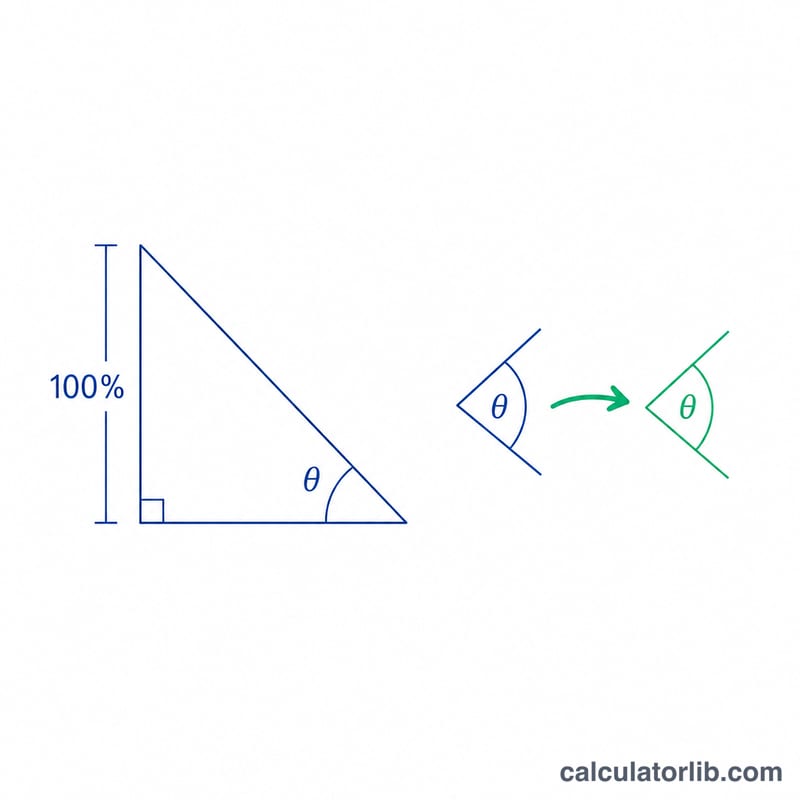
Worked Example
Suppose you have a road with an 8% grade. Divide 8 by 100 to get 0.08. The arctangent of 0.08 is approximately 0.0799 radians. Multiplying by \(180/\pi\) gives about 4.57 degrees. So an 8% grade is a 4.57-degree incline.
$$\theta = \arctan\left(\frac{8}{100}\right) \times \frac{180}{\pi} \approx 4.57^\circ$$FAQ
Why does 100% equal 45 degrees, not 90? Because 100% means rise equals run, and \(\arctan(1) = 45^\circ\). A vertical wall (90°) would be an infinite percentage.
Can I enter a negative slope? Yes. A negative percentage represents a downhill grade and returns a negative angle of the same magnitude.
What's the difference between grade and degrees? Grade is a ratio expressed as a percentage; degrees is an angular measure. They describe the same incline in different units.