What is the Slope Percent to Degrees Calculator?
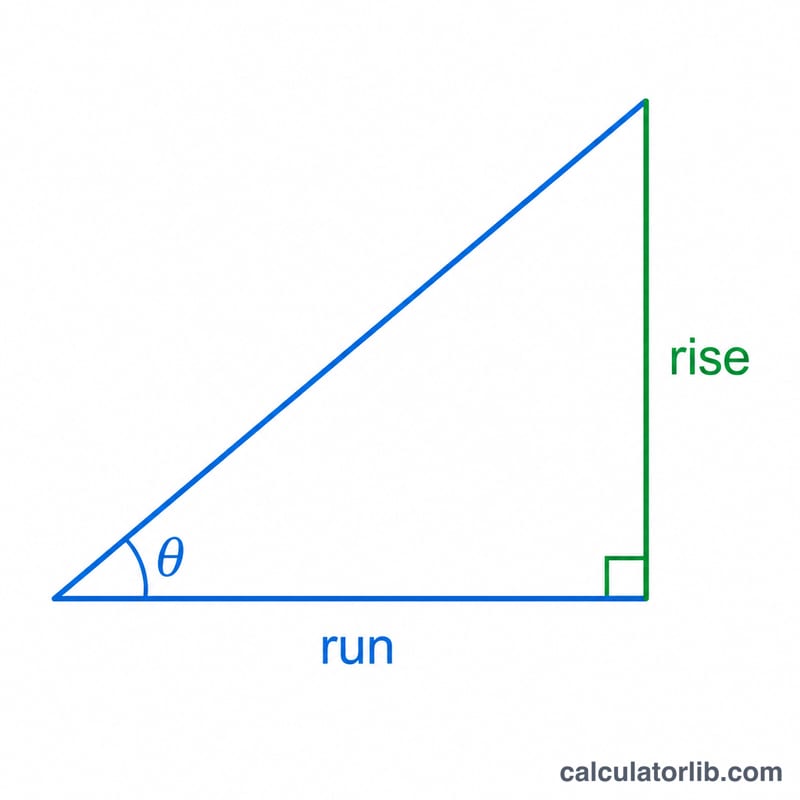
Slope can be expressed in two common ways: as a percentage (grade) or as an angle in degrees. A slope percentage describes the vertical rise divided by the horizontal run, multiplied by 100. For example, a 100% grade means the elevation rises 1 unit for every 1 unit of horizontal distance — which equals a 45° angle. This calculator converts any slope percentage into the equivalent angle in degrees (and radians).
How to use it
Enter the slope percentage (grade) into the input field and submit. The calculator returns the slope angle in degrees as the main result, plus the percentage and the angle in radians for reference. Negative percentages represent downhill slopes and will return a negative angle.
The formula explained
The slope percentage is the tangent of the angle multiplied by 100, so to reverse it we take the inverse tangent (arctangent) of the percentage divided by 100. Since most calculators and people work in degrees rather than radians, the result is multiplied by 180/π to convert from radians to degrees:
$$\theta = \arctan\!\left(\frac{\text{Slope (\%)}}{100}\right) \times \frac{180}{\pi}$$
Worked example
Suppose a road has a 25% grade. Divide 25 by 100 to get 0.25. The arctangent of 0.25 is about 0.2450 radians. Multiply by 180/π (≈57.2958) to get approximately 14.04°. So a 25% grade corresponds to roughly a 14-degree incline.
$$\theta = \arctan\!\left(\frac{25}{100}\right) \times \frac{180}{\pi} = \arctan(0.25) \times 57.2958 \approx 0.2450 \times 57.2958 \approx 14.04°$$
What Common Slope Grades Mean in Practice
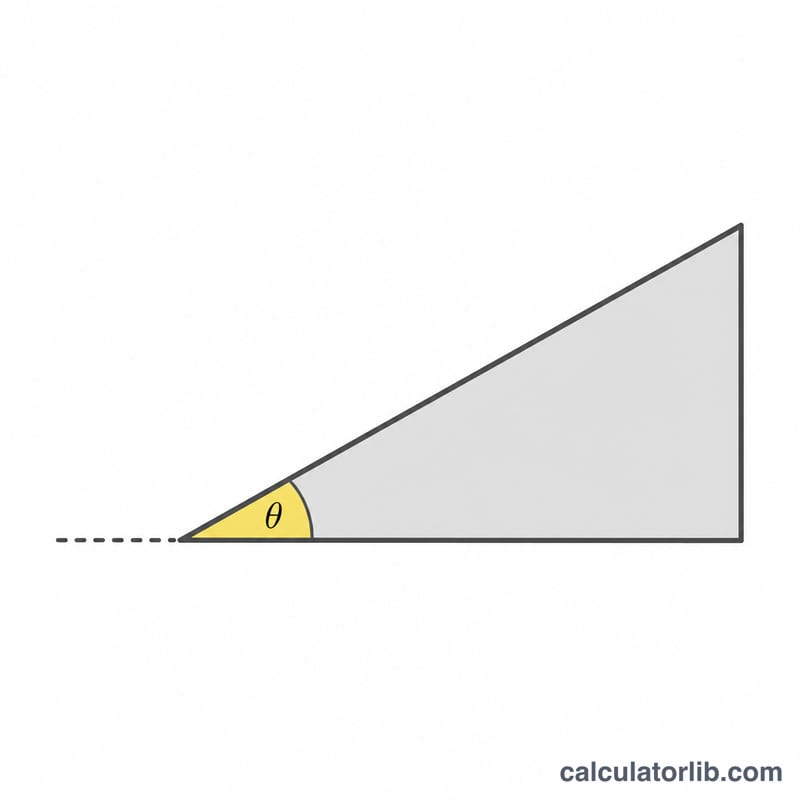
Percent grade is rise divided by run, times 100. Degrees measure the angle from horizontal: \(\theta = \arctan(\text{grade}/100)\). The two scales are not proportional, so it helps to know what a few familiar values look like in both.
| Situation | Grade (%) | Angle (°) |
|---|---|---|
| ADA maximum cross slope (1:48, United States) | ≈2.08% | ≈1.19° |
| 1:20 slope (US ADA: steeper than this counts as a ramp) | 5% | ≈2.86° |
| ADA maximum ramp running slope (1:12, United States) | ≈8.33% | ≈4.76° |
| Moderate hill | 10% | 5.71° |
| Roof pitch 4:12 | ≈33.3% | ≈18.43° |
| Roof pitch 6:12 | 50% | ≈26.57° |
| Roof pitch 12:12 (rise equals run) | 100% | 45° |
Accessibility ramps
The US Americans with Disabilities Act (ADA) Standards set the maximum running slope of an accessible ramp at 1:12. That is 1 unit of rise per 12 units of run, or \(1/12 \approx 8.33\%\), which is \(\arctan(0.0833) \approx 4.76^\circ\). This is a US standard; other countries set their own limits, and many are gentler.
Road grades
In the United States, highway design guidance (such as AASHTO) typically keeps interstate grades to roughly 5–6%, with somewhat steeper grades permitted in mountainous terrain. Local and residential streets can be considerably steeper. Road warning signs for steep descents usually state the grade in percent (for example 6% or 10%), not in degrees. A 6% grade is only about 3.43°, so the angle looks small even though the grade is significant for trucks and brakes. Sign conventions and design limits differ by country.
Roof pitch
Roof pitch is commonly written as rise:12 in North America. A 6:12 roof has a rise of 6 per 12 of run, so \(6/12 = 50\%\) and \(\arctan(0.5) \approx 26.57^\circ\).
Why percent and degrees diverge on steep slopes
For small angles, \(\tan\theta \approx \theta\) when \(\theta\) is in radians. That gives a rule of thumb: degrees ≈ percent × 0.573. It works well at low grades:
- 10%: approximation gives 5.73°, exact value 5.71° (about 0.3% off).
- 20%: approximation gives 11.46°, exact value 11.31° (about 1.3% off).
- 50%: approximation gives 28.65°, exact value 26.57° (about 8% off).
Above roughly 20% the approximation drifts noticeably, so use the arctangent formula. Also note that 100% is 45°, not 90°: percent grade has no upper limit, and a vertical face would be infinite grade.
FAQ
Is a 100% grade the same as vertical? No. A 100% grade is a 45° angle, because rise equals run. A truly vertical wall would be an infinite percentage.
Can the slope percentage exceed 100%? Yes. Any grade steeper than 45° produces a percentage greater than 100% — for instance a 200% grade equals about 63.43°.
How do I convert degrees back to percent? Use \(\text{percent} = \tan(\text{angle in degrees}) \times 100\).