
What Is the Area of a Sector?
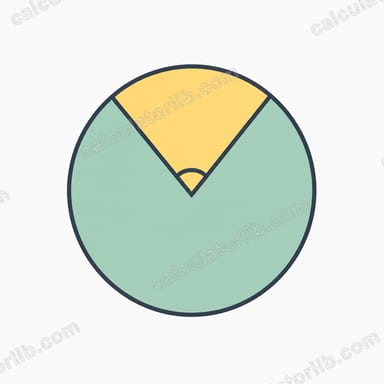
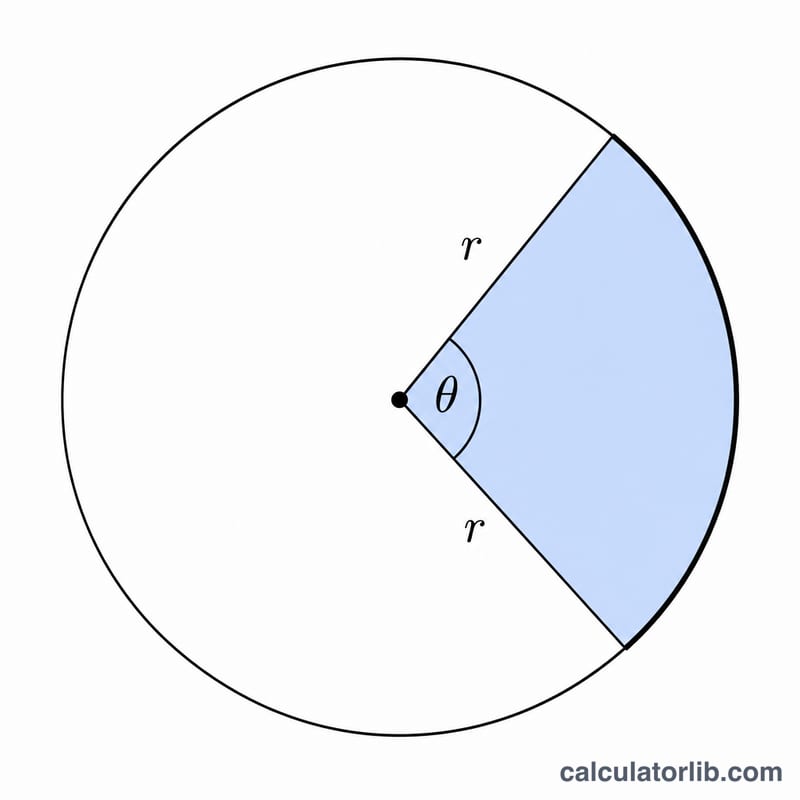
A sector is a "pie slice" of a circle — the region bounded by two radii and the arc between them. Its area is a fraction of the whole circle's area, where the fraction is determined by the central angle. This calculator finds that area instantly from the radius and central angle, accepting the angle in either degrees or radians, and also returns the arc length.
How to Use This Calculator
Enter the radius r of the circle, type the central angle θ, and choose whether that angle is in degrees or radians. Press calculate to see the sector area in square units, plus the arc length and the angle expressed in both units.
The Formula Explained
When the angle is in radians the area is \(A = \tfrac{1}{2} r^{2} \theta\). When the angle is in degrees, the sector is the fraction \(\theta/360\) of the full circle area \(\pi r^{2}\), giving \(A = \tfrac{\theta}{360} \times \pi r^{2}\). The two are equivalent because 360° equals \(2\pi\) radians. The corresponding arc length is \(L = r\theta\) (with \(\theta\) in radians).
$$A = \frac{1}{2}\,\text{Radius}^{2}\cdot\frac{\pi\,\text{Angle (°)}}{180}$$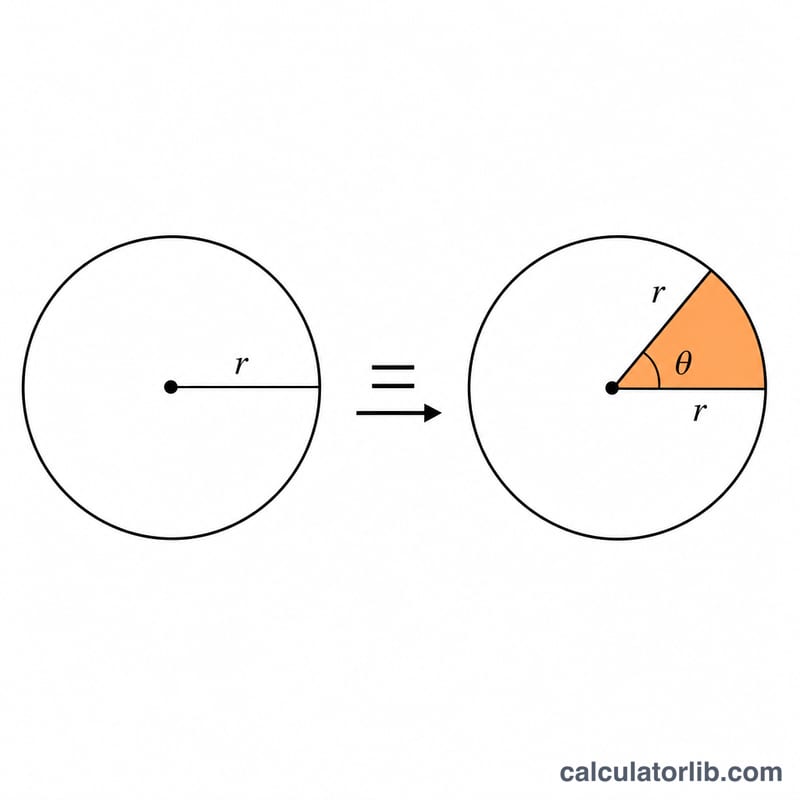
Worked Example
Take a radius of 5 and a 90° central angle. As a fraction of the circle that is \(90/360 = \tfrac{1}{4}\). The full circle area is \(\pi \times 5^{2} = 25\pi \approx 78.54\), so the sector area is \(78.54 / 4 \approx\) 19.635 square units. The arc length is \(5 \times (\pi/2) \approx 7.854\) units.
FAQ
What units does the answer use? The area is in square units of whatever length unit you used for the radius (e.g. cm gives cm²).
Can I enter an angle larger than 360°? Yes, though physically a sector larger than a full circle simply means multiple wraps; the formula still applies mathematically.
How do I convert between degrees and radians? Multiply degrees by \(\pi/180\) to get radians, or multiply radians by \(180/\pi\) to get degrees.