
What Is the Diagonal of a Rectangle?
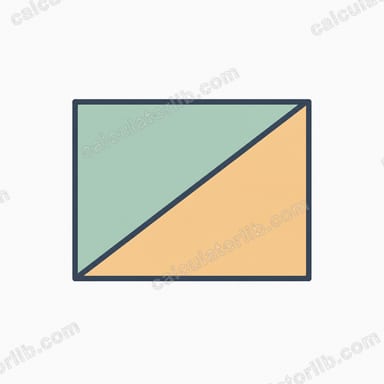
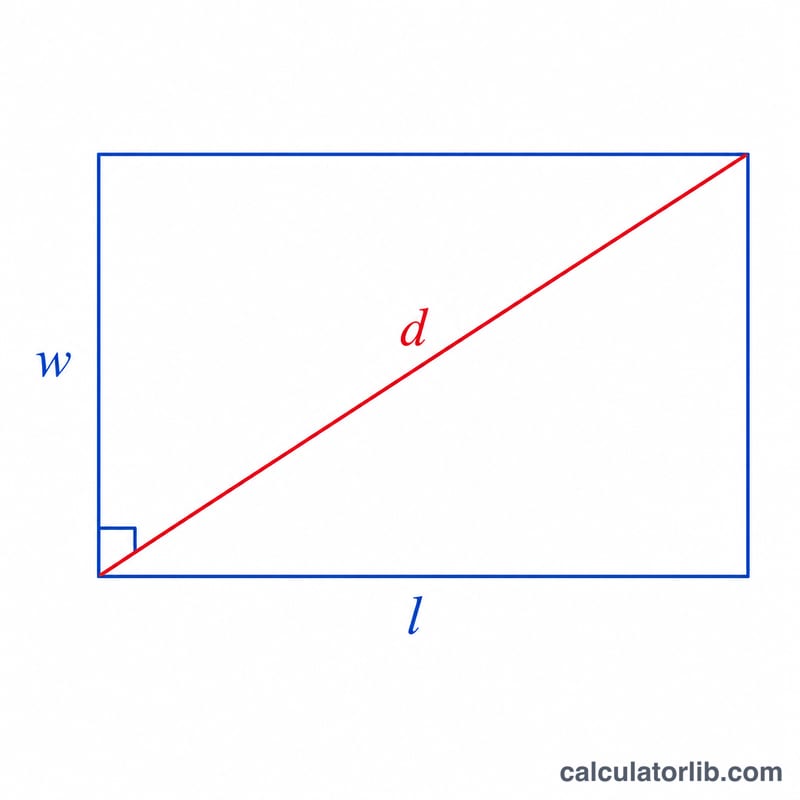
The diagonal of a rectangle is the straight line connecting two opposite corners. Because the length, width, and diagonal form a right triangle, the diagonal is found with the Pythagorean theorem. This calculator instantly computes the diagonal — along with the perimeter and area — from any length and width you enter.
How to Use This Calculator
Enter the rectangle's length (l) and width (w) in the same unit (cm, m, inches, feet — anything works). Click calculate and you'll see the diagonal in those same units, plus the perimeter and area as bonus figures. The result updates for any positive numbers, including decimals.
The Formula Explained
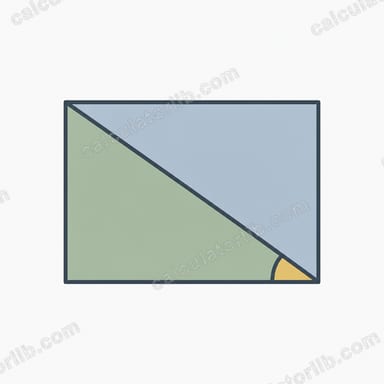
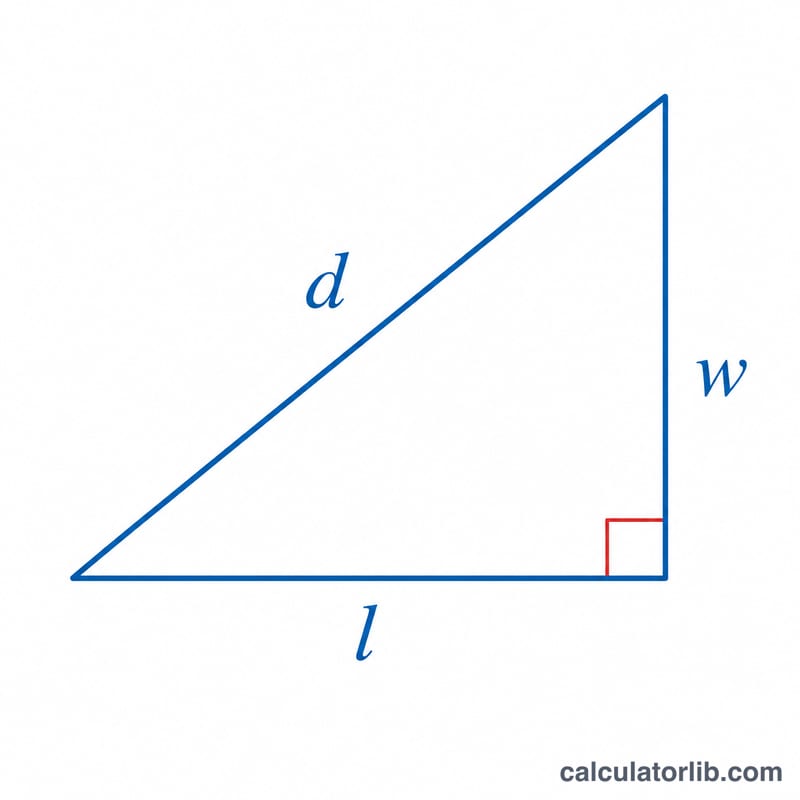
A rectangle's diagonal splits it into two right triangles whose legs are the length and width. By the Pythagorean theorem, the hypotenuse (the diagonal) satisfies:
$$d = \sqrt{l^{2} + w^{2}}$$
So you square each side, add them, and take the square root. The perimeter is \(P = 2(l + w)\) and the area is \(A = l \times w\).
Worked Example
Suppose a rectangle has a length of 3 and a width of 4. Then $$d = \sqrt{3^{2} + 4^{2}} = \sqrt{9 + 16} = \sqrt{25} = 5.$$ This is the classic 3-4-5 right triangle. The perimeter is \(2(3 + 4) = 14\) and the area is \(3 \times 4 = 12\).
FAQ
Are both diagonals of a rectangle equal? Yes — in any rectangle the two diagonals have exactly the same length and bisect each other.
What units does the result use? The diagonal uses the same unit you entered for length and width, so keep them consistent.
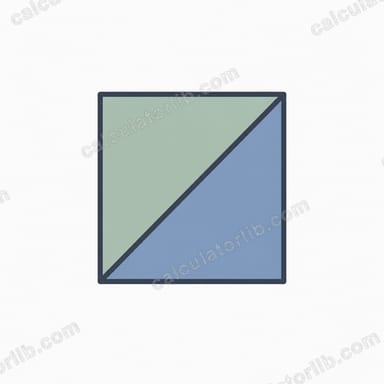
Does this work for a square? Yes. A square is a rectangle with equal sides, so for side s the diagonal is \(s\sqrt{2}\).