
What is a Rowing Split?
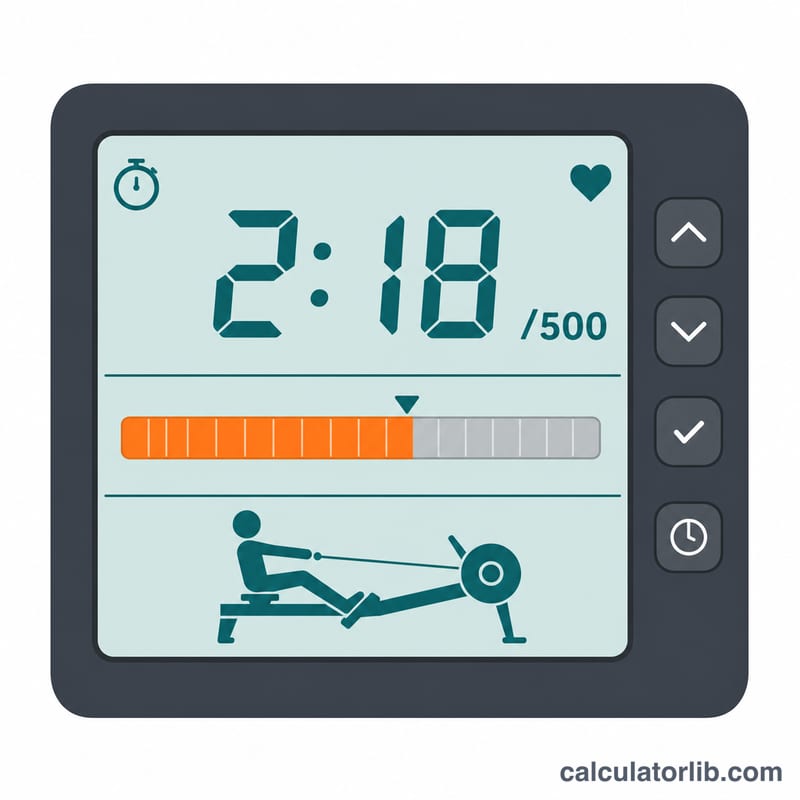
In rowing — both on the water and on the indoor erg (e.g. Concept2) — your split is the time it takes to cover 500 metres at your current pace. It is the standard way rowers measure intensity, because a smaller split means you are moving faster. This calculator converts any distance and finishing time into a clean split per 500m, plus your average speed.
How to Use It
Enter the total distance you rowed in metres, then enter your time as minutes and seconds. The calculator returns your split expressed both as seconds and in the familiar minutes:seconds format that rowing monitors display.
The Formula
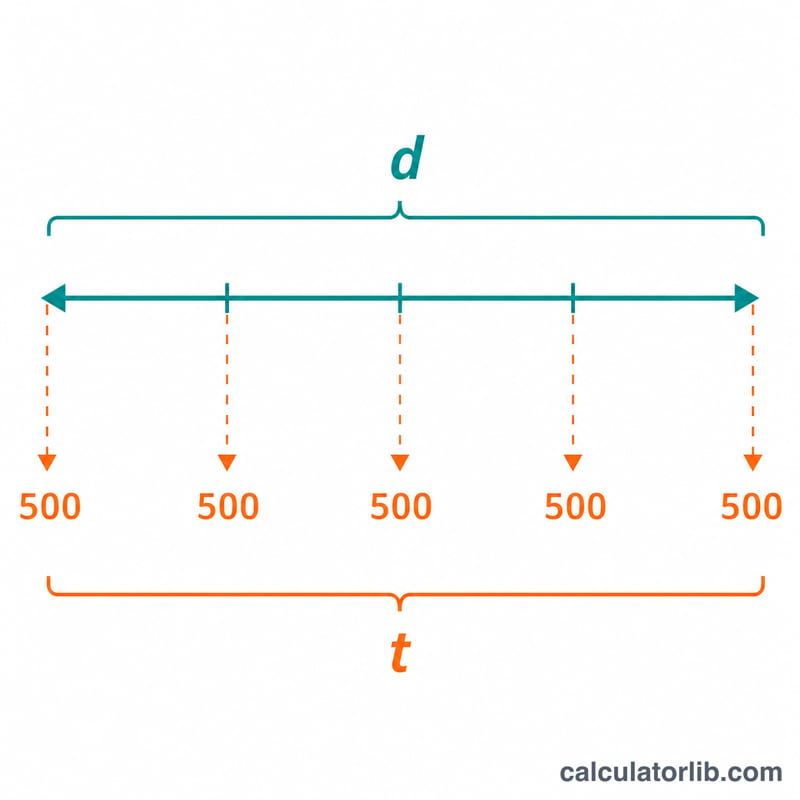
The split is simply the total time divided by the number of 500m segments in the distance:
$$\text{Split}_{500} = \frac{60 \times \text{Minutes} + \text{Seconds}}{\dfrac{\text{Distance (m)}}{500}}$$
Average speed is \(\text{distance} \div \text{time}\) in metres per second.
Worked Example
Suppose you row 2000m in 7 minutes 30 seconds. That is 450 total seconds. The number of 500m segments is \(2000 \div 500 = 4\). So your split is \(450 \div 4 = \textbf{112.5}\) seconds, which displays as 1:52.5 per 500m. Your speed is \(2000 \div 450 \approx 4.444\) m/s.
FAQ
Why 500 metres? 500m is the universal reference distance used by rowing ergometers and coaches, making splits easy to compare across workouts.
How do I lower my split? A lower split means more power per stroke and/or a higher stroke rate. Even a few seconds off your 500m split represents a big improvement over a 2000m race.
Does this work for any distance? Yes — it works for short sprints and long pieces alike, as long as you enter the distance in metres and the full elapsed time.