What This Calculator Does
The Calories Burned Rowing Machine Calculator estimates how much energy you expend during an indoor rowing (ergometer) session. It uses your body weight, how long you rowed, and how hard you worked to produce a calorie figure plus your burn rate per minute and per hour. It is a universal tool — the physiology applies regardless of country or rowing-machine brand.
How to Use It
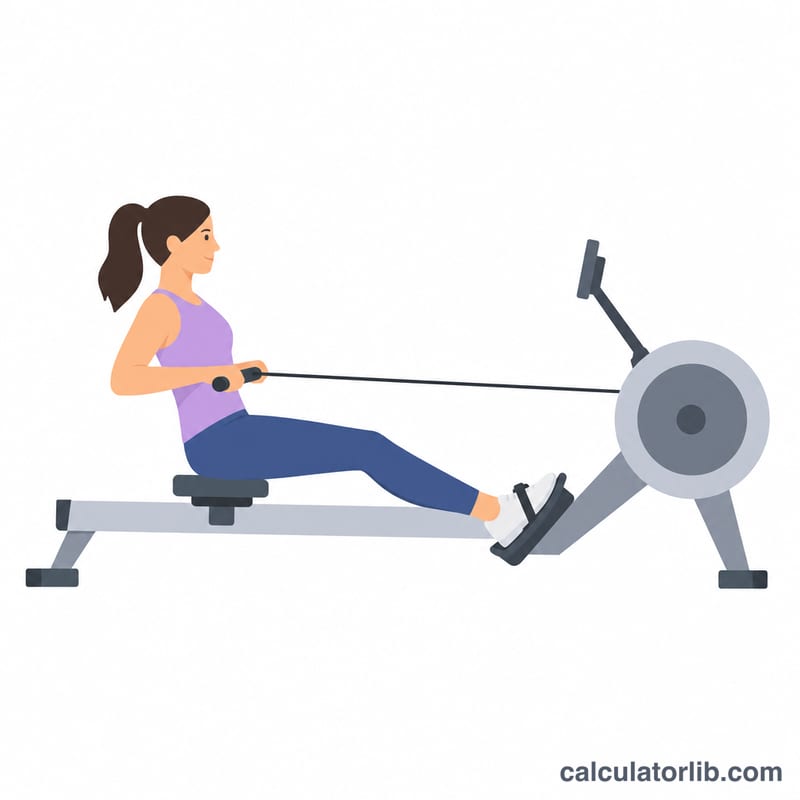
Enter your body weight in kilograms, the number of minutes you rowed, and pick an intensity. Each intensity maps to a MET (Metabolic Equivalent of Task) value: light rowing ≈ 5.0, moderate ≈ 7.5, vigorous ≈ 11.0, and very vigorous ≈ 14.0. Heavier rowers and harder efforts burn more calories per minute, while longer sessions raise the total.
The Formula Explained
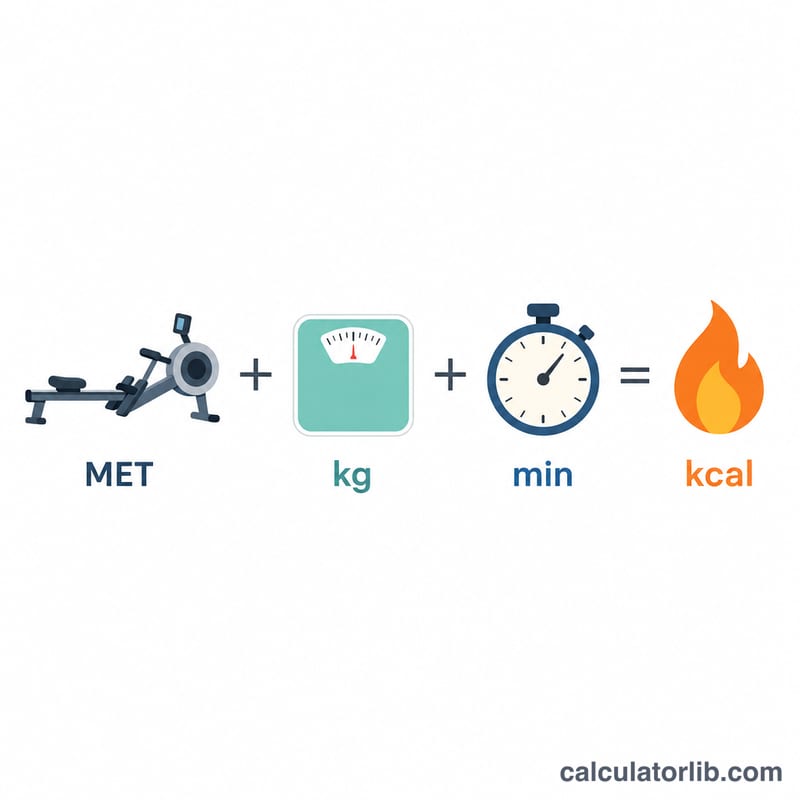
The calculation is based on the standard MET equation: $$\text{kcal} = \frac{\text{MET} \times 3.5 \times \text{kg}}{200} \times \text{minutes}$$. One MET equals an oxygen consumption of 3.5 ml per kg of body weight per minute, and roughly 5 kcal are burned per litre of oxygen consumed. Combining these constants gives the simple formula above, which is widely used in exercise science to approximate energy cost.
Worked Example
Suppose you weigh 80 kg and row for 30 minutes at moderate intensity (MET 7.5). The calculation is $$7.5 \times 3.5 \times 80 \div 200 \times 30 = 315 \text{ kcal}.$$ That works out to about 10.5 kcal per minute, or roughly 630 kcal per hour at that pace.
MET Values for Rowing by Intensity
A MET (metabolic equivalent of task) expresses the oxygen cost of an activity relative to quiet sitting, which is defined as 1 MET ≈ 3.5 mL of oxygen per kilogram of body mass per minute. The calculator uses the four rowing-ergometer intensities below, which come from the 2024 Adult Compendium of Physical Activities (stationary rowing codes 02071–02074).
| Intensity level | Activity description (Compendium wording, abbreviated) | Typical erg effort cue | MET |
|---|---|---|---|
| Light | Rowing, stationary ergometer, light effort | Easy conversational paddling, under 100 W, slower than about 2:30 per 500 m | 5.0 |
| Moderate | Rowing, stationary ergometer, moderate effort | 100–149 W, about 2:30–2:12 per 500 m; breathing noticeably harder but still able to talk | 7.5 |
| Vigorous | Rowing, stationary ergometer, vigorous effort | 150–199 W, about 2:13–2:00 per 500 m; short phrases only | 11.0 |
| Very vigorous | Rowing, stationary ergometer, very vigorous effort | 200 W or more, faster than about 2:00 per 500 m; race-pace or hard interval work | 14.0 |
The pace equivalents are derived from the pace–power relation used by Concept2 ergometers, \(P = 2.80 / t^3\), where \(P\) is watts and \(t\) is the split time in seconds per metre; they are indicative only, because display calibration, drag factor and stroke mechanics all shift the pace that corresponds to a given wattage.
Two limits are worth stating plainly. First, these MET values describe indoor rowing machines, not on-water rowing — the Compendium lists water rowing (sculling, crew, sweep) under separate codes with different values, because boat handling, wind, water drag and stationary recovery phases change the energy cost. Second, the Compendium publishes a single average MET per activity, measured on groups of adults; it does not adjust for your age, sex, body composition, fitness level or rowing technique.
Calories Burned Rowing: Weight and Duration Scenarios
Every figure below uses the same formula as the calculator:
$$\text{kcal} = \frac{\text{MET} \times 3.5 \times \text{weight in kg}}{200} \times \text{minutes}$$Because body mass and duration both enter the formula linearly, calories scale in direct proportion to each: double the time, double the calories; row at 90 kg instead of 60 kg and the same session burns 50% more.
Moderate rowing (7.5 MET) by body mass and session length
| Body mass | kcal per minute | 20 minutes | 30 minutes | 45 minutes |
|---|---|---|---|---|
| 60 kg (132 lb) | 7.88 | 158 | 236 | 354 |
| 75 kg (165 lb) | 9.84 | 197 | 295 | 443 |
| 90 kg (198 lb) | 11.81 | 236 | 354 | 531 |
| 110 kg (243 lb) | 14.44 | 289 | 433 | 650 |
One rower (80 kg) for 30 minutes at each intensity
| Intensity | MET | kcal per minute | 30 minutes |
|---|---|---|---|
| Light | 5.0 | 7.00 | 210 |
| Moderate (100–149 W) | 7.5 | 10.50 | 315 |
| Vigorous (150–199 W) | 11.0 | 15.40 | 462 |
| Very vigorous (200 W or more) | 14.0 | 19.60 | 588 |
Checking one cell by hand, for 80 kg at 11.0 MET for 30 minutes:
$$\frac{11.0 \times 3.5 \times 80}{200} \times 30 = \frac{3080}{200} \times 30 = 15.4 \times 30 = 462 \text{ kcal}$$The intensity block shows why pacing matters more than time alone: moving from light to very vigorous effort raises the burn rate 2.8-fold, so a hard 30-minute piece outpaces an easy 60-minute one. In practice few people hold 200 W for a continuous half hour, so a realistic hard session is better modelled by splitting it — for example 20 minutes at vigorous plus 10 minutes of light warm-up and cool-down — and adding the two results.
What Your Result Means
The number the calculator returns is gross (total) energy expenditure for the time you were rowing. It includes the roughly 1 MET of resting metabolism your body would have spent anyway over those same minutes, simply staying alive. If you want the net cost of the exercise — the extra energy attributable to rowing rather than to sitting — scale the result down:
$$\text{net kcal} \approx \text{gross kcal} \times \frac{\text{MET} - 1}{\text{MET}}$$For an 80 kg rower doing 30 minutes at moderate effort (7.5 MET), the gross figure is 315 kcal, and the net figure is about \(315 \times (7.5 - 1) / 7.5 \approx 273\) kcal. The gap widens at low intensity — at 5.0 MET 20% of the total is resting metabolism — and narrows at 14 MET, where it is only about 7%. Fitness trackers and machine consoles often report gross calories too, so comparing a gross figure against a net one is a common reason two devices seem to disagree.
Putting the number in food and body-mass terms
The widely cited equivalence is that about 7,700 kcal corresponds to 1 kg of body fat (roughly 3,500 kcal per pound). On that basis the 315 kcal session above represents on the order of 0.04 kg — about 315 ÷ 7,700. That figure is a rough energy-content approximation, not a prediction of weight change: real body-mass change depends on total intake, fluid balance, muscle gain and metabolic adaptation over weeks, and a single session's calorie count is easily cancelled by a modest snack. Rowing calories are best read as a measure of training load and consistency rather than as a ledger entry to be eaten back.
How it compares with activity guidance
The World Health Organization recommends that adults do 150–300 minutes of moderate-intensity aerobic activity per week, or 75–150 minutes of vigorous-intensity activity, or an equivalent combination, plus muscle-strengthening work on two or more days. In MET terms, moderate is usually taken as 3–6 MET and vigorous as above 6 MET, so rowing at 100 W and above already counts as vigorous — meaning four 20-minute moderate-to-vigorous erg sessions a week (about 80 minutes) sits inside the vigorous-activity target, and rowing's full-body muscular demand contributes toward the strengthening recommendation as well.
How accurate is it?
Treat the output as an estimate with an uncertainty of roughly ±10–20%, and potentially more at the extremes. The main reasons are that Compendium MET values are group averages rather than individual measurements; that the 3.5 mL/kg/min resting constant overstates resting metabolism for many people, particularly those with higher body fat or larger body mass; that MET values are not adjusted for body composition, age, sex or training status; and that your actual wattage drifts during a session even when you select a single intensity. For a closer figure, use the wattage shown on the ergometer to pick the matching MET row, and split a varied workout into intervals rather than averaging it into one setting.
This section is general physiological information, not medical, dietary or fitness advice, and it contains no personal prescription. If you are managing a medical condition, taking medication that affects heart rate or metabolism, pregnant, or planning a substantial change in training or energy intake, speak with a qualified physician or registered dietitian about your own situation.
FAQ
Is the result exact? No. MET-based estimates are approximations; actual burn depends on fitness, technique, age and metabolism, and can vary by 10–20%.
How do I convert pounds to kilograms? Divide your weight in pounds by 2.205. For example, \(176 \div 2.205 \approx 80\) kg.
Why does a rowing machine show different numbers? Most ergometers estimate calories without knowing your weight, so they often assume a standard person and may differ from this weight-adjusted estimate.