
What Is the Calories Burned Hiking Calculator?
This tool estimates how many calories you burn on a hike using the internationally recognized MET (Metabolic Equivalent of Task) method. One MET equals the energy you use sitting quietly. Hiking ranges from about 5.3 METs on easy flat trails to 9.0 METs on steep climbs with a heavy pack. By combining the MET value with your body weight and how long you hike, you get a reliable calorie estimate that works in any country — it relies only on physics and physiology, not regional rules.
How to Use It
Enter your body weight in kilograms, the duration of your hike in minutes, and select the terrain or intensity that best matches your outing. The calculator returns the total calories burned, plus a breakdown showing calories per minute and per hour so you can compare efforts or plan fueling and hydration.
The Formula Explained
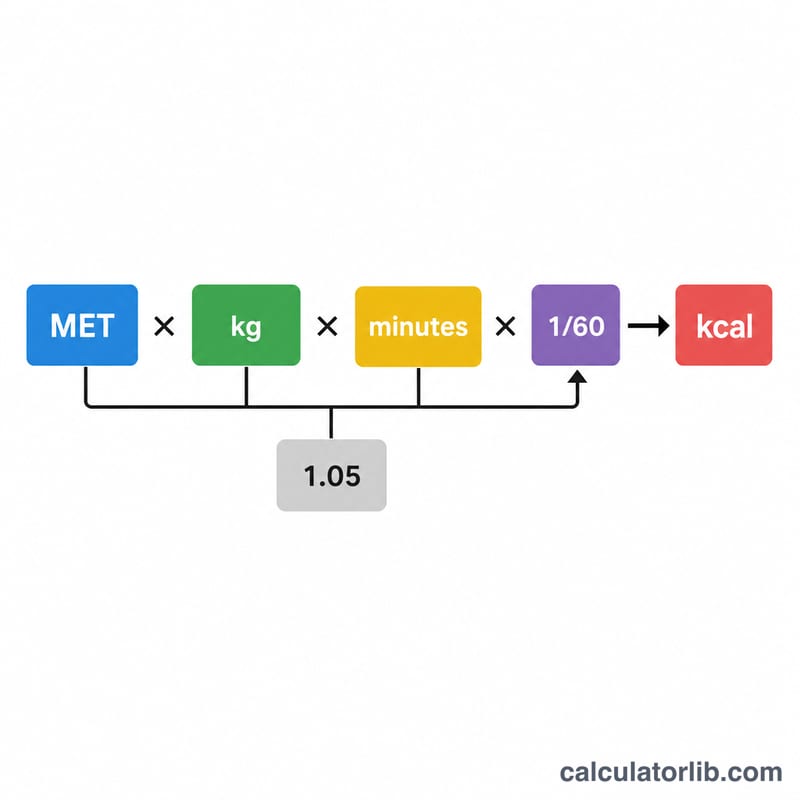
The standard equation is $$\text{kcal} = \frac{\text{MET} \times 3.5 \times \text{kg}}{200} \times \text{minutes}$$. The constant \(3.5\) ml O₂/kg/min is resting oxygen consumption (1 MET), and dividing by \(200\) converts oxygen use into kilocalories (roughly 5 kcal per liter of oxygen). Multiply by your weight and the time spent hiking to get total energy expenditure.
Worked Example
Suppose you weigh 70 kg and hike for 120 minutes on general terrain (MET 6.0). The math: $$\frac{6.0 \times 3.5 \times 70}{200} = 7.35 \text{ kcal per minute}.$$ Over 120 minutes that's \(7.35 \times 120 \approx\) 882 kcal, or about 441 kcal per hour.
FAQ
How accurate is this estimate? MET values are population averages, so individual results vary with fitness, gait, and gear. Treat the number as a solid ballpark, typically within 10–15% of measured values.
Does carrying a backpack matter? Yes. A loaded pack raises the MET value significantly — select the backpack or heavy-pack options for a more realistic figure.
Should I use pounds? The formula needs kilograms. To convert, divide your weight in pounds by 2.205 (e.g., \(154 \text{ lb} \div 2.205 \approx 70 \text{ kg}\)).