
What this calculator does
This Calories Burned Walking Calculator estimates how many calories (kilocalories) you burn on a walk based on your body weight, how fast you walk, and how long you walk for. It also estimates the distance you cover and an approximate step count, making it useful whether you track workouts by time, distance, or steps.
How to use it
Enter your body weight in kilograms, choose your typical walking speed from the dropdown, and enter the duration of your walk in minutes. The calculator selects the appropriate MET (Metabolic Equivalent of Task) value for that walking pace and returns total calories, calories per minute, distance, and steps.
The formula explained
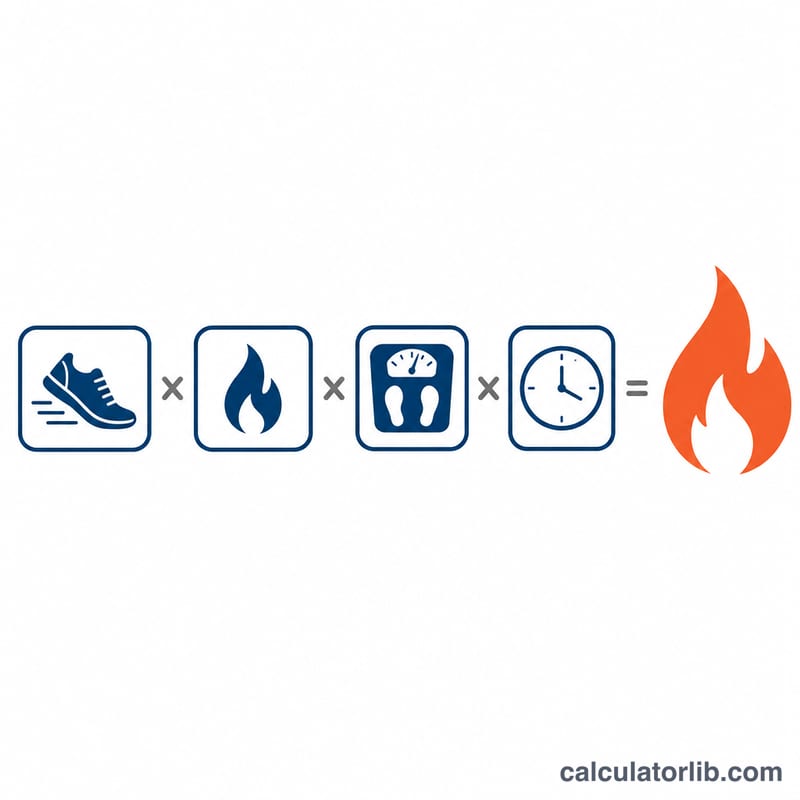
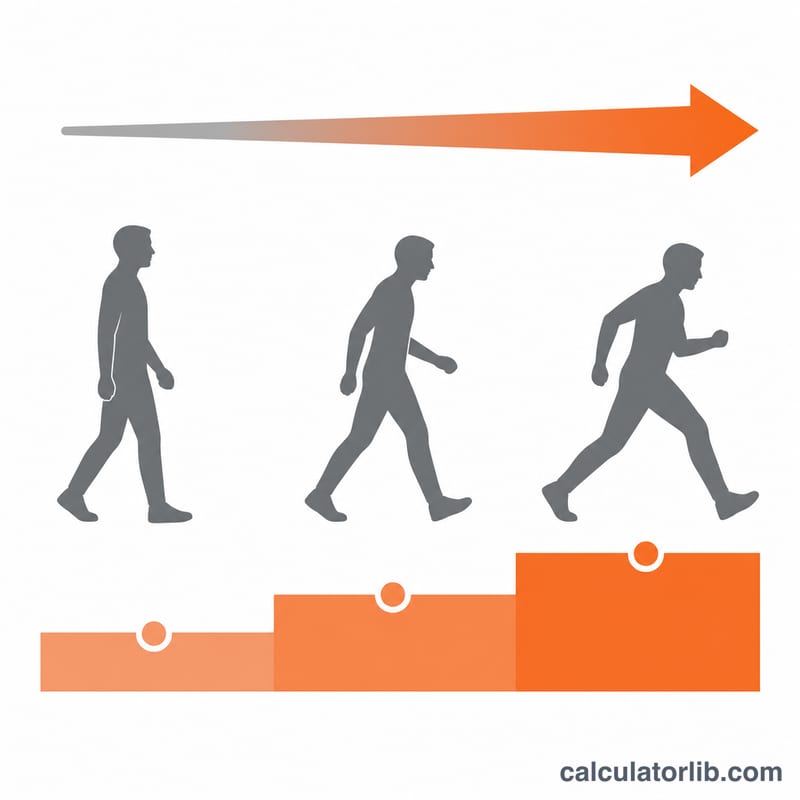
The calculation uses the standard MET energy equation: kcal = MET × 3.5 × weight(kg) ÷ 200 × minutes. One MET equals resting oxygen consumption of about 3.5 ml of oxygen per kilogram per minute. Walking MET values rise with speed — roughly 2.8 for a slow stroll, 3.5 at an average pace, and up to about 8.3 for a fast power walk. Dividing by 200 converts oxygen use into kilocalories per minute.
Worked example
A 70 kg person walks at an average 4.8 km/h (3.0 mph, MET 3.5) for 30 minutes. Calories = 3.5 × 3.5 × 70 ÷ 200 × 30 = 128.625 kcal. At that pace they cover about 2.4 km in around 3,360 steps.
Walking MET Values by Speed
The Metabolic Equivalent of Task (MET) measures how much energy an activity uses relative to sitting quietly (1 MET \(\approx\) 3.5 mL O\(_2\)/kg/min). The values below come from the Compendium of Physical Activities for walking on level firm ground. The faster you walk, the higher the MET and the more calories you burn per minute.
| Walking pace | Speed (km/h) | Speed (mph) | MET |
|---|---|---|---|
| Very slow stroll | 3.2 | 2.0 | 2.8 |
| Slow / leisurely | 4.0 | 2.5 | 3.0 |
| Moderate | 4.8 | 3.0 | 3.5 |
| Brisk | 5.6 | 3.5 | 4.3 |
| Fast | 6.4 | 4.0 | 5.0 |
| Power / very brisk | 7.2 | 4.5 | 8.3 |
The calorie formula uses these METs directly: $$\text{Calories} = \frac{\text{MET} \times 3.5 \times \text{Weight (kg)}}{200} \times \text{Duration (min)}$$
FAQ
Are these numbers exact? No — MET-based estimates are population averages. Actual burn varies with fitness, terrain, incline, and gait, but the result is a solid planning figure.
Does walking faster burn more? Yes. A higher speed has a higher MET value and covers more distance, so total calories rise for the same duration.
How are steps estimated? Steps are approximated from distance using a typical stride that shortens slightly at faster speeds; a fitness tracker will be more personalised.