What this calculator does
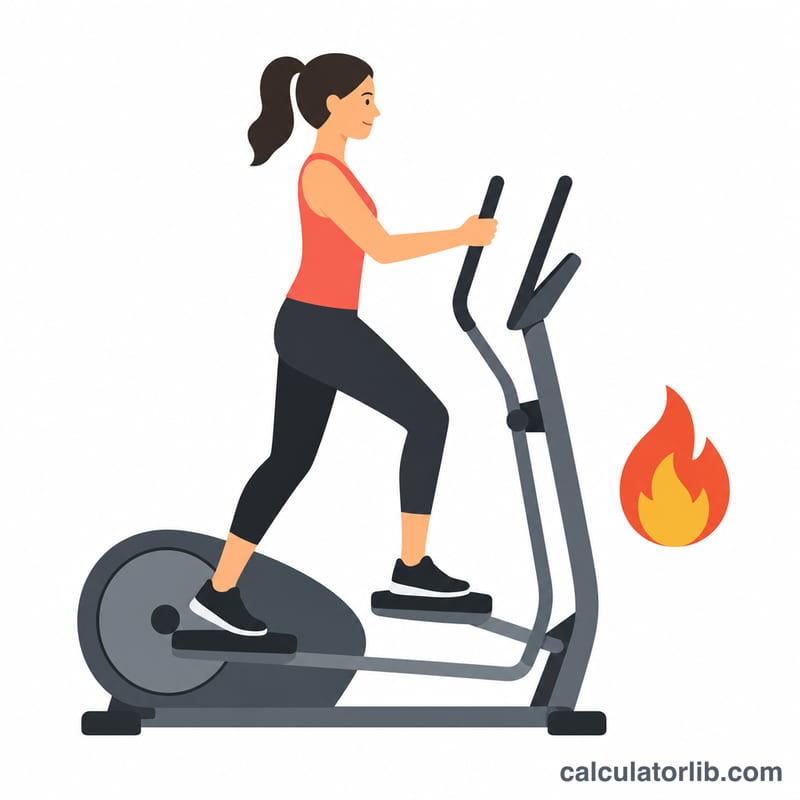
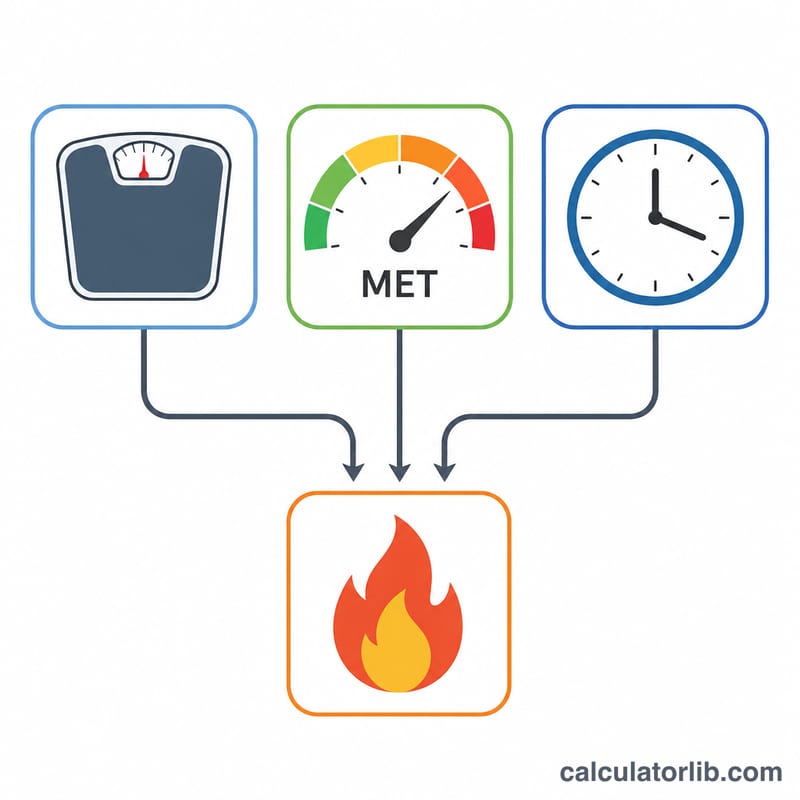
The Calories Burned on Elliptical Calculator estimates how much energy you use during a cross-trainer (elliptical) session. It uses your body weight, how long you exercised, and the workout intensity expressed as a MET value (Metabolic Equivalent of Task). Elliptical training typically falls around 5 METs for general use, rising to about 9 METs at high resistance and effort.
How to use it
Enter your body weight in kilograms, the number of minutes you spent on the elliptical, and choose an intensity that matches how hard the session felt. Press calculate to see total calories burned, plus your burn rate per minute and an equivalent per-hour figure at the same pace.
The formula explained
The estimate uses the standard MET equation: $$\text{kcal} = \frac{\text{MET} \times 3.5 \times \text{kg}}{200} \times \text{minutes}$$. One MET equals an oxygen uptake of roughly 3.5 ml per kilogram per minute. Multiplying by your weight and time and dividing by 200 converts oxygen consumption into kilocalories. A higher MET reflects harder effort, so increasing resistance or stride speed raises the result.
Worked example
A 70 kg person does 30 minutes of moderate elliptical work at 5 METs: $$5 \times 3.5 \times 70 \div 200 \times 30 = 183.75 \text{ kcal}$$ That is about 6.1 kcal per minute, or roughly 368 kcal per hour at the same intensity.
Elliptical MET Values by Intensity
A MET (metabolic equivalent of task) expresses exercise intensity as a multiple of resting energy use. The values below follow the elliptical-trainer entries in the Compendium of Physical Activities, which is the standard reference for MET values. They are rounded and approximate, and the exact figure varies a little between Compendium editions. They are averages for groups of people, not measurements of you.
| Intensity | MET | Perceived effort (RPE 6–20 Borg scale / 0–10 scale) | Talk test |
|---|---|---|---|
| Moderate effort | 5 | Somewhat hard (about 12–13 Borg, 4–5 of 10) | You can talk in full sentences, but breathing is noticeably heavier |
| Vigorous effort | 9 | Hard (about 14–16 Borg, 6–7 of 10) | You can speak only a few words at a time |
Choose the level that best matches how the whole session felt, not only your hardest minutes. If you alternated between efforts, pick the level closest to your average.
Calories Burned by Weight and Duration
Each value uses \(\text{kcal} = \text{MET} \times 3.5 \times \text{kg} / 200 \times \text{minutes}\). For example, 70 kg at 5 METs for 30 minutes: \(5 \times 3.5 \times 70 / 200 = 6.125\) kcal per minute, and \(6.125 \times 30 = \)183.75 kcal.
| Weight | MET | 20 min (kcal) | 30 min (kcal) | 45 min (kcal) |
|---|---|---|---|---|
| 60 kg | 5 | 105.0 | 157.5 | 236.25 |
| 60 kg | 9 | 189.0 | 283.5 | 425.25 |
| 70 kg | 5 | 122.5 | 183.75 | 275.6 |
| 70 kg | 9 | 220.5 | 330.75 | 496.1 |
| 80 kg | 5 | 140.0 | 210.0 | 315.0 |
| 80 kg | 9 | 252.0 | 378.0 | 567.0 |
| 90 kg | 5 | 157.5 | 236.25 | 354.4 |
| 90 kg | 9 | 283.5 | 425.25 | 637.9 |
Values are gross energy expenditure, including the resting energy you would burn anyway, and are estimates. Individual results vary with fitness, body composition and machine calibration.
Pounds to Kilograms Conversion
The calculator takes weight in kilograms. To convert pounds to kilograms, multiply by 0.45359 (equivalently, divide by 2.2046): \(\text{kg} = \text{lb} \times 0.45359\).
| Pounds (lb) | Kilograms (kg) |
|---|---|
| 120 | 54.4 |
| 130 | 59.0 |
| 150 | 68.0 |
| 160 | 72.6 |
| 170 | 77.1 |
| 180 | 81.6 |
| 190 | 86.2 |
| 200 | 90.7 |
| 220 | 99.8 |
| 250 | 113.4 |
Energy units: 1 kcal (the "Calorie" on food labels and machine displays) = 4.184 kJ. So 183.75 kcal is about 769 kJ.
FAQ
How accurate is this? MET-based estimates are good population averages but ignore fitness level, machine calibration, and individual metabolism, so treat the number as a guide.
What MET should I pick? Use 5 for a comfortable steady session and 9 for an intense interval-style workout on high resistance.
Does the elliptical's calorie readout differ? Often yes—machine displays may run high. This calculator gives a consistent, transparent estimate you can compare across workouts.