
What Is Yards Per Attempt?
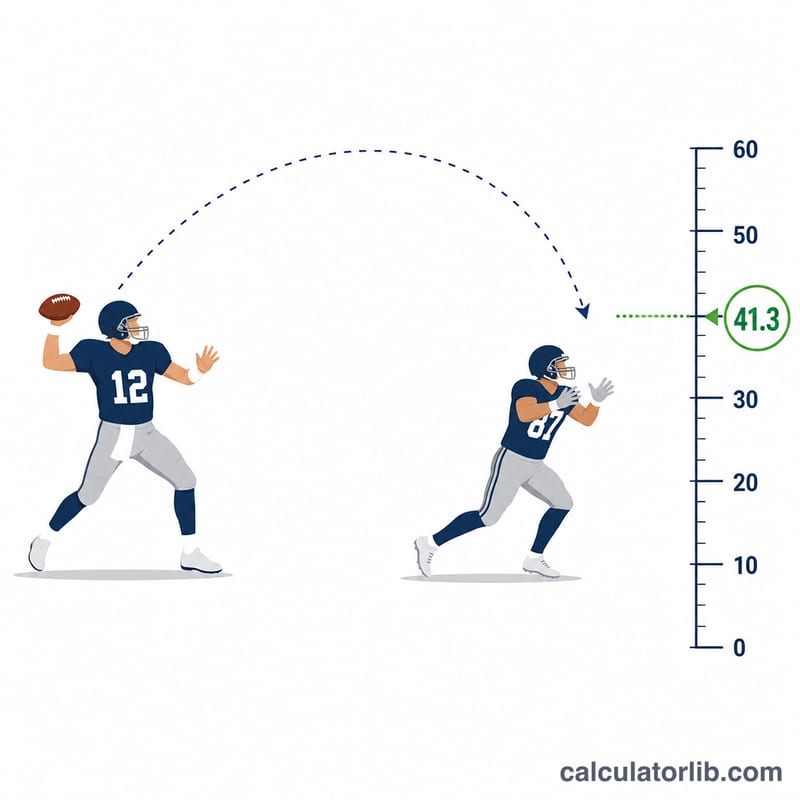
Yards per attempt (often abbreviated Y/A or YPA) is one of the most telling efficiency statistics in American football. It measures the average number of passing yards a quarterback gains for every pass he throws — completions and incompletions alike. Unlike yards per completion, Y/A "punishes" incomplete passes because every attempt counts in the denominator, making it a strong indicator of overall passing efficiency.
How to Use This Calculator
Enter the quarterback's total passing yards and the total number of pass attempts (including incompletions, but not sacks under the standard NFL definition). Click calculate and the tool divides yards by attempts to give the Y/A figure. You can use it for a single game, a season, or a career — just supply the matching totals.
The Formula Explained
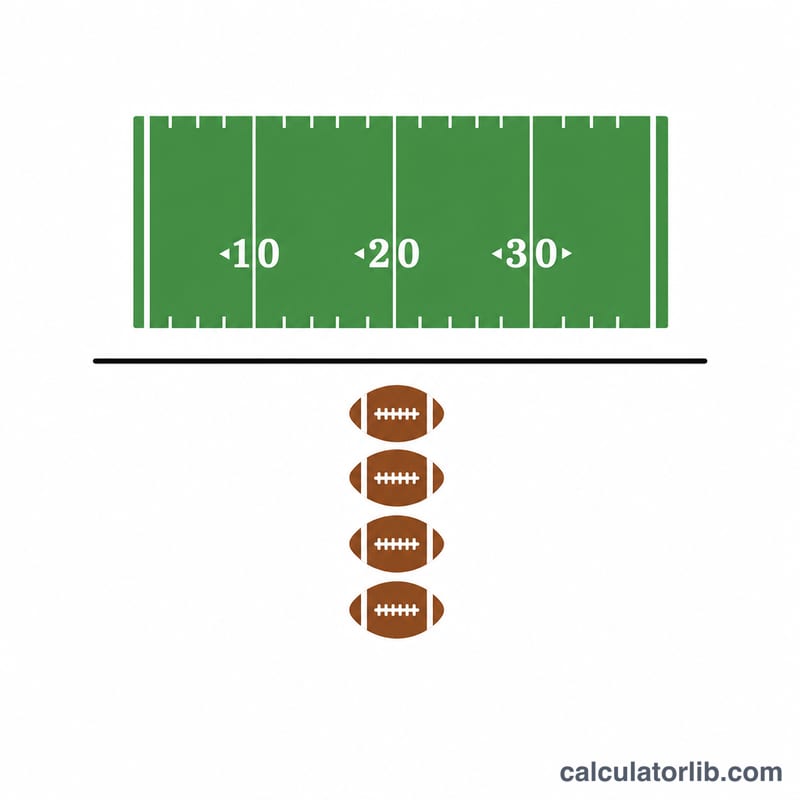
The calculation is simple division: $$\text{Y/A} = \frac{\text{Passing Yards}}{\text{Pass Attempts}}$$ For example, a quarterback with 3,500 passing yards on 500 attempts has a Y/A of \(3{,}500 \div 500 = 7.0\) yards per attempt. As a rule of thumb in modern football, a Y/A around 7.0 is solid, above 8.0 is excellent, and below 6.0 suggests a struggling passing game.
Worked Example
Suppose a QB throws for 320 yards on 40 attempts in a game. \(\text{Y/A} = 320 \div 40 = 8.0\) yards per attempt — an efficient, big-play performance. Compare that to 320 yards on 55 attempts: \(\text{Y/A} = 5.82\), showing the same yardage was far less efficient because it took more throws.
FAQ
Does Y/A include sacks? No. The standard yards-per-attempt stat uses only pass attempts and does not subtract sack yardage. The variant that includes sacks is called "adjusted net yards per attempt."
What is a good Y/A? Roughly 7.0 is league-average for a starter; elite seasons often exceed 8.0 yards per attempt.
Can I use it for a whole season? Yes — enter season totals for passing yards and attempts and the result is the season Y/A.