
What this calculator does
This tool estimates how many calories (kcal) you burn while ice skating. It uses the standard MET (metabolic equivalent) formula, where MET values are taken from the revised Physical Activity METs Table published by the National Institute of Health and Nutrition (Japan), itself derived from the international Compendium of Physical Activities. Because the MET method is universal, this calculator works for anyone, anywhere.
How to use it
Pick the skating activity that best matches what you do, from leisurely general skating (7.0 METs) up to competitive speed skating (13.3 METs) or ice dancing (14.0 METs). Enter your session length in minutes and your body weight in kilograms, then read off your estimated calories burned. A higher MET means a more intense activity that burns more energy per minute.
The formula explained
One MET is the energy your body uses at rest. The relationship used here is: $$\text{Calories} = \text{MET} \times \text{Weight (kg)} \times \frac{\text{Duration (min)}}{60} \times 1.05$$ where 1.05 kcal per kilogram of body weight per hour approximates resting energy expenditure. Since you enter time in minutes, the tool first converts it to hours by dividing by 60.
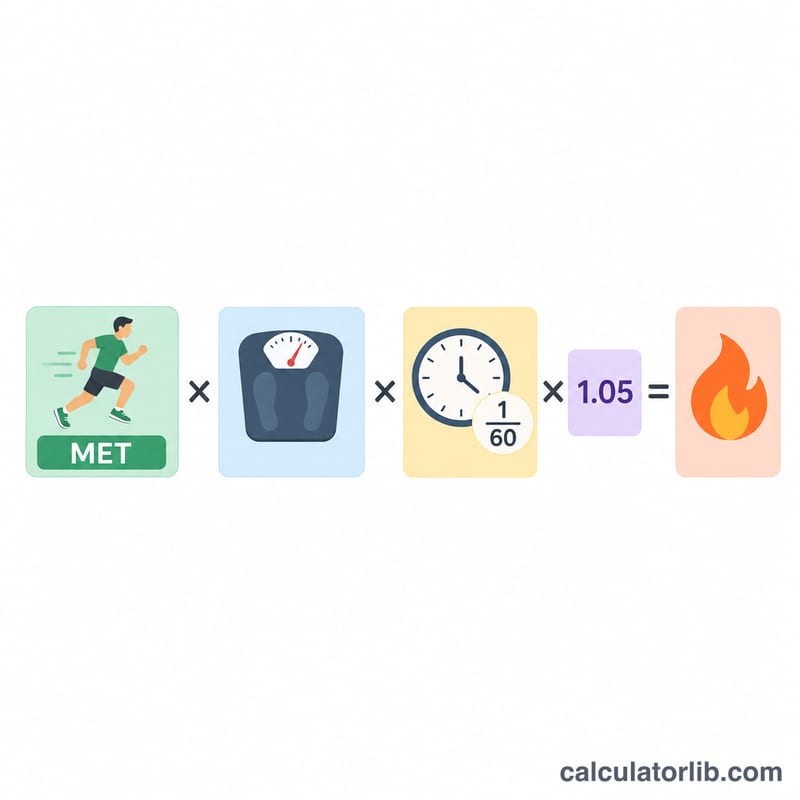
Worked example
Suppose you do general ice skating (MET = 7.0) for 60 minutes and weigh 60 kg. Hours = 60 / 60 = 1.0. $$\text{Calories} = 7.0 \times 60 \times 1.0 \times 1.05 = 441 \text{ kcal}$$ For 30 minutes of competitive speed skating (MET = 13.3) at 70 kg: $$13.3 \times 70 \times 0.5 \times 1.05 = about 488.8 \text{ kcal}$$
FAQ
How accurate is the result? It is an estimate. Actual expenditure varies with metabolism, skating technique, ice conditions and effort, so treat the number as a guide rather than an exact measurement.
Why multiply by 1.05? The factor 1.05 represents kcal burned per MET per kilogram per hour. Some references round this to 1.0; this calculator uses the more precise 1.05.
What is a MET? A MET tells you how many times more energy an activity uses compared to sitting quietly. Skating at 7 METs uses roughly seven times your resting energy.