
What Is Carnot Efficiency?
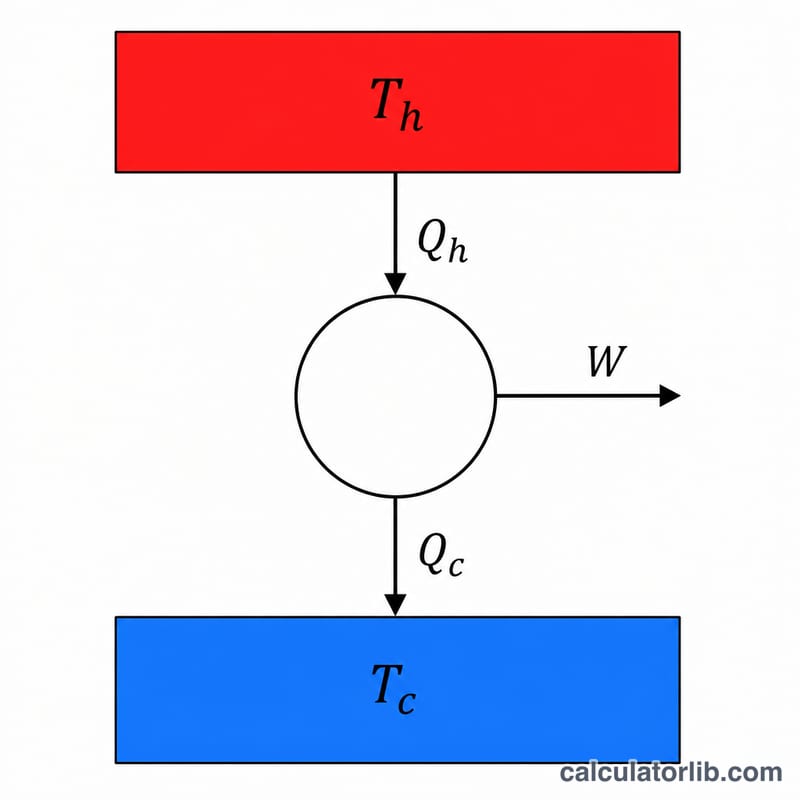
The Carnot efficiency is the maximum possible thermal efficiency that any heat engine can achieve while operating between two thermal reservoirs. Named after the French physicist Sadi Carnot, it represents an ideal, reversible limit set by the second law of thermodynamics. No real engine — steam turbine, internal combustion engine, or refrigeration cycle run in reverse — can exceed this bound. This calculator works universally; it uses pure physics and only requires temperatures expressed in Kelvin.
How to Use the Calculator
Enter the cold reservoir temperature (Tc) and the hot reservoir temperature (Th), both in Kelvin. The hot reservoir must be hotter than the cold one for a meaningful positive efficiency. To convert from Celsius, add 273.15 (e.g. 25 °C = 298.15 K). The calculator returns the efficiency both as a decimal fraction and as a percentage.
The Formula Explained
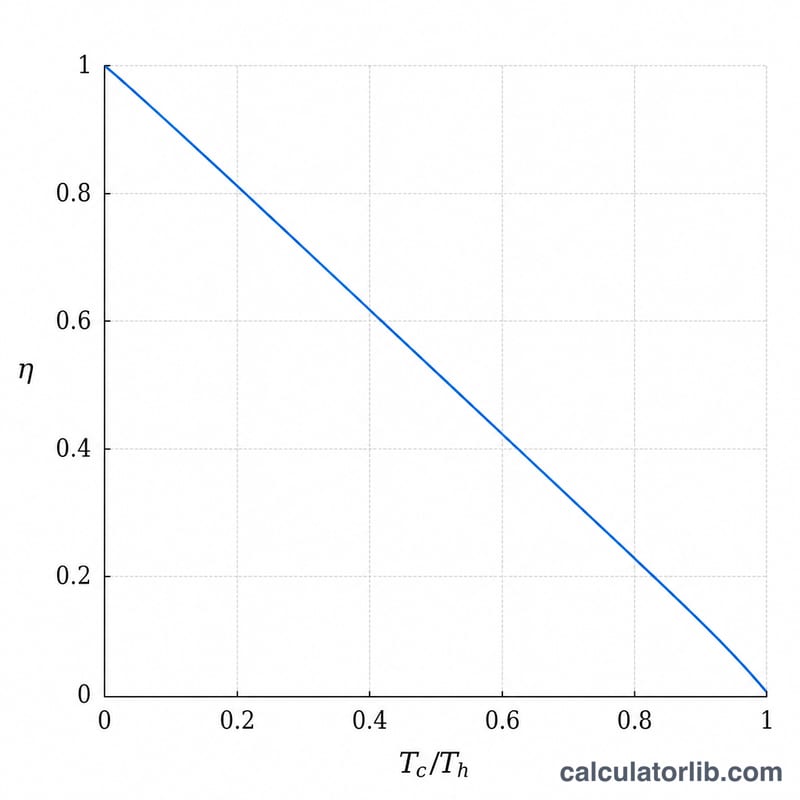
The governing equation is $$\eta = 1 - \frac{T_c}{T_h}$$. Because efficiency rises as the temperature ratio \(T_c/T_h\) shrinks, you maximize efficiency by making the hot reservoir as hot as possible and the cold reservoir as cold as possible. Efficiency reaches 100% only in the impossible limit where \(T_c = 0\) K (absolute zero), confirming that a perfect engine cannot exist.
Worked Example
Suppose an engine runs between a hot reservoir at \(T_h = 500\) K and a cold reservoir at \(T_c = 300\) K. Then $$\eta = 1 - \frac{300}{500} = 1 - 0.6 = 0.4,$$ or 40%. This means at best 40% of the heat absorbed can be converted to work; the remaining 60% must be rejected to the cold reservoir.
FAQ
Why must I use Kelvin? The formula relies on absolute temperature. Using Celsius or Fahrenheit gives physically meaningless results, because ratios of those scales are not proportional to thermal energy.
Can a real engine reach Carnot efficiency? No. Friction, finite heat transfer rates, and irreversibilities mean real engines fall well below the Carnot limit, but it remains a useful benchmark.
What if Tc is greater than Th? The efficiency would be negative, which is unphysical for a heat engine — double-check which reservoir is hotter.