
What Is Charles' Law?
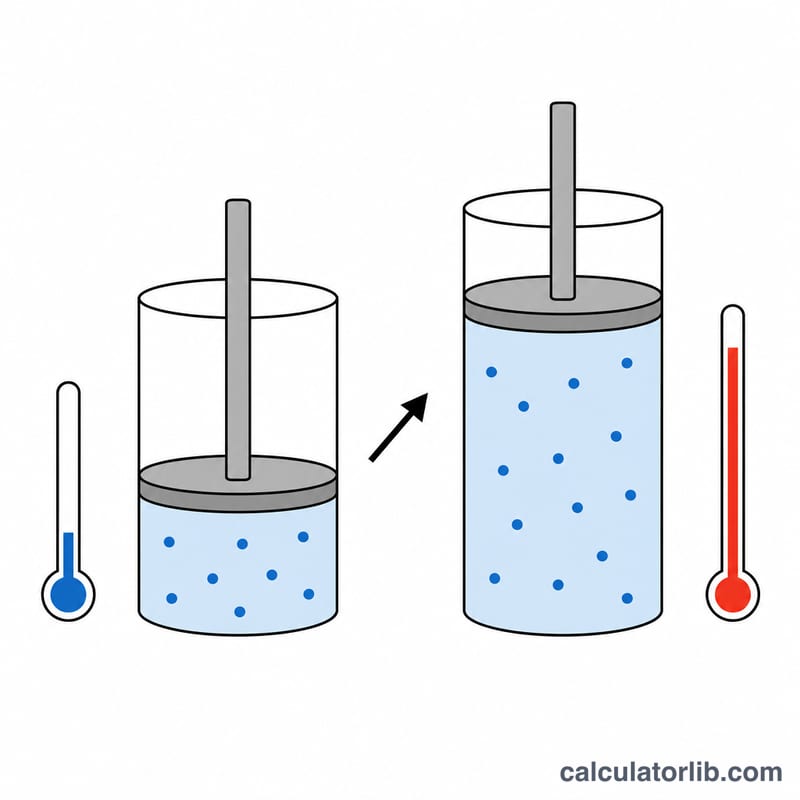
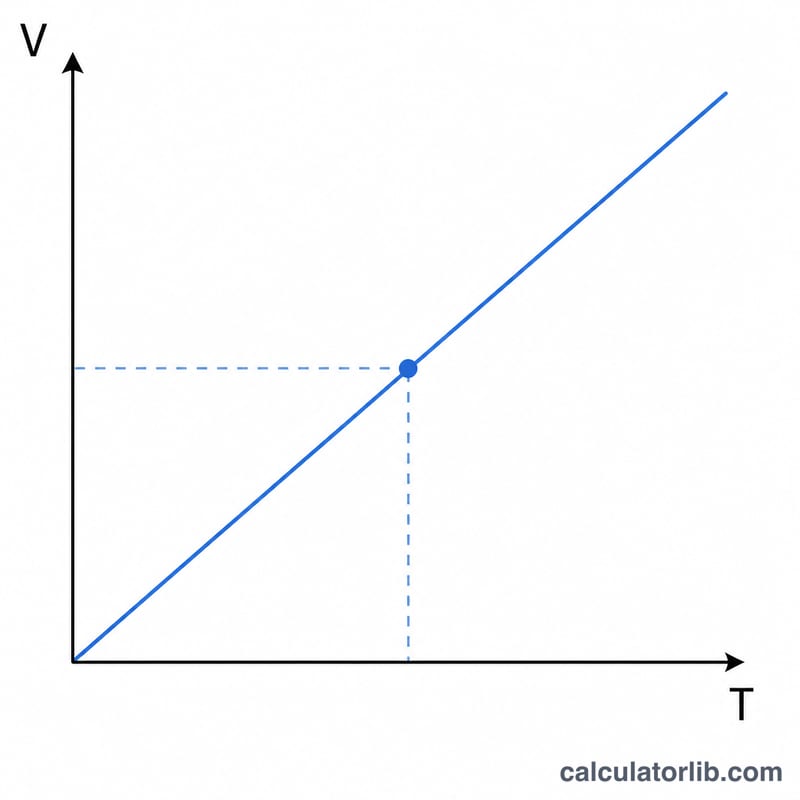
Charles' Law is one of the fundamental gas laws in chemistry and physics. It states that, at constant pressure, the volume of a fixed amount of an ideal gas is directly proportional to its absolute temperature. In other words, heat a gas and it expands; cool it and it contracts. This relationship is written as \( V_1/T_1 = V_2/T_2 \), where temperatures must always be expressed in Kelvin (K).
How to Use This Calculator
Enter the initial volume (V₁), the initial temperature (T₁), and the final temperature (T₂). Make sure both temperatures are in Kelvin — to convert from Celsius, add 273.15. The calculator solves for the final volume (V₂) and shows your inputs for reference.
The Formula Explained
Starting from \( V_1/T_1 = V_2/T_2 \), we rearrange to isolate the unknown:
$$V_2 = \frac{\text{V}_1\text{ (L)} \times \text{T}_2\text{ (K)}}{\text{T}_1\text{ (K)}}$$Because temperature appears as a ratio, you must use an absolute scale (Kelvin). Using Celsius would give nonsensical or negative results, since 0 °C is not zero thermal energy.
Worked Example
Suppose a balloon holds 2 L of gas at 300 K and is warmed to 450 K at constant pressure. Then
$$V_2 = 2 \times \frac{450}{300} = 2 \times 1.5 = 3 \text{ L}$$The gas expands by 50%, exactly matching the 50% rise in absolute temperature.
FAQ
Why must temperature be in Kelvin? Charles' Law is a direct proportionality with absolute temperature. Only the Kelvin scale starts at absolute zero, so ratios are physically meaningful.
What stays constant? Pressure and the amount of gas (moles) are held constant; only volume and temperature change.
Can I solve for T₂ instead? Yes, algebraically \( T_2 = T_1 \times (V_2 / V_1) \), but this tool solves for V₂. Convert your known values accordingly.