
What Is the Efficiency Calculator?
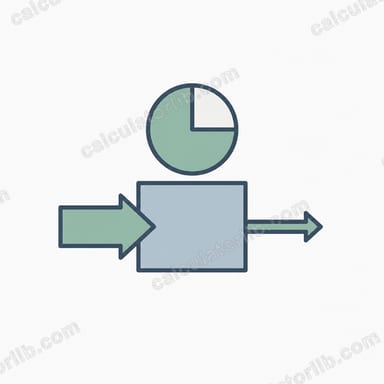
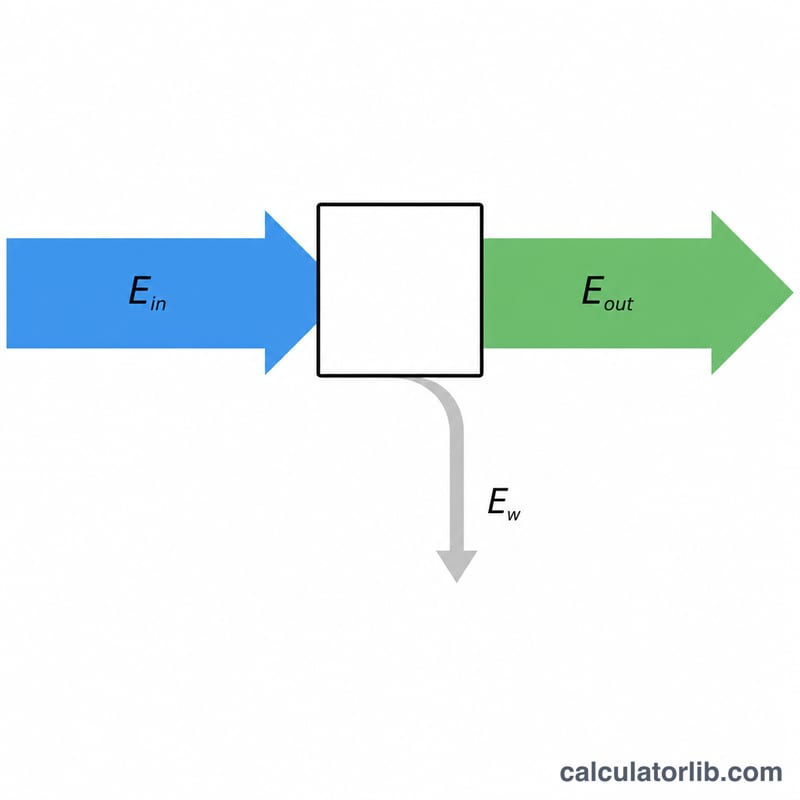
The Efficiency Calculator tells you how much of the energy you put into a machine, device, or process actually comes out as useful work. Efficiency (the Greek letter η, "eta") is the ratio of useful output energy to input energy, expressed as a percentage. No system is perfectly efficient — some energy is always lost to heat, friction, sound, or other forms — so efficiency is always less than 100%.
How to Use It
Enter the useful output energy (the energy that does the job you want) and the input energy (the total energy supplied). The calculator divides output by input, multiplies by 100, and shows the efficiency percentage along with the energy lost. Use any consistent unit — joules, kWh, BTU, or even watts of power — as long as both values use the same unit.
The Formula Explained
The core equation is $$\eta\,(\%) = \frac{\text{Useful Output Energy}}{\text{Input Energy}} \times 100$$ If a motor draws 1000 J and delivers 800 J of mechanical work, its efficiency is \(800 \div 1000 \times 100 = 80\%\). The remaining 200 J is energy lost, typically as heat. The loss is simply input minus output.
Worked Example
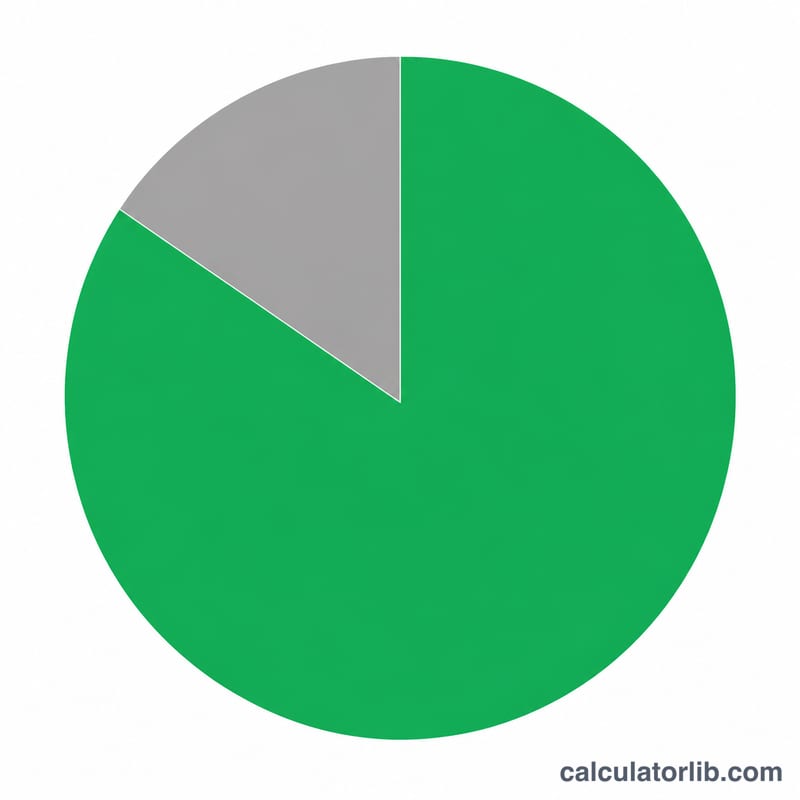
A power plant takes in 5000 MJ of chemical energy from fuel and produces 2000 MJ of electrical energy. Efficiency = \(2000 \div 5000 \times 100 = 40\%\), with 3000 MJ lost as waste heat — a typical figure for a thermal power station.
FAQ
Can efficiency be over 100%? No. That would mean a device produces more energy than it consumes, violating the conservation of energy. If you get over 100%, recheck your input and output values.
Does the unit matter? Only that both values share the same unit. Because efficiency is a ratio, the units cancel out, leaving a pure percentage.
Can I use power instead of energy? Yes. Efficiency from output power ÷ input power gives the same percentage as energy, since power is energy per unit time.