
What is the Heat Transfer Calculator?
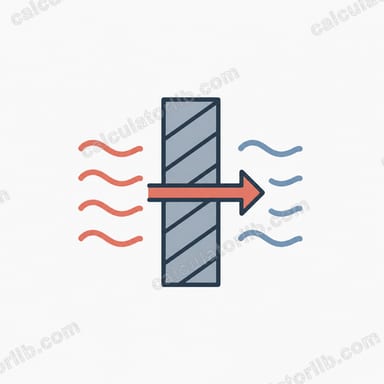
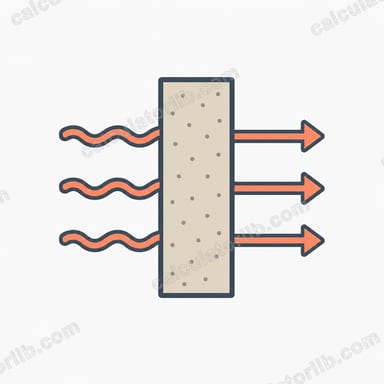
This calculator estimates how much heat conducts through a solid material — such as a wall, window, or metal plate — using Fourier's law of steady-state conduction. It returns both the heat transfer rate (power, in watts) and the total heat energy transferred over a chosen time (in joules and kilojoules). It is a universal physics tool and applies anywhere.
How to use it
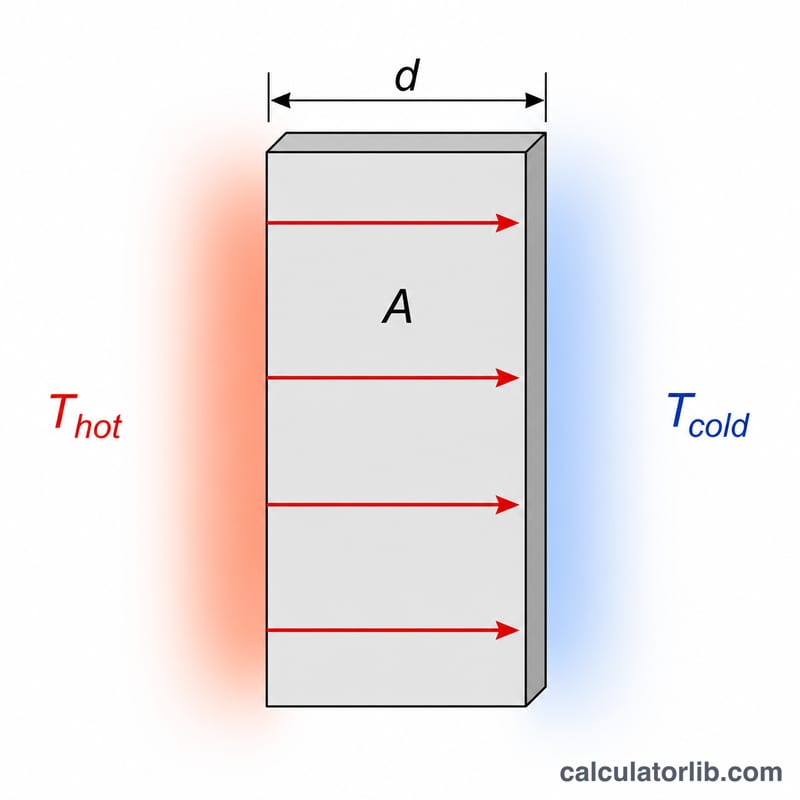
Enter the material's thermal conductivity k (W/m·K), the cross-sectional area A (m²) through which heat flows, the temperature difference ΔT (K or °C) across the material, its thickness d (m), and the time t in seconds. The calculator divides by thickness, so it must be greater than zero.
The formula explained
The heat transfer rate is \(\dot{Q} = \frac{k \cdot A \cdot \Delta T}{d}\). Multiplying by time gives total energy $$Q = \frac{k \cdot A \cdot \Delta T \cdot t}{d}.$$ A higher conductivity, larger area, or bigger temperature gap increases heat flow, while greater thickness reduces it. Note ΔT in kelvin and celsius are numerically equal for a difference.
Worked example
A fiberglass wall has k = 0.04 W/m·K, area 10 m², ΔT = 20 K, thickness 0.1 m. $$\text{Rate} = \frac{0.04 \times 10 \times 20}{0.1} = 80 \text{ W}.$$ Over 1 hour (3600 s), $$Q = 80 \times 3600 = 288{,}000 \text{ J} = 288 \text{ kJ}.$$
FAQ
What units should I use? SI units throughout: W/m·K, m², kelvin, metres, seconds. The result is in watts and joules.
Does ΔT need to be in kelvin? A temperature difference has the same value in kelvin or celsius, so either works for ΔT.
Is this for steady-state only? Yes — it assumes constant ΔT and one-dimensional conduction, ignoring transient warm-up and convection/radiation.