
What Is the Heat Transfer Coefficient?
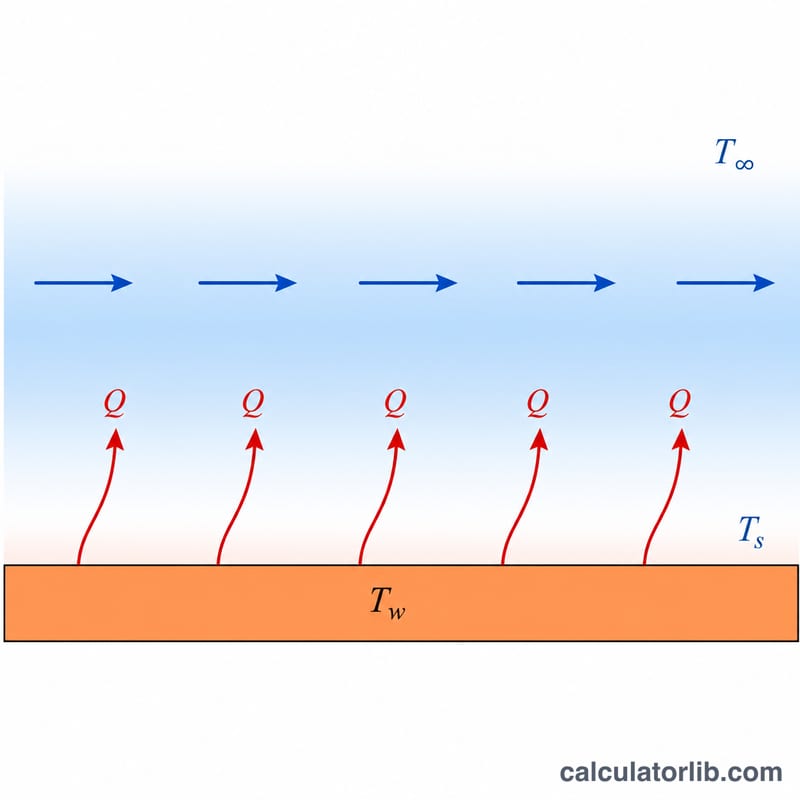
The convective heat transfer coefficient, denoted h, quantifies how effectively heat is transferred between a solid surface and a moving fluid (liquid or gas). It is a central parameter in thermal engineering, HVAC design, heat exchanger sizing, and electronics cooling. This calculator computes h directly from Newton's law of cooling using the heat transfer rate, the surface area, and the temperature difference between the surface and the fluid.
The Formula Explained
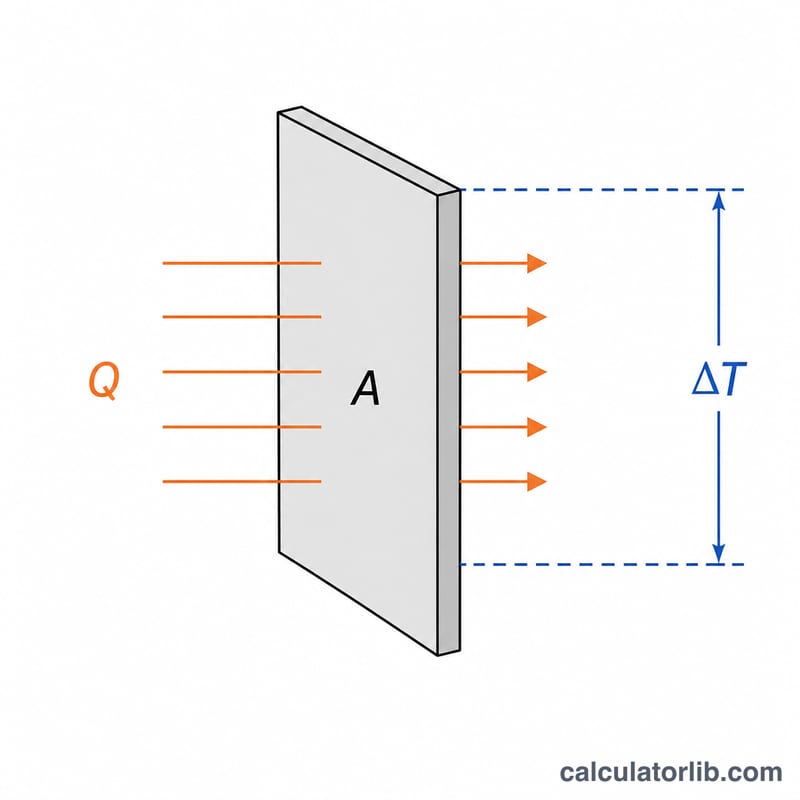
The calculation is based on $$h = \frac{\text{Q (W)}}{\text{A (m}^2\text{)} \times \text{ΔT (K)}}$$ a rearrangement of Newton's law of cooling, \(Q = h \cdot A \cdot \Delta T\). Here Q is the heat transfer rate in watts (W), A is the heat-exchange surface area in square metres (m²), and ΔT is the temperature difference in kelvin (K) or degrees Celsius (the size of a kelvin equals a degree Celsius, so the difference is identical). The result h is expressed in W/(m²·K). A higher value means the surface sheds or absorbs heat more readily.
How to Use It
Enter the total heat transfer rate Q, the surface area A in contact with the fluid, and the temperature difference ΔT. Press calculate to get the coefficient instantly. Keep all inputs in SI units for a result in W/(m²·K).
Worked Example
Suppose a flat plate dissipates Q = 5000 W over an area A = 2 m² with a surface-to-fluid temperature difference of ΔT = 25 K. Then $$h = \frac{5000}{2 \times 25} = \frac{5000}{50} = 100 \ \text{W/(m}^2\cdot\text{K)}$$ a value typical of forced air convection.
FAQ
What units should I use? Use SI units: Q in watts, A in square metres, ΔT in kelvin (or °C difference). The output is W/(m²·K).
Can I use °C for ΔT? Yes — a temperature difference in °C is numerically identical to one in kelvin, so the result is unchanged.
What are typical values of h? Free convection in air is roughly 5–25, forced convection in air 10–500, forced convection in water 100–15,000, and boiling/condensation can exceed 10,000 W/(m²·K).