
What Is Joule Heating?
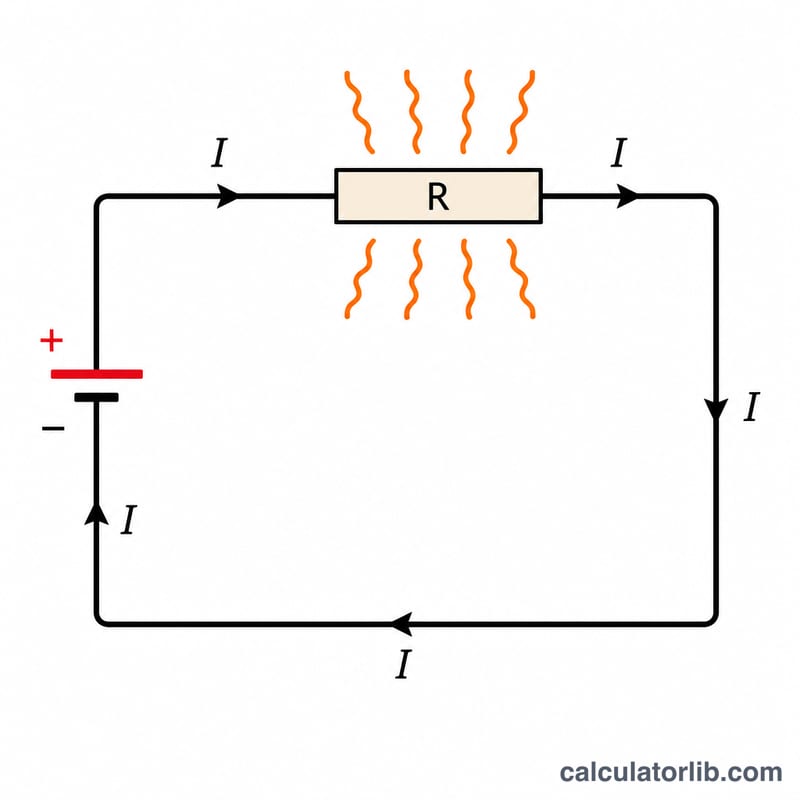
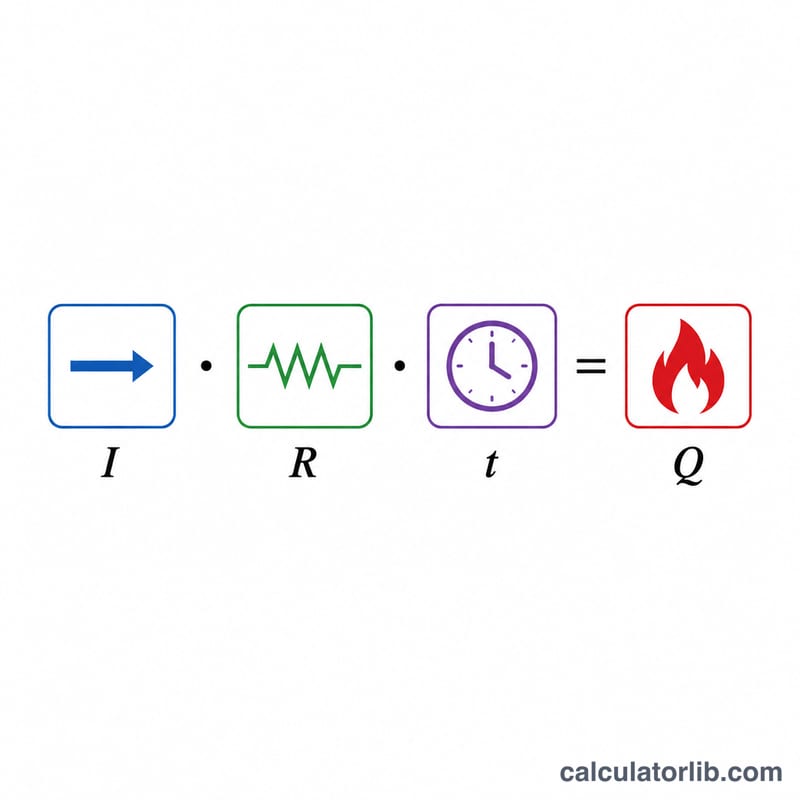
Joule heating (also called resistive or Ohmic heating) is the process by which the passage of an electric current through a conductor produces heat. The amount of heat is described by Joule's first law: \(Q = I^{2} \cdot R \cdot t\), where Q is heat in joules, I is current in amperes, R is resistance in ohms, and t is time in seconds. This calculator is universal — it applies anywhere, using SI units.
How to Use the Calculator
Enter the current flowing through the component, its electrical resistance, and how long the current flows. The tool returns the total heat energy generated in joules, the steady power dissipation in watts (\(P = I^{2}R\)), and the heat expressed in kilocalories (\(1\ \text{kcal} = 4184\ \text{J}\)) for thermal comparisons.
The Formula Explained
Because power is the rate of energy conversion, \(P = I^{2}R\) gives watts (joules per second). Multiplying by the duration t yields the total energy: $$Q = P \cdot t = I^{2} \cdot R \cdot t.$$ Note that heat scales with the square of the current, so doubling the current quadruples the heat — a key reason high-current wiring must be sized carefully.
Worked Example
A heating element with \(R = 10\ \Omega\) carries \(I = 2\ \text{A}\) for \(t = 60\ \text{s}\). $$\text{Power} = 2^{2} \times 10 = 40\ \text{W}.$$ $$Q = 40 \times 60 = 2{,}400\ \text{J}.$$ In kilocalories that is \(2400 \div 4184 \approx 0.5736\ \text{kcal}\).
FAQ
Does this work for AC? For AC use the RMS current value; the same formula then gives average heat.
Why is heat proportional to I²? Voltage across the resistor is \(V = IR\), and power \(P = VI = I^{2}R\), so heat rises with the square of current.
What if I know voltage instead? You can substitute \(R = V/I\) or use \(Q = V^{2}t/R\) when voltage and resistance are known.