
What This Calculator Does
The Water Heating Energy Calculator tells you how much energy is needed to raise the temperature of a given amount of water. This is useful for sizing water heaters, estimating utility costs, designing solar thermal systems, brewing, and physics homework. It uses the universal specific-heat equation, so it applies anywhere in the world.
How to Use It
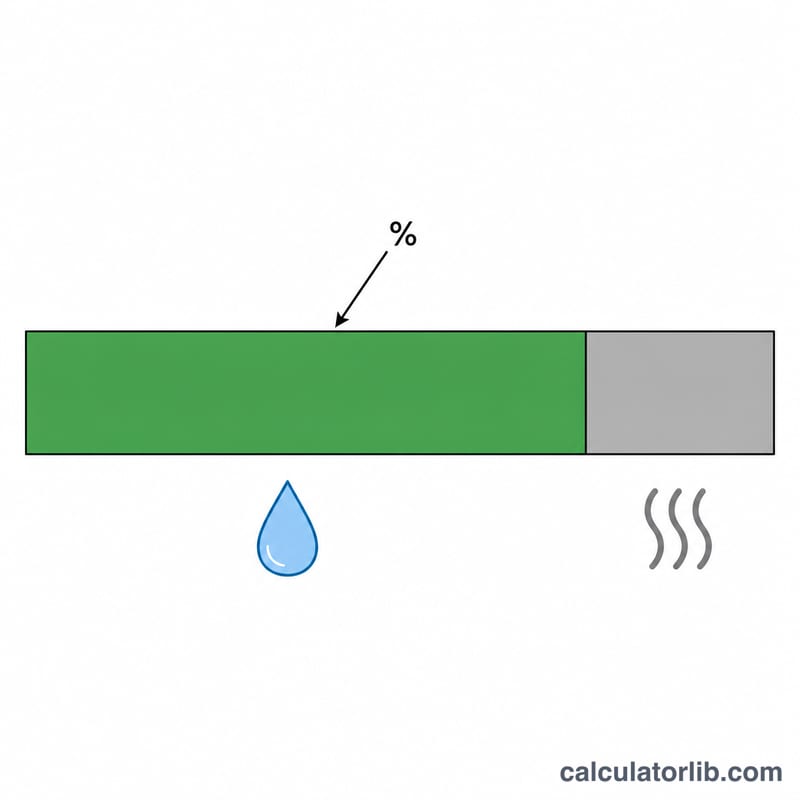
Enter the water volume in liters, the starting temperature and the target temperature in degrees Celsius, and your heater's efficiency as a percentage (use 100% for the ideal/theoretical energy). The calculator returns the energy in kilowatt-hours, kilojoules and joules. Because 1 liter of water weighs essentially 1 kilogram, volume in liters is treated directly as mass in kilograms.
The Formula Explained
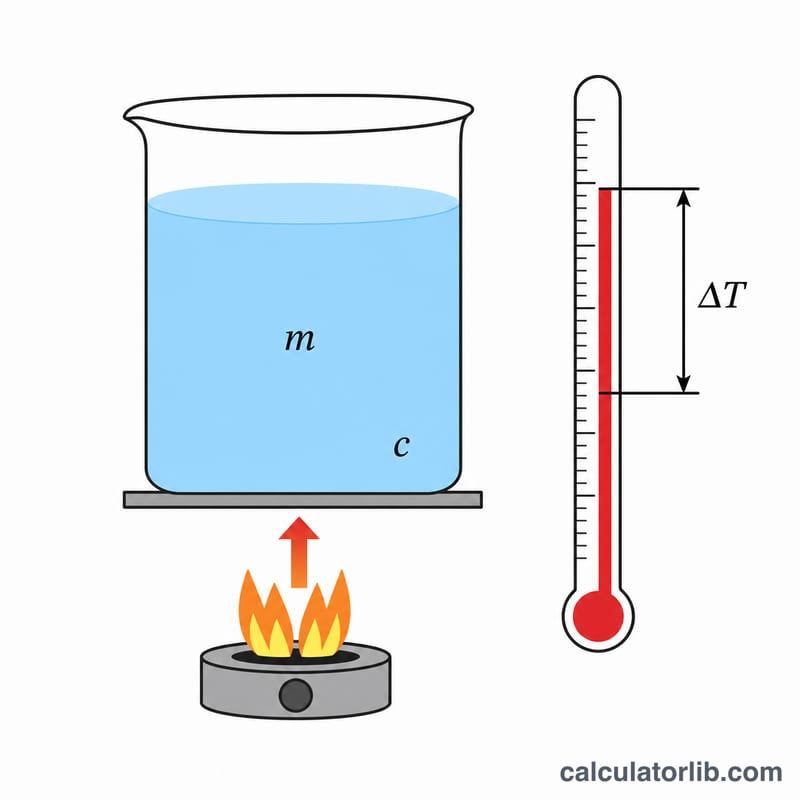
The core equation is $$Q = m \times c \times \Delta T$$, where \(Q\) is heat energy in joules, \(m\) is the mass of water in kilograms, \(c\) is the specific heat capacity of water (4186 J/kg·°C), and \(\Delta T\) is the temperature change (end minus start). To convert joules to kilowatt-hours, divide by 3,600,000. When efficiency is below 100%, the actual energy you must supply is higher: \(Q \div (\eta/100)\).
Worked Example
Heating 50 liters of water from 15 °C to 60 °C at 100% efficiency: \(\Delta T = 45\) °C, \(m = 50\) kg.
$$Q = 50 \times 4186 \times 45 = 9{,}418{,}500 \text{ J} = 2{,}615.7 \text{ kJ}$$Dividing by 3,600,000 gives about 2.616 kWh.
FAQ
Why use 4186 J/kg·°C? That is the specific heat capacity of liquid water near room temperature; it varies only slightly with temperature.
Does this include heat losses? The ideal value does not. Use the efficiency field to account for losses in real heaters (typical electric ~95–100%, gas storage tanks ~55–70%).
Can I use gallons? Convert first — 1 US gallon ≈ 3.785 liters, 1 imperial gallon ≈ 4.546 liters.