
What Is the De Broglie Wavelength?
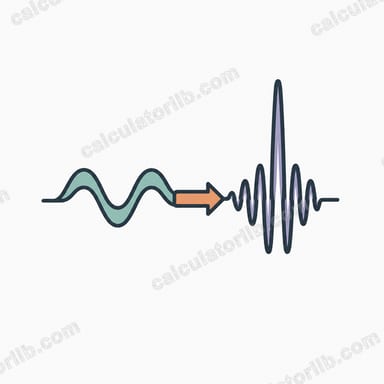
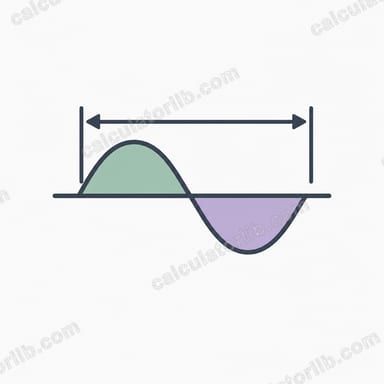
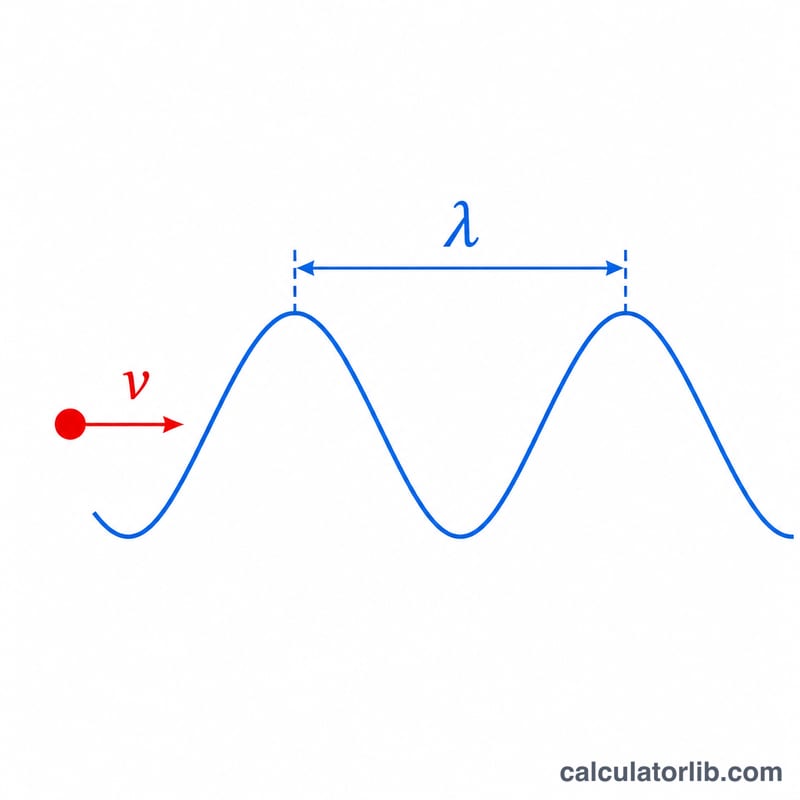
In 1924 Louis de Broglie proposed that every moving particle has an associated wave. Its wavelength, called the de Broglie wavelength, is inversely proportional to the particle's momentum. This idea is a cornerstone of quantum mechanics and explains phenomena such as electron diffraction. This calculator works for any particle using non-relativistic momentum (\(p = mv\)).
How to Use This Calculator
Enter the particle's mass in kilograms and its velocity in meters per second. The calculator computes the wavelength in meters (scientific notation) and also converts it to nanometers, along with the momentum used. For an electron, mass \(\approx 9.109 \times 10^{-31}\) kg; for a proton, \(\approx 1.673 \times 10^{-27}\) kg.
The Formula Explained
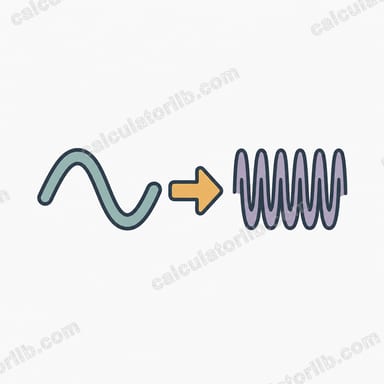
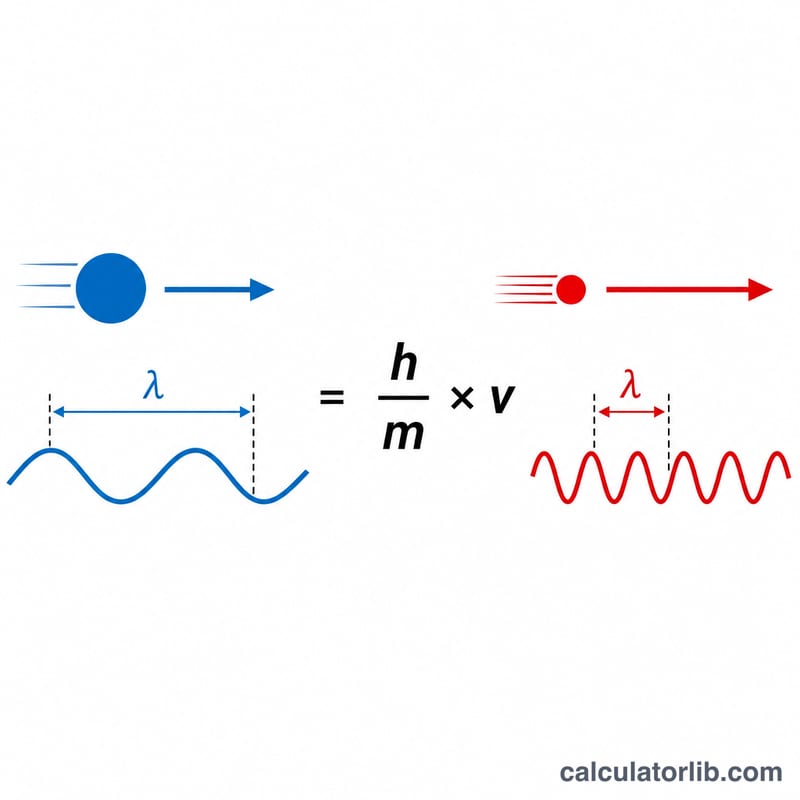
The relationship is $$\lambda = \frac{h}{m \cdot v}$$ where \(h\) is Planck's constant (\(6.62607015 \times 10^{-34}\ \text{J}\cdot\text{s}\)), \(m\) is mass, and \(v\) is velocity. Because momentum \(p = m \cdot v\), this is equivalent to \(\lambda = h / p\). Heavier or faster particles have smaller wavelengths, which is why everyday objects show no observable wave behavior.
Worked Example
Consider an electron (\(m = 9.10938356 \times 10^{-31}\) kg) moving at \(v = 2.18 \times 10^6\) m/s. Momentum $$p = 9.10938356 \times 10^{-31} \times 2.18 \times 10^6 \approx 1.9858 \times 10^{-24}\ \text{kg}\cdot\text{m/s}.$$ Then $$\lambda = \frac{6.62607015 \times 10^{-34}}{1.9858 \times 10^{-24}} \approx 3.337 \times 10^{-10}\ \text{m},$$ or about 0.334 nm — comparable to atomic spacing, which is why electrons diffract through crystals.
FAQ
Does this account for relativity? No. It uses classical momentum \(p = mv\), which is accurate for velocities well below the speed of light. Near light speed, relativistic momentum should be used.
What units do I use? Mass in kilograms and velocity in meters per second give the wavelength in meters. The tool also reports nanometers for convenience.
Why is the wavelength so tiny for large objects? Because Planck's constant is extremely small, massive everyday objects have wavelengths far below any measurable scale, so they behave classically.