
What is TDEE?
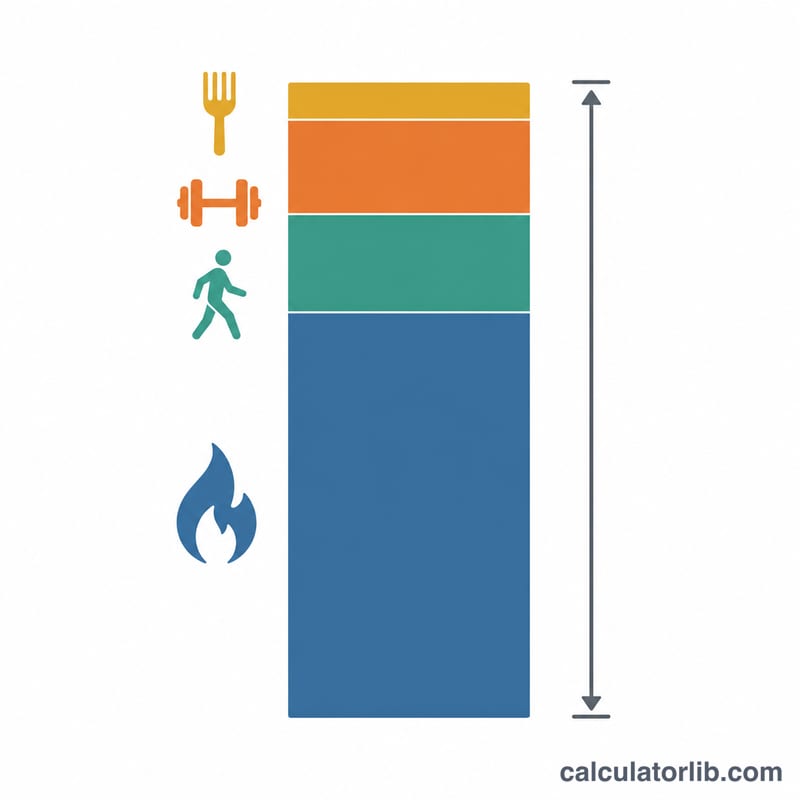
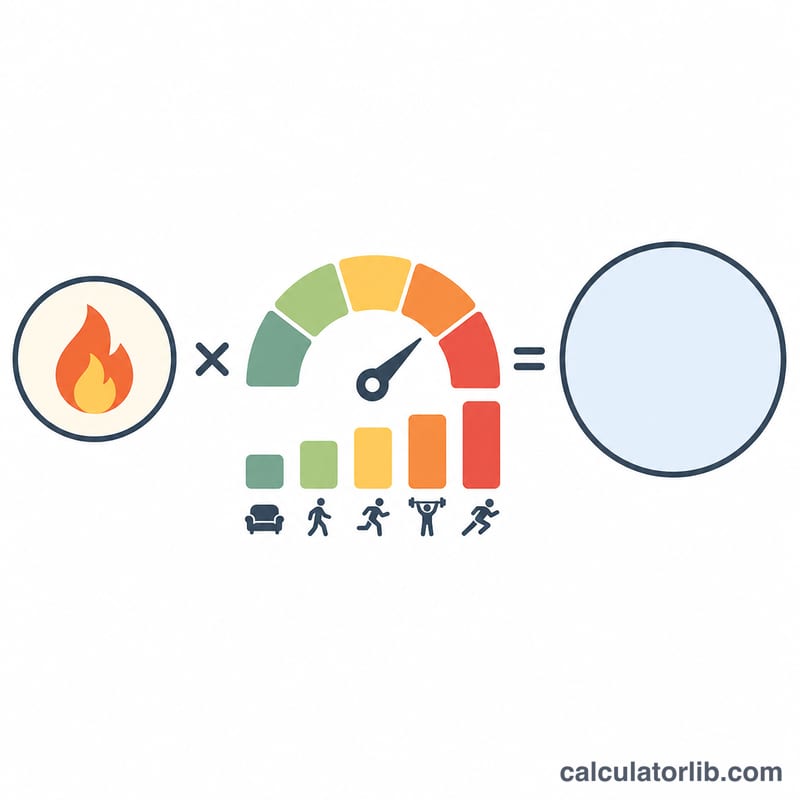
Total Daily Energy Expenditure (TDEE) is the total number of calories your body burns in a typical day, including everything from breathing and digestion to exercise. It starts from your Basal Metabolic Rate (BMR) — the energy your body uses at complete rest — and multiplies it by an activity factor (PAL, physical activity level) to account for movement. This calculator uses the revised Harris-Benedict equation (Roza & Shizgal, 1984), a widely used population estimate. It is universal physiology and not specific to any country.
How to use this calculator
Enter your age in years, select your sex, and type your height in centimetres and weight in kilograms. Then choose the activity level that best matches your weekly routine. The tool first computes your BMR, then multiplies it by the activity multiplier to give your TDEE. Results are shown in kilocalories (kcal) per day.
The formula explained
For males, $$\text{BMR} = 13.397 \times \text{weight(kg)} + 4.799 \times \text{height(cm)} - 5.677 \times \text{age} + 88.362.$$ For females, $$\text{BMR} = 9.247 \times \text{weight(kg)} + 3.098 \times \text{height(cm)} - 4.330 \times \text{age} + 447.593.$$ TDEE is then \(\text{BMR} \times \text{PAL}\), where PAL ranges from 1.2 (sedentary) up to 1.9 (very hard daily training).
Worked example
A 30-year-old male, 175 cm tall and 70 kg, with moderate activity (PAL 1.55): $$\text{BMR} = 13.397 \times 70 + 4.799 \times 175 - 5.677 \times 30 + 88.362 = 1695.67 \text{ kcal}.$$ $$\text{TDEE} = 1695.67 \times 1.55 = 2628.28 \text{ kcal per day}.$$
FAQ
Should I eat exactly my TDEE? Eating around your TDEE tends to maintain weight. To lose weight, eat below it; to gain, eat above it — typically by 300-500 kcal.
How accurate is it? The Harris-Benedict equation is an estimate for the general population. Individual metabolism varies, so use the result as a starting point and adjust based on real-world results.
Which activity level should I pick? Choose honestly based on structured exercise frequency. Most people with desk jobs and light workouts fall in the 1.2-1.375 range.