
What is the Heisenberg Uncertainty Principle?
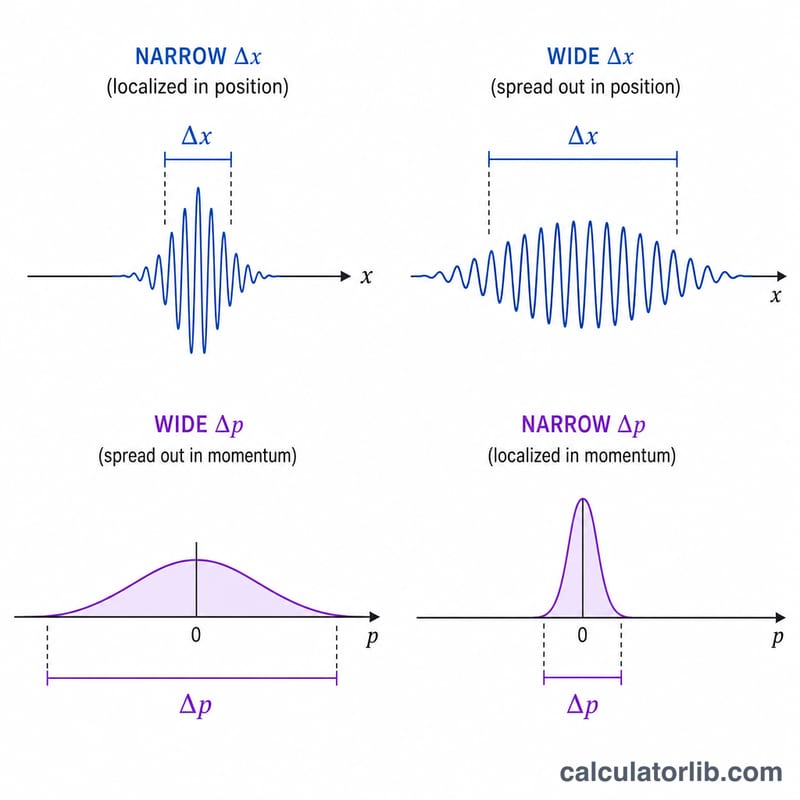
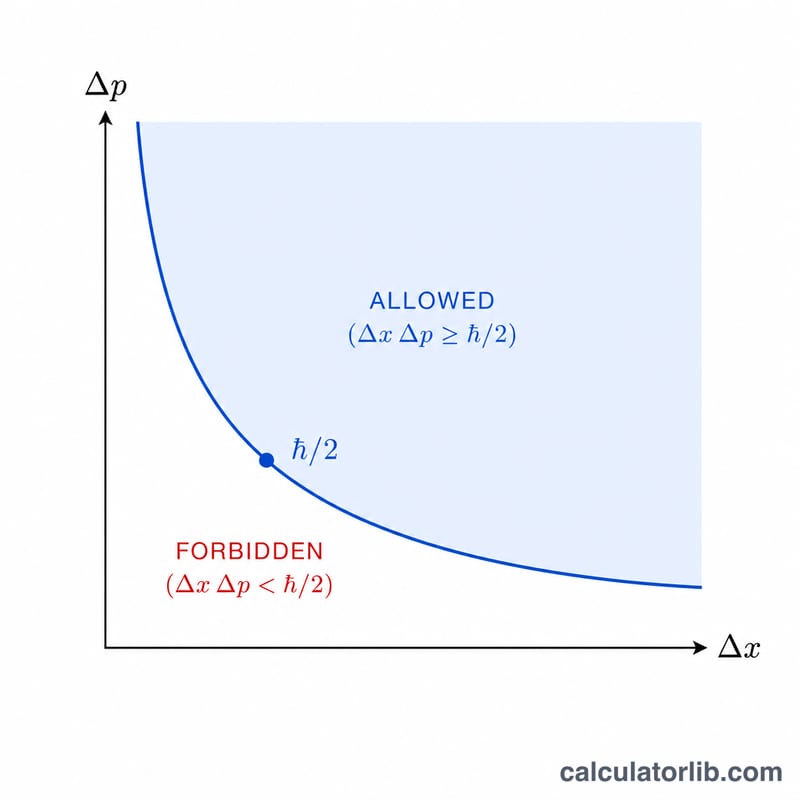
The Heisenberg uncertainty principle is a cornerstone of quantum mechanics. It states that you cannot simultaneously know both the exact position and the exact momentum of a particle. The more precisely one is known, the less precisely the other can be determined. Mathematically, the product of the two uncertainties has a fundamental lower bound: \(\Delta x \cdot \Delta p \geq \frac{\hbar}{2}\).
How to use this calculator
Choose whether you want to solve for the minimum uncertainty in momentum (\(\Delta p\)) or position (\(\Delta x\)). Enter the known uncertainty as a mantissa and a power of ten — for example, a position uncertainty of \(1 \times 10^{-9}\) m is entered as 1 with power -9. The calculator returns the minimum uncertainty of the complementary quantity.
The formula explained
The reduced Planck constant is \(\hbar = 1.054571817 \times 10^{-34}\ \text{J}\cdot\text{s}\). The minimum-uncertainty form of the principle is \(\Delta x \cdot \Delta p = \frac{\hbar}{2}\). Solving for the unknown gives $$\Delta p = \frac{\hbar}{2 \cdot \Delta x} \quad \text{or} \quad \Delta x = \frac{\hbar}{2 \cdot \Delta p}$$ The half factor comes from the standard-deviation formulation of the principle.
Worked example
Suppose an electron's position is known to within \(\Delta x = 1 \times 10^{-9}\) m. The minimum uncertainty in momentum is $$\Delta p = \frac{1.054571817 \times 10^{-34}}{2 \times 1 \times 10^{-9}} = 5.273 \times 10^{-26}\ \text{kg}\cdot\text{m/s}$$ This tiny but non-zero value reflects the fundamental quantum limit on measurement precision.
FAQ
Is the uncertainty principle a measurement limitation? No — it is a fundamental property of quantum systems, not merely a limit of our instruments.
Why \(\frac{\hbar}{2}\) and not \(h\)? The factor of \(\frac{1}{2}\) arises when uncertainties are defined as standard deviations of the quantum probability distributions.
What units does this use? Position in meters (m) and momentum in kg·m/s, consistent with SI units.