
What Is Archimedes' Principle?
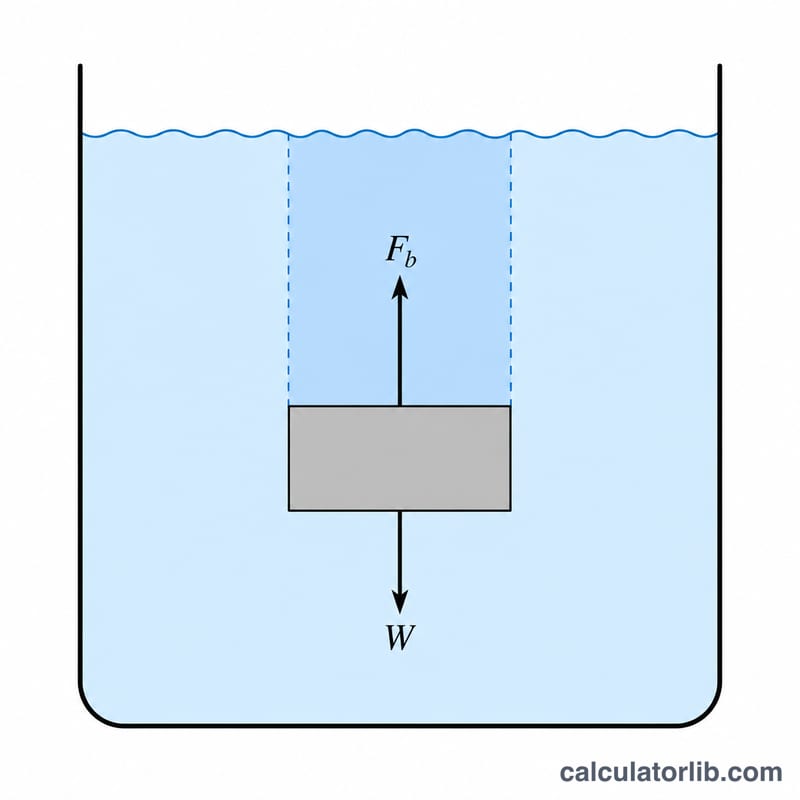
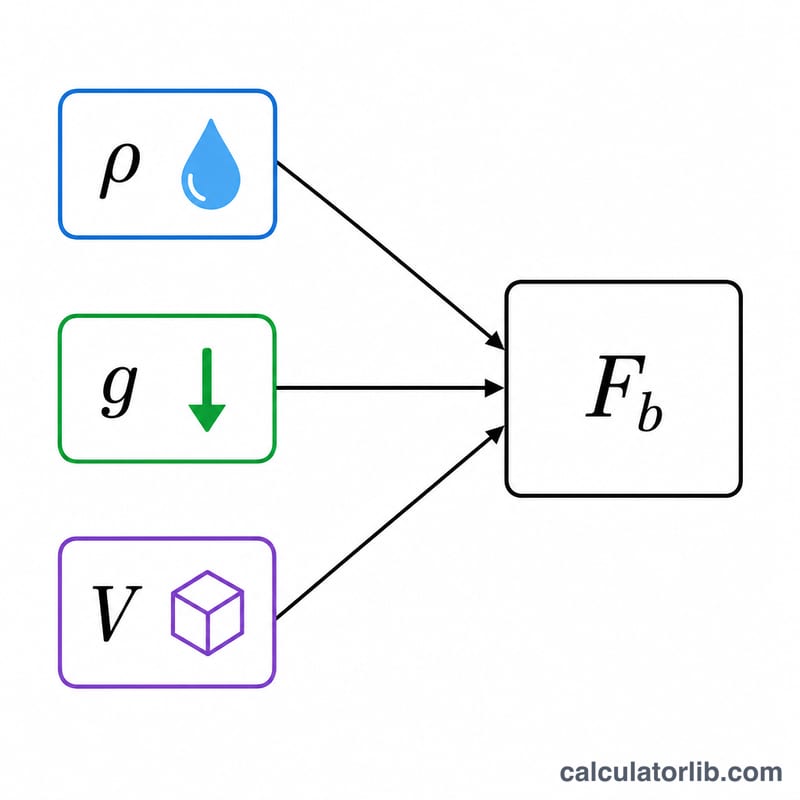
Archimedes' principle states that any object submerged in a fluid experiences an upward buoyant force equal to the weight of the fluid it displaces. This calculator finds that buoyant force from three inputs: the fluid's density (\(\rho\)), gravitational acceleration (\(g\)), and the displaced volume (\(V\)). The result is the upward force in newtons (N).
How to Use the Calculator
Enter the fluid density in kilograms per cubic metre — fresh water is about 1000 kg/m³ and seawater about 1025 kg/m³. Enter gravity (9.81 m/s² on Earth) and the volume of fluid displaced by the object in cubic metres. If the object is fully submerged, the displaced volume equals the object's own volume. Press calculate to get the buoyant force.
The Formula Explained
The buoyant force is given by $$F_b = \rho \cdot g \cdot V$$ The product \(\rho \cdot V\) is the mass of the displaced fluid, and multiplying by \(g\) converts that mass into weight (force). So buoyancy literally equals the weight of fluid pushed out of the way — exactly what Archimedes discovered.
Worked Example
Suppose a 0.01 m³ object is fully submerged in fresh water (\(\rho = 1000\) kg/m³) with \(g = 9.81\) m/s². Then $$F_b = 1000 \times 9.81 \times 0.01 = 98.1 \text{ N}$$ The object is pushed upward with 98.1 newtons of force.
Common Fluid Densities
Archimedes' principle states that the buoyant force on a submerged or floating object equals the weight of the fluid it displaces, \(F_b = \rho \cdot g \cdot V\). The fluid density \(\rho\) is the first quantity you need. The table below lists representative densities at roughly room temperature (about 20 °C) and standard atmospheric pressure. Density varies with temperature, pressure, and composition, so treat these as nominal reference values.
| Fluid | Density (kg/m³) |
|---|---|
| Air (15 °C, sea level) | 1.225 |
| Gasoline | 745 |
| Ethanol | 789 |
| Olive oil | 920 |
| Fresh water | 1000 |
| Seawater | 1025 |
| Milk (whole) | 1030 |
| Glycerine | 1260 |
| Mercury | 13534 |
Because buoyant force scales directly with density, an object displacing the same volume in mercury experiences a force more than 13 times larger than in fresh water — which is why dense liquids float objects that sink in water.
Gravitational Constants by Location
The acceleration due to gravity \(g\) is the second factor in \(F_b = \rho \cdot g \cdot V\). The same displaced volume of the same fluid produces a different buoyant force depending on the gravitational field. Standard gravity on Earth is defined as exactly \(9.80665\ \text{m/s}^2\), commonly rounded to 9.81.
| Location | Gravity \(g\) (m/s²) |
|---|---|
| Earth (sea level, standard) | 9.81 |
| Moon | 1.62 |
| Mars | 3.71 |
| Jupiter (cloud-top equator) | 24.79 |
| Sun (surface) | 274 |
On Earth, \(g\) is not perfectly constant. It varies with latitude and altitude, ranging from about \(9.78\ \text{m/s}^2\) near the equator to about \(9.83\ \text{m/s}^2\) at the poles, and it decreases slightly with elevation. For most engineering and everyday buoyancy calculations the value 9.81 m/s² is accurate enough.
FAQ
Will the object float? Compare the buoyant force to the object's weight. If buoyancy is greater than or equal to the object's weight, it floats; if less, it sinks.
What volume do I use if the object floats? Use only the submerged portion's volume — the part below the waterline that actually displaces fluid.
What value should I use for g? Use 9.81 m/s² for Earth at sea level. Use 1.62 for the Moon or 3.71 for Mars if modeling other bodies.