
What is the Heisenberg Uncertainty Calculator?
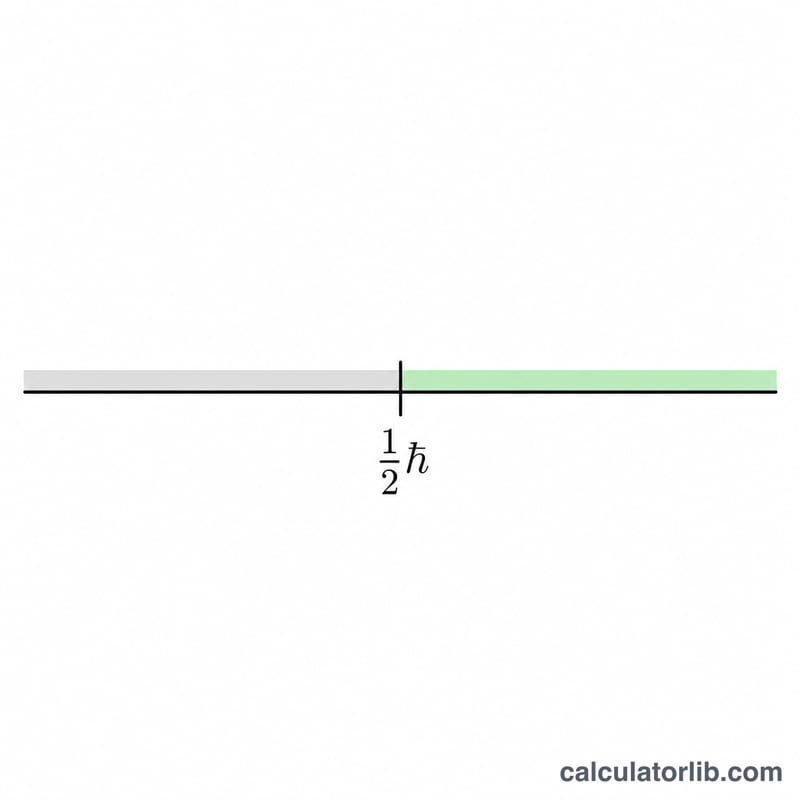
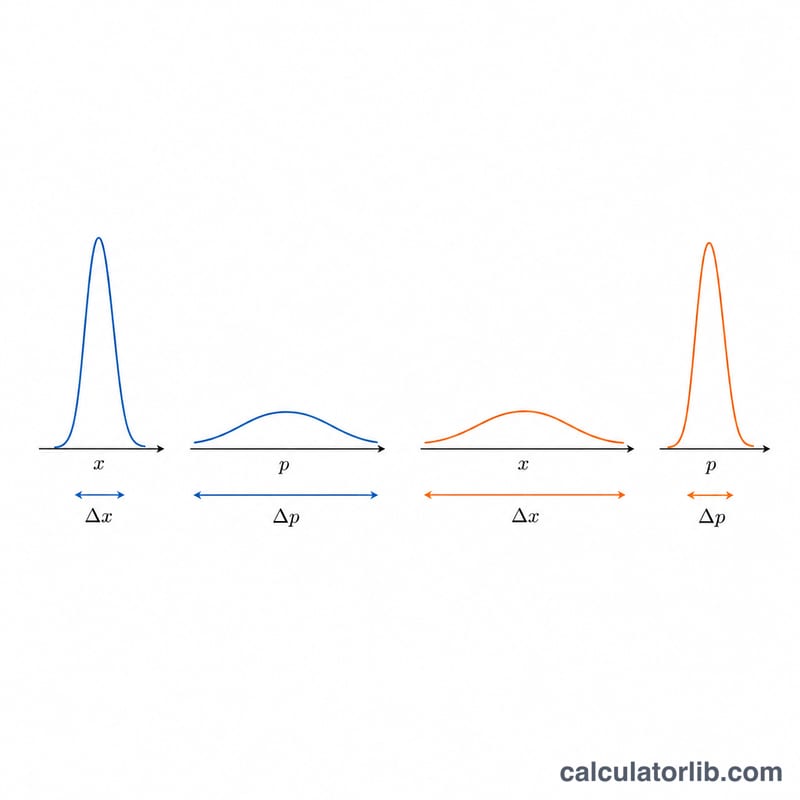
This tool applies the Heisenberg uncertainty principle, a cornerstone of quantum mechanics, which states that the position and momentum of a particle cannot both be known with arbitrary precision at the same time. The product of the position uncertainty (\(\Delta x\)) and momentum uncertainty (\(\Delta p\)) must be at least half of the reduced Planck constant \(\hbar\). This is a universal physical law and applies everywhere — no country or jurisdiction scope is needed.
How to use it
Choose whether you want to solve for the minimum momentum uncertainty (\(\Delta p\)) given a known position uncertainty (\(\Delta x\)), or the minimum position uncertainty (\(\Delta x\)) given a known momentum uncertainty (\(\Delta p\)). Enter the known value as a mantissa and a power-of-ten exponent. For instance, to enter \(1 \times 10^{-10}\) m, type 1 in the value field and -10 in the exponent field. Use SI units: metres for position and \(\text{kg}\cdot\text{m/s}\) for momentum.
The formula explained
The principle is written as $$\Delta x \cdot \Delta p \geq \frac{\hbar}{2},$$ where \(\hbar = h/2\pi \approx 1.054571817 \times 10^{-34}\ \text{J}\cdot\text{s}\) is the reduced Planck constant. The equality case gives the smallest possible product, so the minimum value of the unknown uncertainty is \(\hbar/2\) divided by the known uncertainty. Any real measurement will have a product equal to or larger than this theoretical floor.
Worked example
Suppose an electron's position is known to within \(\Delta x = 1 \times 10^{-10}\) m (about one atomic diameter). Then the minimum momentum uncertainty is $$\Delta p = \frac{1.054571817 \times 10^{-34} / 2}{1 \times 10^{-10}} = 5.2728590850 \times 10^{-25}\ \text{kg}\cdot\text{m/s}.$$ This is the smallest momentum spread physically allowed for that position precision.
FAQ
Why is there a fundamental limit? It arises from the wave nature of matter; it is not a measurement-tool limitation but a property of nature itself.
Which constant is used? The CODATA value of the reduced Planck constant, \(\hbar = 1.054571817 \times 10^{-34}\ \text{J}\cdot\text{s}\).
Can the product ever be smaller? No. The calculator returns the theoretical minimum; actual experiments always meet or exceed it.