
What is the moment of a force?
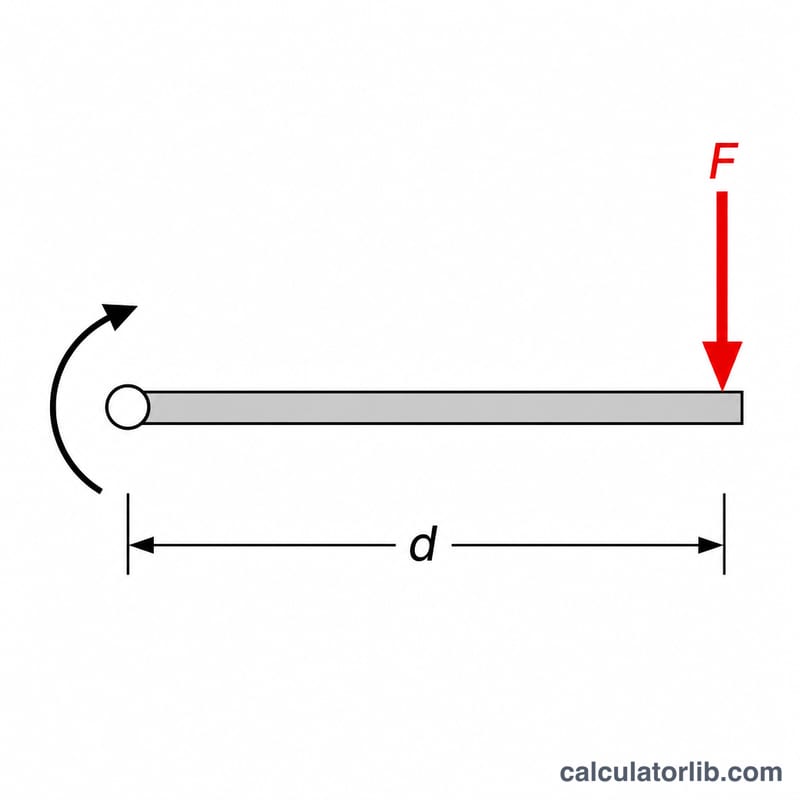
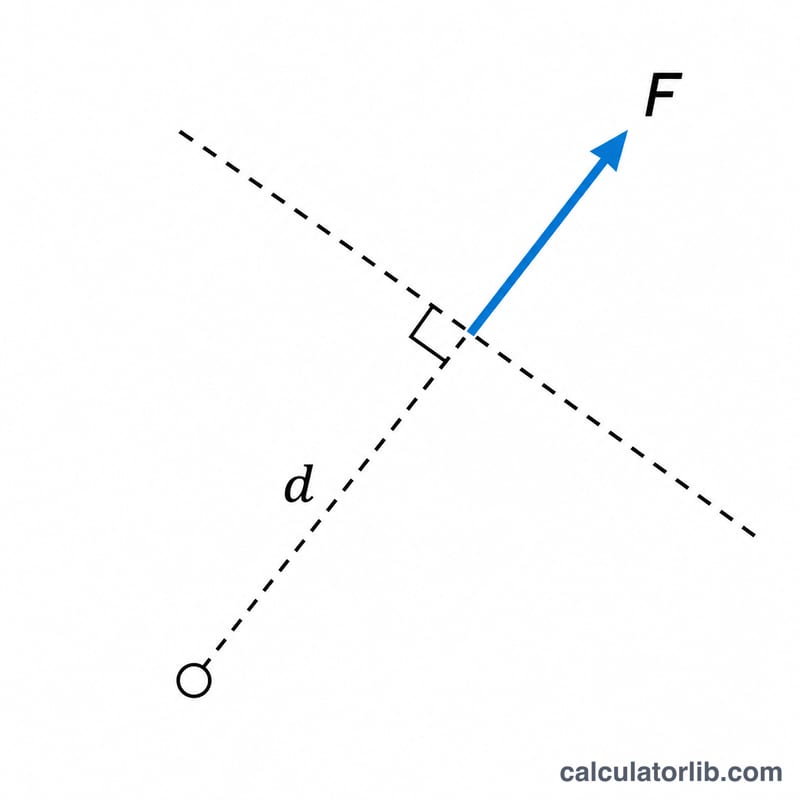
The moment of a force, often called torque, measures the turning effect a force produces about a pivot or axis. It is calculated by multiplying the magnitude of the force by the perpendicular distance from the pivot to the line of action of that force. This calculator uses the standard physics relationship \(M = F \times d\) and reports the result in newton-metres (N\(\cdot\)m), the SI unit of moment.
How to use this calculator
Enter the force in newtons (N) and the perpendicular distance in metres (m). The perpendicular distance is the shortest distance between the pivot and the line along which the force acts — not necessarily the length of the arm if the force is applied at an angle. Press calculate to get the moment in N\(\cdot\)m.
The formula explained
The equation is $$M = F \cdot d$$ where \(M\) is the moment (N\(\cdot\)m), \(F\) is the applied force (N), and \(d\) is the perpendicular distance (m). A larger force or a longer lever arm both increase the turning effect. If the force is not perpendicular, use \(d = L \cdot \sin(\theta)\), where \(L\) is the actual distance and \(\theta\) is the angle between the force and the arm.
Worked example
Suppose you push with a force of 50 N on a spanner at a perpendicular distance of 0.3 m from the bolt. The moment is $$M = 50 \times 0.3 = 15 \text{ N}\cdot\text{m}$$ This is the turning effort applied to loosen the bolt.
FAQ
What is the difference between moment and torque? They describe the same quantity — the turning effect of a force — and share the unit N\(\cdot\)m. "Torque" is more common in engineering and rotating machinery; "moment" is common in statics.
Why must the distance be perpendicular? Only the component of force perpendicular to the arm produces rotation. Using the perpendicular distance automatically accounts for this.
Can I use other units? Yes, but keep them consistent. This tool assumes newtons and metres, giving N\(\cdot\)m. Pound-feet (lb\(\cdot\)ft) is a common imperial alternative.