
What This Calculator Does
The Gravitational Force Calculator works out the attractive force between any two objects that have mass, based on Newton's law of universal gravitation. Every object in the universe pulls on every other object, and this tool quantifies that pull in newtons (N). It's useful for physics students, teachers and anyone curious about how mass and distance shape gravity — from two people standing apart to planets orbiting the Sun.
The Three Inputs
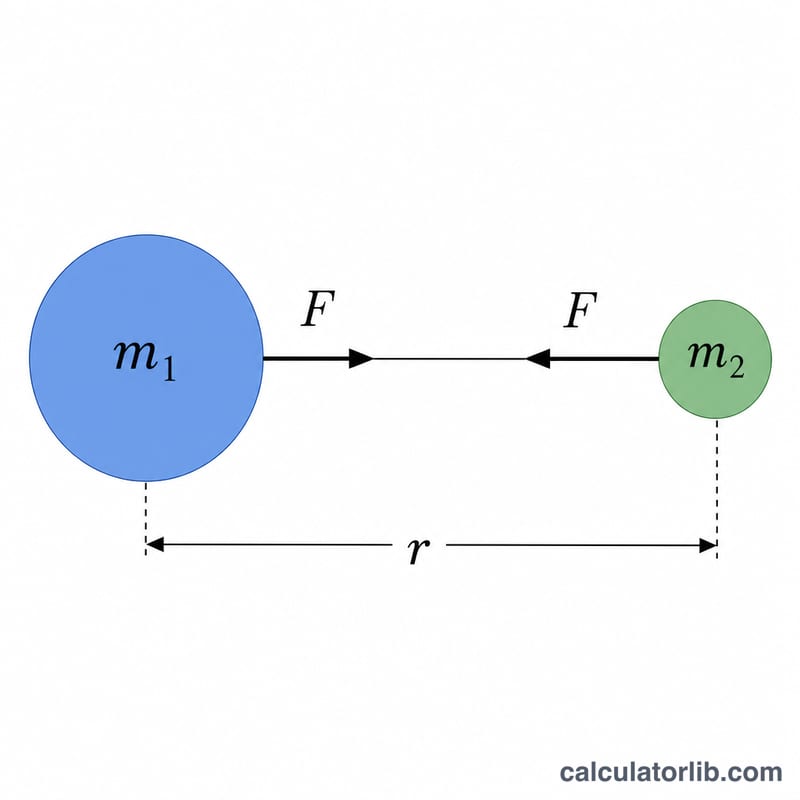
- Mass 1 (kg) – the mass of the first object in kilograms.
- Mass 2 (kg) – the mass of the second object in kilograms.
- Distance between centers (m) – the separation between the centres of mass of the two objects, in metres. Note this is measured centre-to-centre, not surface-to-surface.
The Formula
The calculator uses Newton's law of universal gravitation:
F = G × (m₁ × m₂) / r²
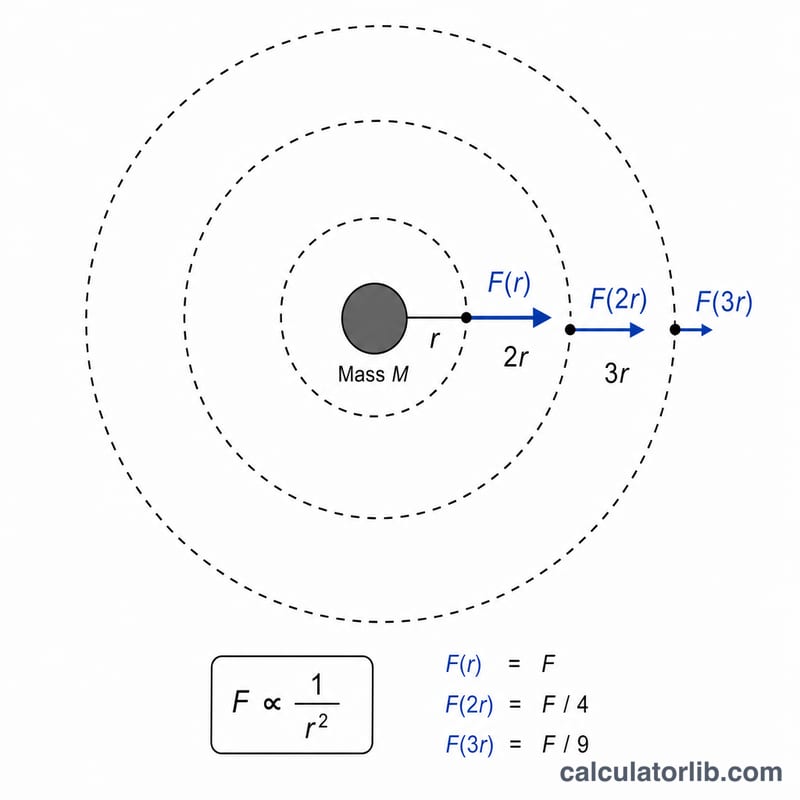
Here G is the gravitational constant, fixed at 6.67430 × 10⁻¹¹ N·m²/kg². The force grows in direct proportion to the product of the two masses, and falls off with the square of the distance — so doubling the separation cuts the force to a quarter. The tool multiplies the two masses together, divides by the distance squared, then multiplies by G to return the force.
Worked Example
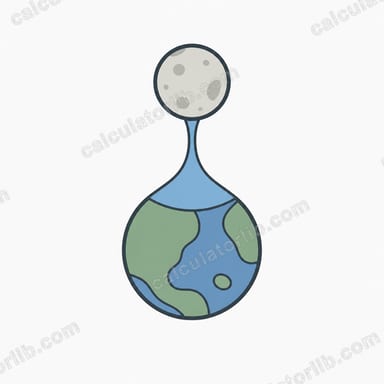
Suppose Mass 1 = 5.972 × 10²⁴ kg (Earth), Mass 2 = 7.348 × 10²² kg (Moon), and the distance = 3.844 × 10⁸ m.
- Product of masses: 5.972e24 × 7.348e22 ≈ 4.388e47
- Distance squared: (3.844e8)² ≈ 1.478e17
- F = 6.67430e-11 × 4.388e47 / 1.478e17 ≈ 1.98 × 10²⁰ N
That huge figure is the gravitational pull holding the Moon in orbit around Earth.
Frequently Asked Questions
Why is the force so tiny for everyday objects? Because G is extremely small (6.67430 × 10⁻¹¹). Two 70 kg people one metre apart attract each other with only about 3.3 × 10⁻⁷ N — far too weak to feel.
What happens if I enter zero distance? Dividing by zero is undefined, so the result becomes infinite. Always use a realistic, non-zero centre-to-centre distance.
What units does the answer use? The force is returned in newtons (N), provided you enter masses in kilograms and distance in metres.