What the Force to Horsepower Calculator Does
This calculator converts mechanical work done over time into power, expressed in horsepower. It uses United States customary units: force in pounds (lbs) and distance in feet (ft), with time in seconds. Whether you are sizing a winch, checking a hoist, or working through a physics problem, this tool turns a simple push or pull over a distance into a real horsepower figure.
The Inputs You Provide
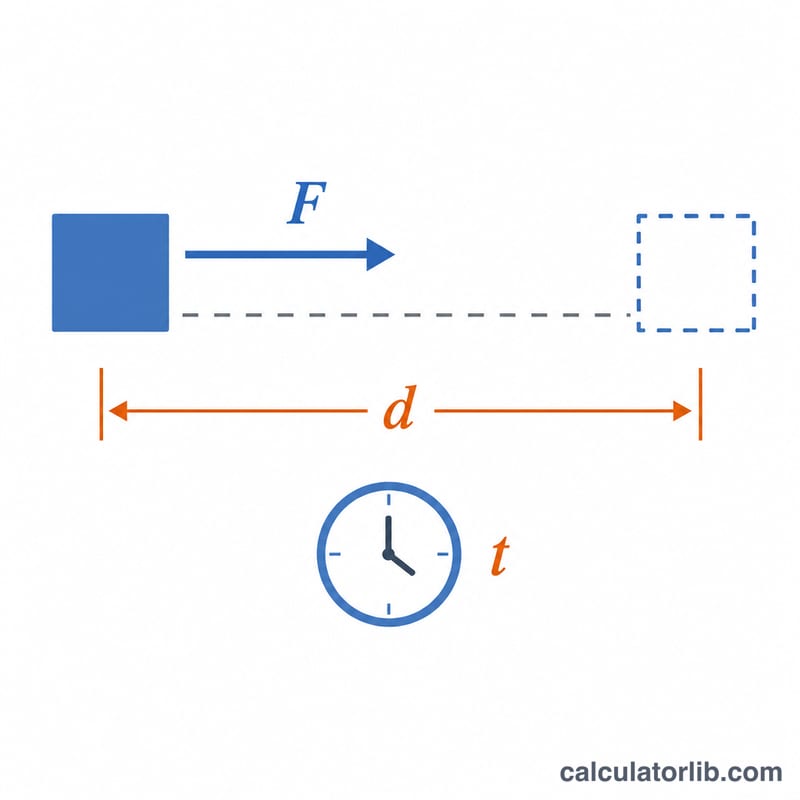
- Force (lbs): The force applied, measured in pounds-force. This is how hard you push, pull, or lift.
- Distance (ft): The distance over which that force acts, in feet.
- Time (seconds): How long it takes to move the load through that distance.
The Formula and How It Works
The displayed formula is:
$$\text{HP} = \frac{\text{Force (lbs)} \times \text{Distance (ft)}}{\text{Time (s)}} \times \frac{1.355818}{745.7}$$
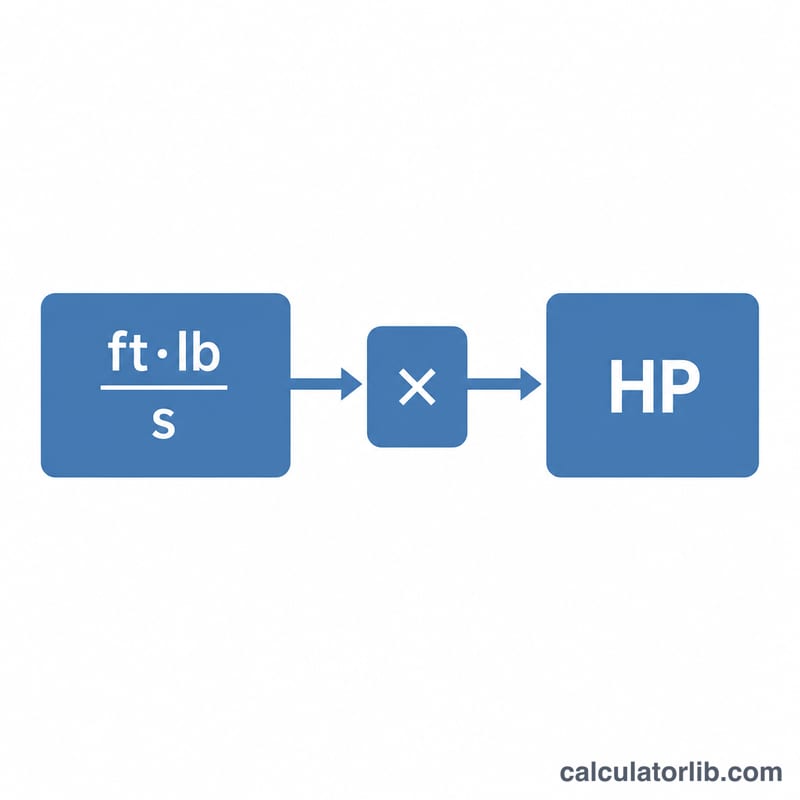
Behind the scenes the calculator works in stages to stay accurate. First it finds power in foot-pounds per second: Force × Distance / Time. It then converts that to watts by multiplying by 1.355818 (one foot-pound per second equals 1.355818 watts). Finally it divides the watts by 745.7 to give horsepower (745.7 watts = 1 mechanical horsepower).
This two-step conversion through watts is the physically correct route, so the result is metric/mechanical horsepower based on the international watt definition.
Worked Example
Suppose you lift a 550 lb load 10 ft in 5 seconds:
- Power in ft-lbs/sec = \((550 \times 10) / 5 = 1{,}100\) ft-lbs/sec
- In watts = \(1{,}100 \times 1.355818 = 1{,}491.4\) W
- In horsepower = \(1{,}491.4 / 745.7 =\) about 2.0 hp
So moving that load in five seconds requires roughly two horsepower of sustained power.
Power and Work Unit Conversions
This calculator expects force in pounds-force (lbf), distance in feet (ft), and time in seconds (s), and it reports mechanical (imperial) horsepower — the horsepower convention used in the United States and the United Kingdom, not metric horsepower (PS/CV) used in much of continental Europe and Japan. If your measurements are in newtons, kilograms-force, metres or minutes, convert them with the input-side rows below before typing them into the form.
Output-side: power units
| Quantity | Equivalent values |
|---|---|
| 1 horsepower (mechanical/imperial) | 745.7 W = 550 ft-lb/s = 33,000 ft-lb/min |
| 1 metric horsepower (PS, CV) | 735.5 W = 0.9863 hp (mechanical) |
| 1 kilowatt (kW) | 1.34102 hp (mechanical) = 1.35962 metric hp |
| 1 ft-lb/s | 1.355818 W = 1/550 hp |
| 1 watt (W) | 0.737562 ft-lb/s = 0.00134102 hp |
Input-side: force, distance and time
| If you measured | Multiply by | To get the field value |
|---|---|---|
| kilograms-force (kgf) | 2.20462 | pounds-force (lbf) → force |
| newtons (N) | 0.224809 | pounds-force (lbf) → force |
| metres (m) | 3.28084 | feet (ft) → distance |
| minutes | 60 | seconds (s) → time |
Example of using the table: a 300 kgf load is \(300 \times 2.20462 = 661.4\) lbf, and a 4 m lift is \(4 \times 3.28084 = 13.12\) ft — those are the numbers to enter, not 300 and 4.
Constants Used in the Calculation
The conversion from mechanical work per unit time to horsepower rests on four defined quantities. All of them are exact definitions (not measurements), so the only uncertainty in a result comes from your own inputs and from the small rounding described at the end.
| Constant | Value | Units | Role in the formula |
|---|---|---|---|
| Foot-pound-force per second | 1 ft-lb/s = 1.3558179483314004 (shown as 1.355818) | W (J/s) | Converts force × distance ÷ time into watts |
| Mechanical (imperial) horsepower | 745.69987158227 (rounded to 745.7 in this tool) = 550 ft-lb/s | W | Divisor that turns watts into horsepower |
| Metric horsepower (PS/CV) | 735.49875 = 75 kgf·m/s | W | Not used here; shown for comparison |
| Standard gravity, \(g\) | 9.80665 (= 32.174 ft/s²) | m/s² | Defines pounds-force: 1 lbf is the weight of 1 lb mass under \(g\) |
The foot-pound-force follows directly from two exact definitions, 1 lbf = 4.4482216152605 N and 1 ft = 0.3048 m:
$$1\ \text{ft-lb} = 4.4482216152605\ \text{N} \times 0.3048\ \text{m} = 1.3558179483314004\ \text{J}$$Mechanical horsepower is then defined as exactly 550 ft-lb/s:
$$1\ \text{hp} = 550 \times 1.3558179483314004 = 745.69987158227\ \text{W}$$Effect of the rounding. This tool divides by 745.7 rather than 745.69987158227. The two differ by about 0.00013 W, a relative difference of roughly \(1.7 \times 10^{-7}\) — about 0.000017%. On a 100 hp result that is an error of about 0.000017 hp, far smaller than any realistic uncertainty in a measured force, distance or stopwatch time, so it never matters in practice.
Note on pounds-force: because 1 lbf is defined through standard gravity, a weight in pounds can be entered directly as the force needed to lift it steadily at constant speed. If the load is being accelerated, the required force is larger than its weight and must be computed separately before entering it.
Frequently Asked Questions
Is the result in mechanical or metric horsepower? The calculator divides watts by 745.7, which is the mechanical (imperial) horsepower value, so your answer is in mechanical horsepower.
What happens if I enter zero for time? Dividing by zero is undefined, so always enter a positive time value greater than zero to get a meaningful result.
Can I use this for any units? No. The formula assumes pounds for force, feet for distance, and seconds for time. Convert your figures to these units first for an accurate horsepower output.