
What is the Torque to Horsepower Calculator?
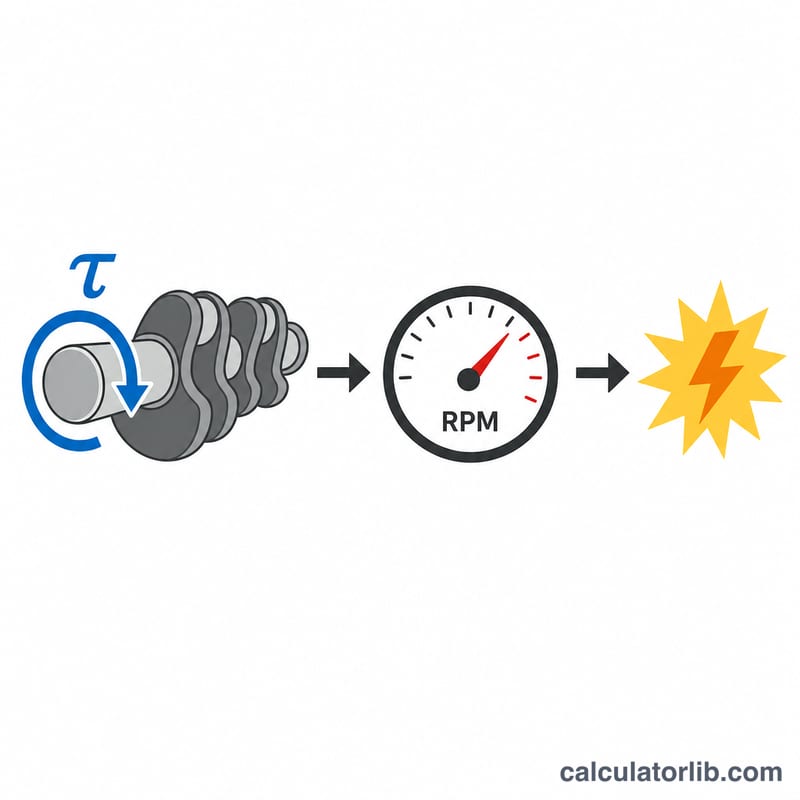
This tool converts an engine's torque output (measured in pound-feet) and its rotational speed (RPM) into horsepower. Torque and horsepower describe two different but related aspects of engine performance: torque is the twisting force the engine produces, while horsepower is the rate at which that work is done. Because of how they are defined in the imperial system, they are always linked by a fixed constant.
How to Use It
Enter the engine's torque in pound-feet (lb-ft) and the engine speed in revolutions per minute (RPM) at which that torque is measured. Click calculate to get the horsepower produced at that operating point. To map a full power curve, run the calculation at several RPM points using the corresponding torque values from a dyno sheet.
The Formula Explained
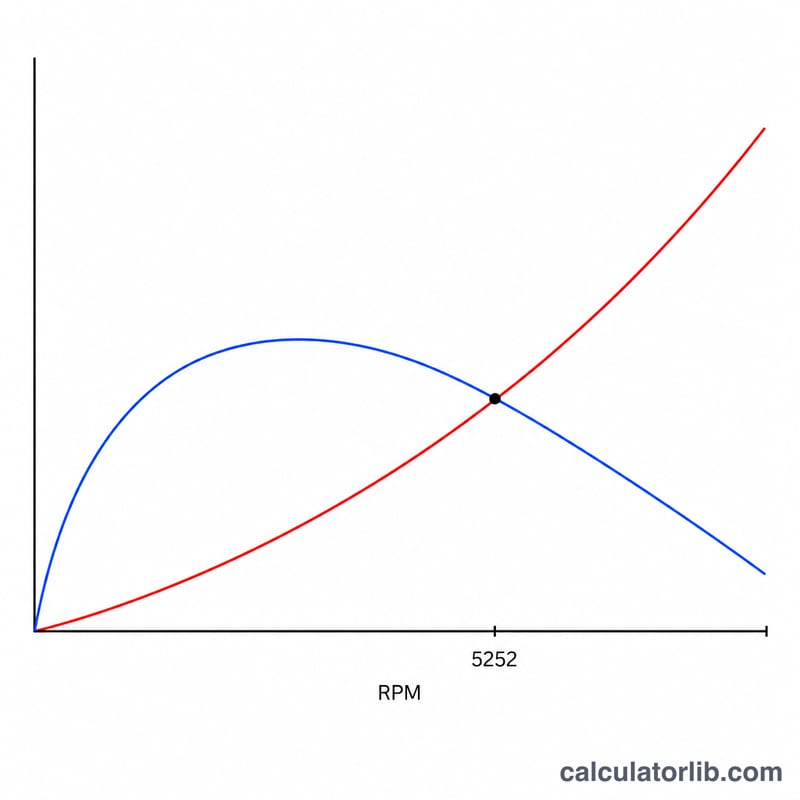
The relationship is $$\text{HP} = \frac{\text{Torque (lb-ft)} \times \text{RPM}}{5252}$$ The number 5252 comes from converting rotational mechanics into horsepower: one horsepower equals 33,000 lb-ft per minute, and dividing 33,000 by \(2\pi\) (radians per revolution) gives approximately 5252. A neat consequence is that torque and horsepower always cross at exactly 5252 RPM on a dyno graph, because at that speed the multiplier equals 1.
Worked Example
Suppose an engine makes 400 lb-ft of torque at 5000 RPM. $$\text{Horsepower} = \frac{400 \times 5000}{5252} = \frac{2{,}000{,}000}{5252} \approx 380.81 \text{ hp}$$ So this engine produces about 381 horsepower at 5000 RPM.
FAQ
Why 5252? It is the unit-conversion constant for imperial horsepower (\(33{,}000 \div 2\pi\)). It only applies when torque is in lb-ft and power is in mechanical horsepower.
Does this work with Newton-meters? No — convert Nm to lb-ft first (\(1 \text{ Nm} \approx 0.7376 \text{ lb-ft}\)), or use a metric (kW) formula instead.
Why do torque and HP curves cross at 5252 RPM? Because at 5252 RPM the term \(\text{RPM} \div 5252\) equals 1, making horsepower numerically equal to torque at that point.