
What is the Degrees Minutes Seconds Calculator?
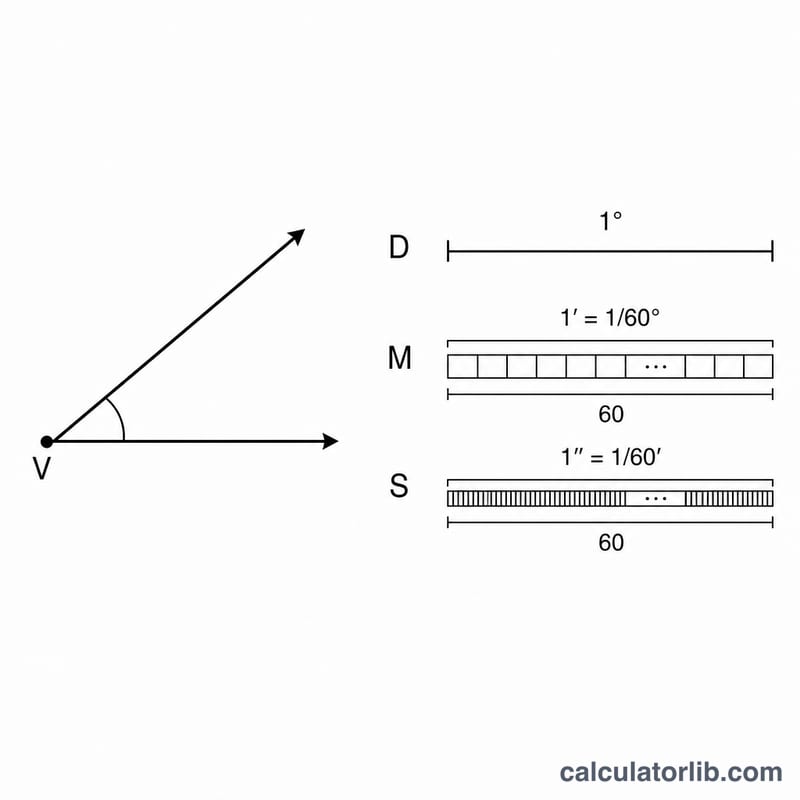
This tool converts an angle written in the degrees–minutes–seconds (DMS) format into decimal degrees and radians. DMS is widely used in navigation, surveying, astronomy and geographic coordinates (latitude and longitude), where one degree is divided into 60 arcminutes and each minute into 60 arcseconds. Decimal degrees are easier to use in calculators, spreadsheets and mapping software.
How to use it
Enter the whole degrees value (use a negative number for south latitudes or west longitudes), the minutes (0–59) and the seconds (0–59.999). The calculator returns the equivalent decimal degrees plus the same angle expressed in radians.
The formula explained
The conversion is a simple weighted sum:
$$\text{Decimal Degrees} = \text{Degrees} + \frac{\text{Minutes}}{60} + \frac{\text{Seconds}}{3600}$$
Because 1 minute = 1/60 of a degree and 1 second = 1/3600 of a degree, dividing each sub-unit by its place value and adding them rebuilds the full angle. To convert to radians, multiply the result by \(\pi/180\).
Worked example
Take the latitude 40° 26′ 46″. Compute \(26 \div 60 = 0.43333\ldots\) and \(46 \div 3600 = 0.012777\ldots\). Adding: $$40 + 0.43333 + 0.012777 = 40.446111°$$ In radians that is \(40.446111 \times \pi/180 \approx 0.705919 \text{ rad}\).
FAQ
How do I handle negative coordinates? Put the minus sign on the degrees field. The minutes and seconds always stay positive; the calculator applies the sign to the whole result.
Can minutes or seconds exceed 60? In proper DMS notation they should stay below 60, but the math still works if you enter larger values — they will roll into the degrees total.
What's the difference between decimal degrees and radians? Decimal degrees express the angle on a 0–360 scale; radians express it on a 0–2π scale and are required by most trigonometric functions in programming.