What Is a Radians to Degrees Converter?
Angles can be measured in two common units: radians and degrees. Radians are the standard unit in higher mathematics, calculus, and physics, while degrees are more intuitive for everyday geometry. This calculator converts any angle given in radians into its equivalent in degrees, so you can move quickly between the two systems without manual arithmetic.
How to Use It
Type the angle value in radians into the input field and the calculator instantly returns the result in degrees. The input accepts decimals and multiples of \(\pi\) expressed as numbers (for example, enter 3.14159 for \(\pi\) radians). The answer is shown rounded for readability but computed at full precision.
The Formula Explained
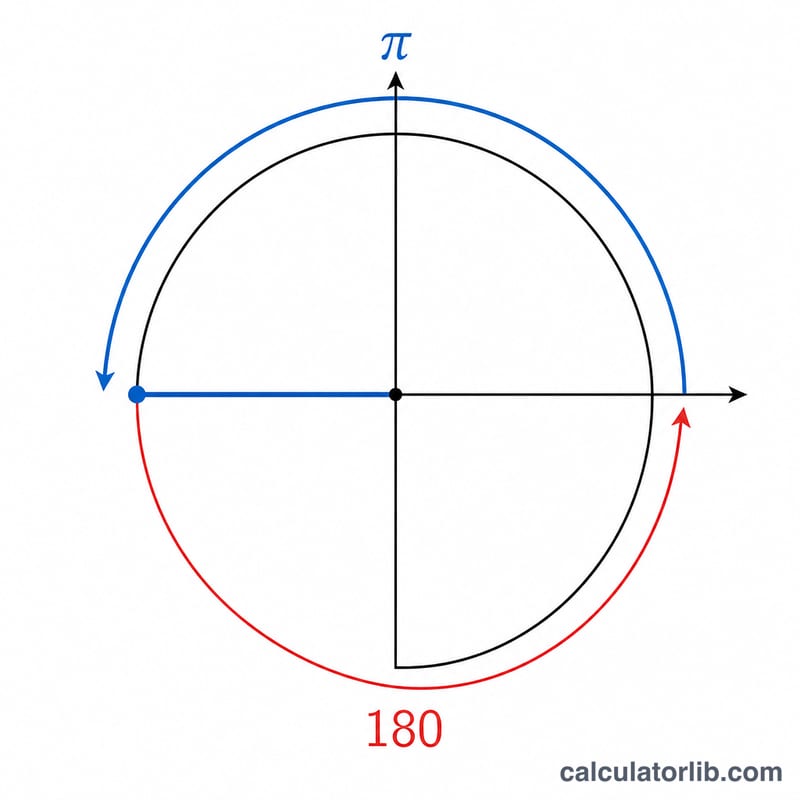
A full circle is \(2\pi\) radians, which equals 360 degrees. Dividing both sides shows that \(\pi\) radians = 180 degrees. Therefore, to convert any angle you multiply by the conversion factor \(180/\pi\):
$$\text{degrees} = \text{radians} \times \frac{180}{\pi}$$
The factor \(180/\pi\) is approximately 57.29578, so one radian is just under 57.3 degrees.
Worked Example
Convert 1 radian to degrees. Multiply: $$1 \times \frac{180}{\pi} = 1 \times 57.29578 = 57.29578°$$ As another example, \(\pi/2\) radians (about 1.5708) converts to \(1.5708 \times 57.29578 \approx 90°\), exactly a right angle.
Common Radians to Degrees Conversions
The table lists frequently used angles. Exact values are written as multiples of π. Each degree value follows from \(\text{Degrees} = \text{Radians} \times \frac{180}{\pi}\), and the decimal radian values are rounded to four places.
| Radians (exact) | Radians (decimal) | Degrees |
|---|---|---|
| 0 | 0 | 0° |
| π/6 | 0.5236 | 30° |
| π/4 | 0.7854 | 45° |
| π/3 | 1.0472 | 60° |
| π/2 | 1.5708 | 90° |
| 2π/3 | 2.0944 | 120° |
| 3π/4 | 2.3562 | 135° |
| 5π/6 | 2.6180 | 150° |
| π | 3.1416 | 180° |
| 3π/2 | 4.7124 | 270° |
| 2π | 6.2832 | 360° |
Example: for \(\frac{\pi}{3}\), the π cancels: \(\frac{\pi}{3} \times \frac{180}{\pi} = \frac{180}{3} = 60\), so the angle is 60°.
Constants Used in the Conversion
- π ≈ 3.14159265359
- 180/π ≈ 57.2957795131 degrees per radian, the multiplier used to convert radians to degrees. For example, 1 rad ≈ 57.2958°.
- π/180 ≈ 0.0174532925199 radians per degree, the multiplier for the reverse conversion (degrees to radians).
- One full turn = 2π rad = 360° (also 400 gradians, an optional unit sometimes used in surveying).
The conversion is a simple proportion: a half turn is π radians and also 180°, so \(\frac{\text{degrees}}{180} = \frac{\text{radians}}{\pi}\).
FAQ
How many degrees is 1 radian? About 57.29578 degrees.
How do I convert degrees back to radians? Use the reverse formula: \(\text{radians} = \text{degrees} \times \frac{\pi}{180}\).
Is this conversion exact? The relationship is mathematically exact; only the displayed value is rounded for readability while the underlying computation keeps full precision.